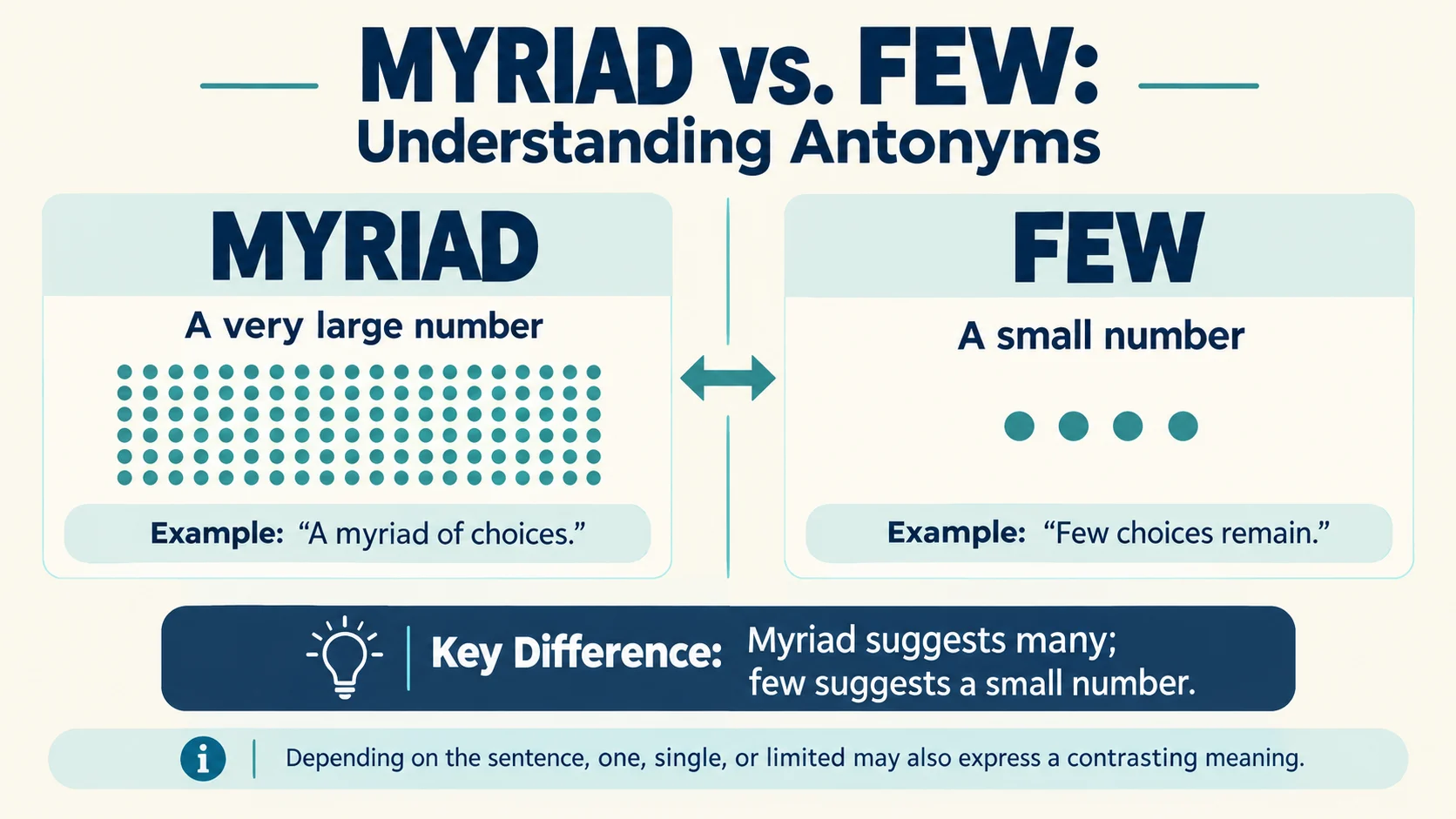
The opposite of myriad depends on context. Myriad means a very large or countless number of things. Few is a strong contextual opposite when myriad refers to numerous items or people. Other alternatives include one, single, and limited, depending on whether you want to emphasize quantity, individuality, or restriction.
- Part of speech: Adjective and noun.
- Primary contextual opposite: Few.
- Meaning: Myriad describes a very large number or an extremely wide variety of things.
- Why it fits: Few refers to a small number, making it a useful contrast when myriad describes numerous people, objects, choices, or possibilities.
For example, “The library offers a myriad of books” contrasts naturally with “The library offers few books.” However, myriad does not have one universally accepted opposite for every situation. The best choice depends on what the sentence emphasizes.
Direct and Strong Antonyms
Myriad does not have a single perfect antonym that works in every context. Words such as few, one, and limited can express opposing quantities, but their grammatical roles and meanings differ. They should be selected according to the intended contrast rather than treated as interchangeable dictionary opposites.
| Antonym | Tone or Nuance | Example Sentence |
|---|---|---|
| Few | A small number; a strong contextual contrast | The store carries few varieties of tea. |
| One | A single unit instead of many | We received one proposal instead of a myriad of suggestions. |
| Single | Emphasizes individuality or only one item | She chose a single design from a myriad of options. |
| Limited | Emphasizes a restricted quantity or range | The small clinic has a limited selection of services. |
| Scarce | Suggests that something is difficult to find or available in insufficient quantities | Fresh water is scarce in the region. |
| Minimal | Emphasizes the smallest or very low amount needed or present | The project required minimal equipment. |
These words express different kinds of contrast. Few focuses on number, single emphasizes one item, and limited highlights restriction. Scarce concerns availability, while minimal emphasizes a very small amount or degree.
Therefore, these are best understood as contextual opposites, not a list of universally interchangeable antonyms.
Contextual and Subtle Opposites
The best opposite of myriad changes according to the sentence’s meaning, tone, and intended emphasis.
| Context | Best Opposite | Why It Fits |
|---|---|---|
| Numerous people or objects | Few | Contrasts a large quantity with a small one |
| Many available choices | One or limited | Emphasizes a single option or restricted selection |
| A wide range of possibilities | Narrow or limited | Highlights a restricted range rather than a large number |
| Numerous available resources | Scarce | Contrasts abundance with insufficient availability |
| A multitude of separate items | Single | Emphasizes individuality rather than multiplicity |
When Few Is the Best Choice
Use few when myriad describes a large number of countable things.
Example: “The conference attracted a myriad of visitors.”
A natural contrast is: “The conference attracted few visitors.”
This pair clearly contrasts a large crowd with a small attendance. In everyday American English, few is direct and easy to understand.
When One or Single Works Better
Sometimes the sentence focuses on the difference between many possibilities and one specific choice.
Example: “A myriad of candidates applied for the position.”
A contrasting sentence might be: “Only one candidate applied for the position.”
Here, one creates a precise numerical contrast. Single works especially well when emphasizing an individual item, as in “She selected a single photograph from a myriad of images.”
When Limited or Scarce Is More Accurate
Use limited when the focus is on restriction rather than an exact number.
Example: “The website provides a myriad of learning resources.”
A contextual contrast is: “The website provides a limited range of learning resources.”
Use scarce when availability is the main issue. For instance, “The region has a myriad of natural resources” contrasts with “Natural resources are scarce in the region.” The second sentence changes the emphasis from abundance to insufficient availability.
Understanding Myriad in Different Grammatical Roles
Myriad can function as an adjective, as in “myriad opportunities,” or as a noun, as in “a myriad of opportunities.” Its grammatical role matters when choosing an opposite.
For example, “few opportunities” works naturally as an adjective phrase, while “a single opportunity” emphasizes one possibility. The goal is to create a natural sentence, not simply replace myriad with a word from an antonym list.
Words That Seem Opposite But Are Not
Common Grammatical or Semantic Confusions
1. Variety
Variety describes differences among types or categories, not necessarily the total number of items. Myriad can refer to numerous things, while variety emphasizes diversity.
Example: “The restaurant offers a myriad of dishes” emphasizes quantity. “The restaurant offers a variety of dishes” emphasizes the different options available. The words can overlap, but variety is not an antonym of myriad.
2. Rare
Rare means uncommon or occurring infrequently. It may contrast with common, but it is not a direct opposite of myriad.
For example, “The museum displays a myriad of paintings” describes quantity. “The museum displays rare paintings” describes how unusual the paintings are. A large collection can contain many rare paintings, so the two concepts are compatible.
Subtle Tone Differences
The choice of opposite affects how a sentence sounds.
- Few is simple and conversational: “We have few seats left.”
- Limited sounds more neutral or professional: “We have limited seating available.”
- Scarce emphasizes difficulty obtaining something: “Affordable housing is scarce.”
- Single emphasizes one individual item: “She submitted a single application.”
These words are not interchangeable. Choose the one that expresses the intended contrast without changing the original meaning.
Frequently Asked Questions
1. What is the direct antonym of myriad?
Myriad has no single universally applicable direct antonym. Few is a strong contextual opposite when myriad means a large number. One or single works when the sentence contrasts numerous items with an individual item.
2. Is few the opposite of myriad?
Yes, few can function as an opposite of myriad when both refer to quantity. For example, “a myriad of opportunities” contrasts with “few opportunities.” However, limited may fit better when the sentence emphasizes a restricted range rather than a small count.
3. How can I use an antonym of myriad in a sentence?
Identify whether myriad describes quantity, choice, or variety. For quantity, use few. For one item, use single. For restricted availability, use limited. For example, replace “a myriad of options” with “a limited number of options” when emphasizing restriction.
Practical Word Choice
- Identify the intended meaning. Determine whether myriad refers to a large number, a wide range, or numerous possibilities before selecting an opposite.
- Match the context and tone. Choose few for quantity, single for one item, and limited for restricted availability. Read the revised sentence aloud to check that it sounds natural.
Final Thoughts
The most useful contextual opposite of myriad is few when the word describes a large number of things. However, one, single, limited, and scarce can express different contrasts depending on the sentence.
Good word choice depends on meaning, not simply on finding a word listed in a thesaurus. A precise opposite preserves your intended message while making your writing clearer.
Which word would you use as the opposite of myriad in your own sentence?