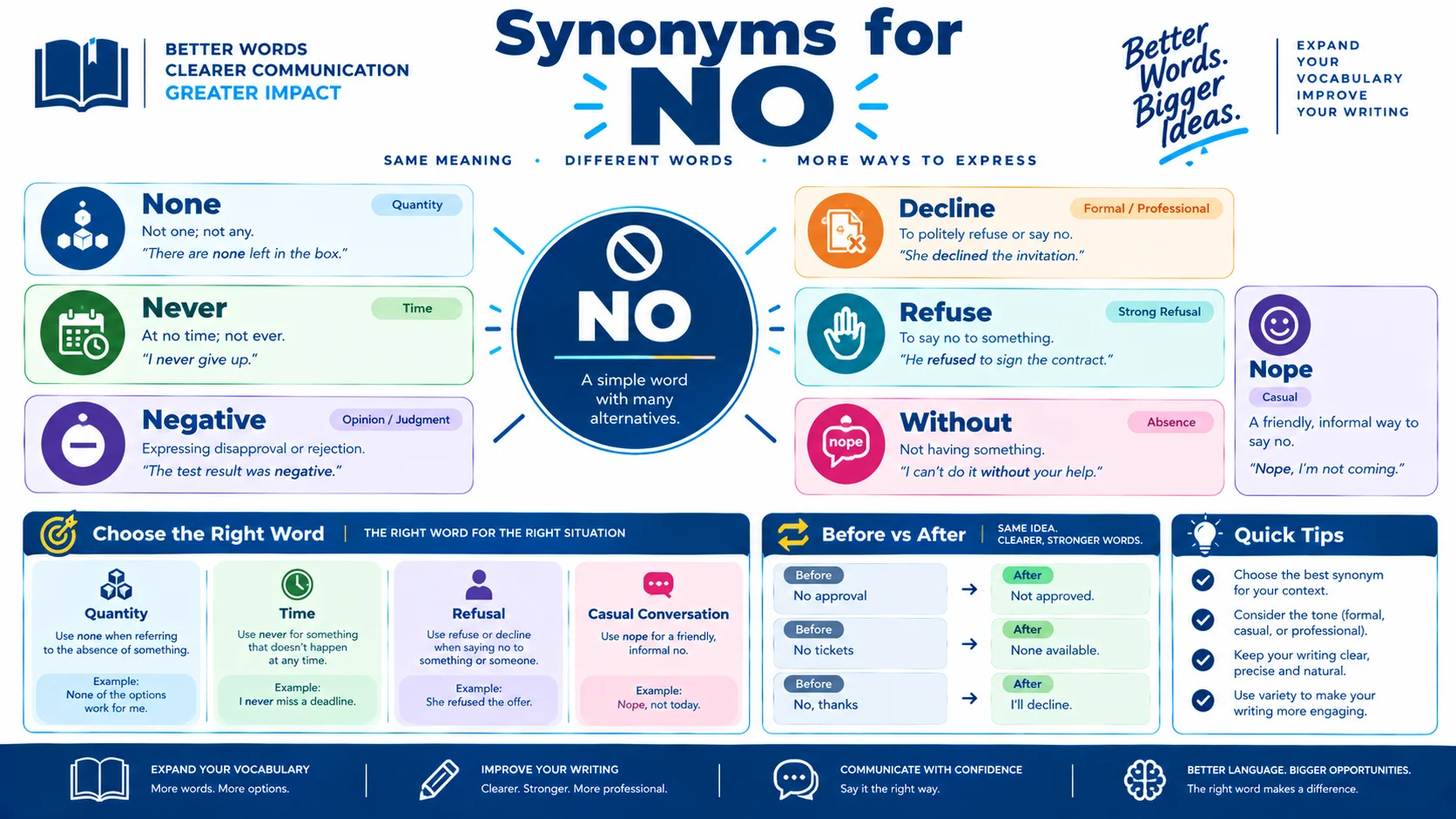
When you need a synonym for “no,” the best replacement depends on what you mean. Common alternatives include none, not any, never, negative, nope, zero, without, and decline, but they do not work in every sentence. For professional or academic writing, phrases such as “not available,” “unable to,” “declined,” or “negative” can sound more precise.
What Does No Mean?
Definition
No is a common English word used to express negative answers, denial, refusal, absence, or lack. It can function as a determiner, adverb, noun, or interjection.
For example:
- No, I cannot attend.
- There is no evidence of fraud.
- We received no response.
- She said no to the proposal.
Because “no” has several grammatical and contextual uses, there is no single replacement that works everywhere.
Common Uses
The word no commonly expresses:
Negative answers:
“No, I don’t agree.”
Refusal:
“He said no to the offer.”
Absence or lack:
“There is no evidence.”
Zero quantity:
“We have no available seats.”
Negative judgment:
“That is a no from me.”
Prohibition:
“No smoking.”
The right alternative depends on which of these meanings you want to communicate.
Best Synonyms for No
| Synonym or Alternative | Meaning | Best Used When | Example |
|---|---|---|---|
| None | Not one or not any | Talking about quantity | None of the answers were correct. |
| Not any | Zero amount or absence | Replacing “no” before a noun | We have not received any updates. |
| Never | Not at any time | Talking about time | I have never seen that movie. |
| Nope | Informal no | Casual conversation | “Are you coming?” “Nope.” |
| Negative | A refusal or negative answer | Formal or professional contexts | The response was negative. |
| Decline | Politely refuse | Invitations, offers, or requests | She decided to decline the invitation. |
| Refuse | Reject or say no | Stronger refusal | He refused the proposal. |
| Reject | Refuse to accept | Applications, ideas, offers, or proposals | The committee rejected the proposal. |
| Deny | Say something is untrue or refuse a claim | Statements or accusations | The company denied the allegation. |
| Without | In the absence of something | Rewriting sentences about lack | He left without an explanation. |
| Zero | Nothing or none | Numbers and quantities | There were zero errors. |
| Nothing | Not anything | Objects, things, or results | Nothing was found. |
| Unavailable | Not available | Business and professional writing | The requested service is unavailable. |
| Impossible | Cannot happen or be done | Situations that cannot occur | The deadline makes completion impossible. |
| Not at all | Strong negative response | Polite conversation | “Did I bother you?” “Not at all.” |
Not all of these are dictionary-perfect synonyms. Some are contextual alternatives that communicate the same idea in a particular sentence.
Synonyms by Context
Formal Writing
In formal writing, simply repeating “no” can sometimes sound blunt. Depending on the meaning, these alternatives may provide greater precision:
- Negative
- Declined
- Rejected
- Denied
- Unavailable
- Absent
- Not permitted
- Not applicable
- Not available
- Without
For example:
Basic:
“No permission was granted.”
More formal:
“Permission was not granted.”
Or:
Basic:
“No evidence was found.”
Formal:
“No evidence was identified.”
The second version is not necessarily a synonym replacement. It is a more precise way to express the same underlying idea.
Professional Writing
Workplace communication often benefits from alternatives that explain why something cannot happen.
Instead of:
No, we cannot approve this request.
You might write:
We are unable to approve this request at this time.
Instead of:
No, the position is not available.
You could write:
The position is currently unavailable.
Useful professional alternatives include unable to, declined, unavailable, not approved, not permitted, rejected, and not applicable.
The goal is not simply to replace the word “no.” It is to make the message clear while maintaining an appropriate professional tone.
Academic Writing
Academic writing usually favors precise statements over conversational alternatives such as nope.
Depending on the sentence, useful alternatives include:
- None
- Not any
- Never
- Absent
- Lack of
- Without
- Negative
- Not observed
- Not identified
- Not supported
For example:
Informal:
“No significant difference was found.”
Academic:
“No significant difference was observed.”
Another option might be:
The analysis found no statistically significant difference.
Here, retaining no is actually clearer than forcing a synonym into the sentence.
Daily Conversation
Casual conversation gives you more flexibility.
Common alternatives include:
- Nope
- Nah
- Not really
- Not at all
- Never
- Nothing
- None
- Absolutely not
- Not this time
For example:
“Do you want coffee?”
“Nope.”
Or:
“Are you upset?”
“Not really.”
Nah and nope are informal, so they generally fit texting and casual conversation better than academic or business writing.
Professional Alternatives for No
If you’re writing an email, workplace message, customer response, or business document, consider replacing a blunt “no” with a phrase that gives the reader useful information.
Unable to
Use unable to when something cannot be done.
We are unable to process the request today.
Declined
Use declined when someone chooses not to accept an offer, invitation, request, or opportunity.
The applicant declined the offer.
Not Approved
Use not approved when a request, proposal, or action has not received authorization.
The proposed budget was not approved.
Not Available
Use not available when something cannot currently be accessed or obtained.
The requested appointment time is not available.
Not Permitted
Use not permitted when rules or policies prevent an action.
Outside food is not permitted in the facility.
Not Applicable
Use not applicable when something does not relate to the particular situation.
This section is not applicable to international applicants.
These expressions are often more informative than simply saying no.
Simple Alternatives for No
For everyday writing, these alternatives are easy to understand:
- None
- Nothing
- Never
- Not any
- Without
- Not really
- Nope
- Nah
Consider the difference:
I have no money.
You could say:
I have none.
Or:
I don’t have any money.
But you would not normally replace “no” with “never” because never refers specifically to time.
This illustrates an important rule: a synonym must match both the meaning and grammar of the original word.
Stronger Alternatives for No
Sometimes you want to communicate a firm refusal.
Useful expressions include:
- Absolutely not
- Definitely not
- Under no circumstances
- Never
- Refuse
- Reject
- Denied
- Not permitted
For example:
“Can I enter without permission?”
“Absolutely not.”
In a formal policy:
Access is not permitted without authorization.
The first sentence sounds conversational and forceful. The second sounds formal and policy-oriented.
Difference Between Similar Synonyms
No vs. None
No usually comes before a noun:
There are no tickets left.
None generally stands alone or replaces a noun phrase:
None are available.
No vs. Not Any
No and not any can often express the same idea.
There is no water.
There isn’t any water.
The second construction uses not with any, rather than the determiner no.
No vs. Never
No can express denial or absence, while never means not at any time.
No, I don’t know him.
I have never met him.
They are related negative expressions, but they are not interchangeable.
No vs. Nope
Nope is an informal form of no.
“Did you call her?”
“Nope.”
It works well in casual speech and texting but is usually inappropriate in academic papers or formal business correspondence.
No vs. Negative
Negative can describe a negative answer, result, response, or condition.
The test result was negative.
However, negative cannot replace every use of no.
You would not normally write:
“Negative, I don’t want coffee.”
unless you are deliberately using a specialized or unusual style.
No vs. Refuse
Refuse is a verb meaning to decline or reject something.
She refused the offer.
“No” can be the actual response:
She said no.
These words communicate related ideas but perform different grammatical roles.
Choosing the Right Alternative
The easiest way to find the right synonym for no is to identify what kind of “no” you mean.
If you mean zero quantity, consider:
none, zero, not any, nothing
If you mean a negative answer, consider:
negative, not really, nope
If you mean refusal, consider:
decline, refuse, reject, deny
If you mean absence, consider:
without, lacking, absent, not available
If you mean a prohibition, consider:
not permitted, prohibited, forbidden
If you mean not at any time, use:
never
This context-based approach produces much more natural writing than replacing every occurrence of “no” with the same synonym.
Real-World Examples
Business Example
Original:
No approval has been received.
Alternative:
Approval has not yet been received.
This version is natural for professional communication because it makes the timing clear.
Academic Example
Original:
There was no significant relationship between the variables.
Alternative:
No significant relationship was observed between the variables.
Both are appropriate, but observed emphasizes the result of the analysis.
Daily Conversation Example
Original:
“Are you going to the party?”
Alternative:
“Nope, I’m staying home.”
Here, nope works because the setting is casual.
Opposite Words
The opposite of no depends on its meaning.
When no means a negative answer, the opposite is:
yes, certainly, absolutely, agreed
When no means absence, the opposite may be:
some, any, available, present
When no means zero, the opposite can be:
one, some, several, many
When no means refusal, the opposite may be:
accept, agree, approve, consent
Because “no” has several grammatical functions, its opposite also changes according to context.
FAQs
What is another word for no?
Common alternatives for no include none, not any, never, negative, nope, decline, refuse, reject, without, and zero. The best choice depends on whether “no” expresses refusal, absence, quantity, prohibition, or a negative answer.
What is a formal synonym for no?
Formal alternatives include negative, declined, rejected, denied, not approved, not permitted, unavailable, and not applicable. The correct option depends on the sentence and intended meaning.
What is a professional alternative for no?
Professional alternatives include unable to, not available, not approved, not permitted, declined, and not applicable. These phrases can make workplace communication more precise and informative.
What word can replace no in an essay?
Depending on the sentence, you can use none, not any, never, without, absent, lacking, or not observed. However, keeping no is often the clearest choice when it already fits the sentence naturally.
What is a polite way to say no?
Polite alternatives include I’m unable to, I’ll have to decline, not at this time, unfortunately not, and I appreciate the offer, but I’ll pass. The best phrase depends on the situation.
What is a casual synonym for no?
Nope and nah are common casual alternatives. Nope is widely used in texting and everyday conversation, while nah can sound even more relaxed.
Is “none” a synonym for “no”?
None can express a similar idea, especially when referring to quantity, but the words have different grammatical uses. For example, “no books” can become “none,” but “no” cannot always be replaced with “none.”
Is “negative” another word for no?
Sometimes. Negative can describe a negative response or result, but it is not a universal replacement for no. Context determines whether it sounds natural.
What is a stronger word for no?
For a firm refusal, expressions such as absolutely not, definitely not, refuse, reject, or under no circumstances can communicate stronger opposition.
What is another word for saying no?
Depending on the context, saying no can be described as refusing, declining, rejecting, denying, or turning down a request or offer.
Conclusion
The best synonym for “no” depends on what you are trying to say. Use none or not any for quantity, never for time, decline or refuse for rejection, without for absence, and not permitted for rules or restrictions. In casual conversation, nope and nah work naturally.
For professional and academic writing, focus less on finding a one-word replacement and more on choosing the expression that communicates the exact meaning. Sometimes the simplest and most accurate choice is still no.