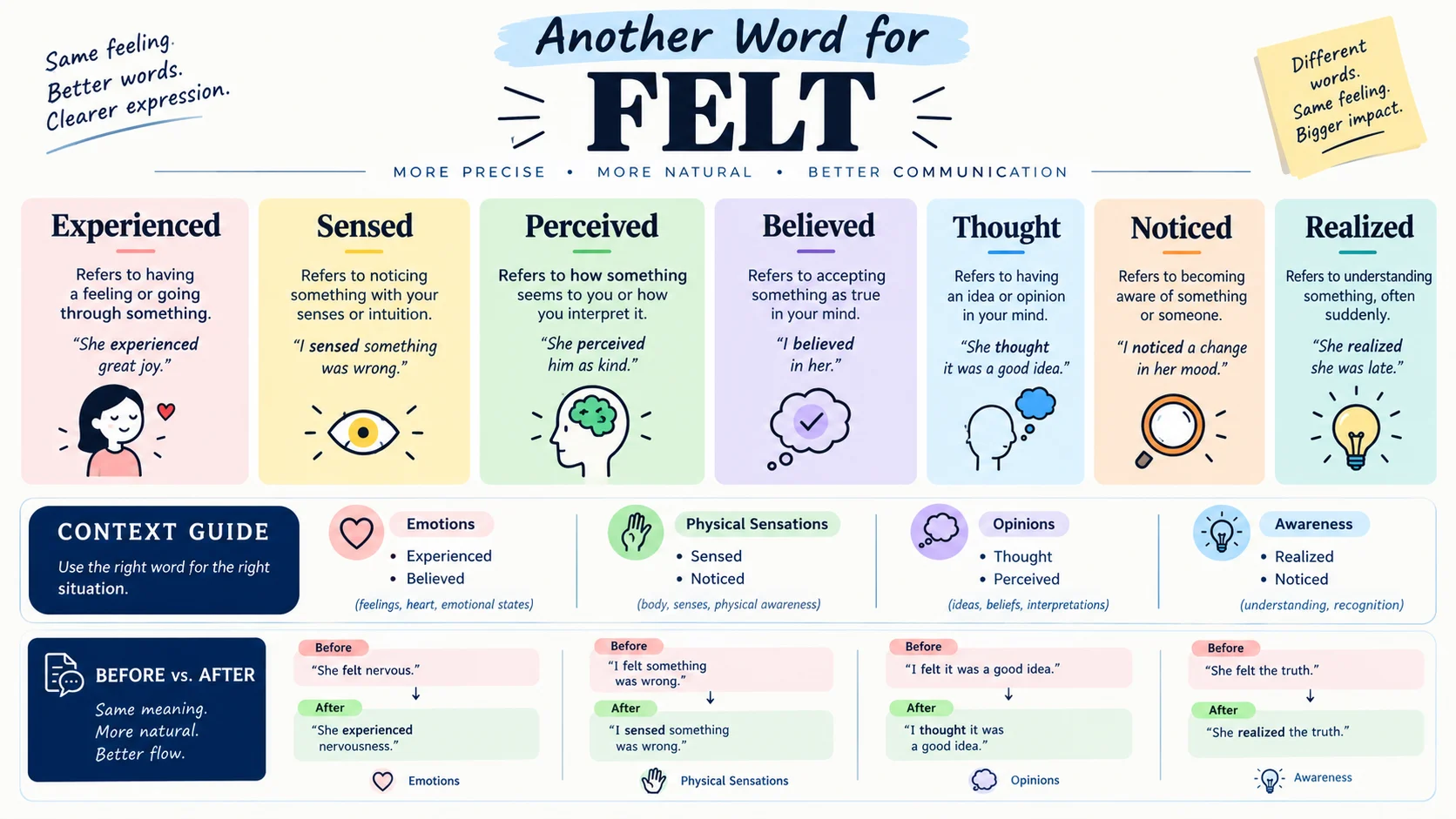
Another word for felt depends on the meaning. Common alternatives include experienced, sensed, noticed, believed, thought, perceived, realized, endured, touched, and understood. For emotions, experienced or sensed often works well. For opinions, believed or thought may be more accurate.
What Does Felt Mean?
Definition
Felt is the past tense and past participle of feel. It can describe an emotional experience, physical sensation, personal opinion, perception, or response to something.
The best synonym depends heavily on how felt appears in a sentence.
For example:
- “She felt nervous.” → She experienced nervousness.
- “He felt the cold air.” → He sensed the cold air.
- “I felt that the plan was risky.” → I believed the plan was risky.
- “The fabric felt soft.” → The fabric seemed soft to the touch.
Because felt has several meanings, there is no single replacement that works in every sentence.
Common Uses
The word felt commonly refers to:
- Emotions: “She felt happy.”
- Physical sensations: “He felt the heat.”
- Opinions: “I felt the decision was unfair.”
- Perception: “They felt something was wrong.”
- Understanding: “She felt that he needed help.”
- Physical qualities: “The material felt rough.”
Best Synonyms for Felt
| Synonym | Meaning | Best Used When | Example |
|---|---|---|---|
| Experienced | Went through or personally encountered something | Emotions, events, situations | She experienced intense relief. |
| Sensed | Detected through feeling or perception | Physical or intuitive awareness | He sensed something unusual. |
| Perceived | Became aware of or interpreted something | Formal or academic writing | The participants perceived a difference. |
| Believed | Held an opinion or conviction | Opinions and judgments | She believed the decision was necessary. |
| Thought | Held an idea or opinion | Everyday conversation | I thought the meeting was useful. |
| Noticed | Became aware of something | Observable changes or details | He noticed a change in her tone. |
| Realized | Became consciously aware of something | New understanding | She realized the mistake immediately. |
| Understood | Recognized the meaning or situation | Comprehension and empathy | He understood how difficult it was. |
| Endured | Went through something difficult | Pain, hardship, or unpleasant experiences | They endured years of hardship. |
| Touched | Emotionally affected | Emotional reactions | Her kindness touched everyone. |
| Seemed | Appeared to be a certain way | Describing impressions | The room seemed unusually quiet. |
| Detected | Discovered or perceived something | Technical and formal contexts | The device detected a slight change. |
Synonyms by Context
Formal Writing
In formal writing, perceived, experienced, sensed, and detected can replace felt when they preserve the intended meaning.
Original:
“The participants felt a significant difference.”
Formal alternatives:
- “The participants perceived a significant difference.”
- “The participants experienced a significant difference.”
- “The participants detected a significant difference.”
Perceived is especially useful when describing how someone interprets or understands something.
Professional Writing
Professional writing often benefits from replacing vague uses of felt with a more precise verb.
Instead of:
“The manager felt that the proposal needed changes.”
You could write:
“The manager believed that the proposal needed changes.”
Or:
“The manager determined that the proposal needed changes.”
Use believed when describing an opinion. Use determined when the person reached a conclusion based on evaluation or evidence.
Academic Writing
Academic writing usually favors precise language.
Instead of:
“Students felt that the new method was effective.”
Consider:
“Students perceived the new method as effective.”
Or:
“Students reported experiencing positive results from the new method.”
The second version can be more precise when the statement comes from participant reports.
Daily Conversation
For everyday speech, simple alternatives usually sound more natural:
- thought
- sensed
- noticed
- experienced
- believed
- understood
For example:
“I felt something was wrong.”
Natural alternatives include:
“I sensed something was wrong.”
“I thought something was wrong.”
The best choice depends on whether you mean intuition or an opinion.
Professional Alternatives for Felt
If you’re writing a resume, cover letter, report, or business email, avoid replacing every instance of felt with the same synonym.
Consider these alternatives:
- Perceived for an interpretation
- Believed for an opinion
- Observed for something noticed
- Recognized for awareness
- Experienced for an event or condition
- Determined for a conclusion
- Identified for recognizing a problem
- Detected for discovering something
- Concluded for reaching a judgment
Resume example:
Weak:
“I felt the project needed a new strategy.”
Stronger:
“I identified the need for a new project strategy.”
The second sentence gives the reader more specific information about what happened.
Simple Alternatives for Felt
If you want easy, natural words, try:
- Thought
- Knew
- Sensed
- Noticed
- Experienced
- Believed
- Understood
- Seemed
Examples:
Felt happy → Was happy
Felt nervous → Was nervous
Felt pain → Experienced pain
Felt something move → Sensed something move
Felt the answer was wrong → Thought the answer was wrong
Sometimes the best replacement is not another synonym but a more direct sentence.
Stronger Alternatives for Felt
When felt sounds too vague, choose a verb that identifies the exact experience.
Experienced
Use experienced when someone personally went through an event, emotion, condition, or situation.
“She experienced significant stress during the transition.”
Perceived
Use perceived when the focus is on interpretation or awareness.
“Customers perceived the service as more reliable.”
Sensed
Use sensed for physical perception or intuition.
“He sensed tension in the room.”
Endured
Use endured when the experience involved difficulty or suffering.
“The community endured severe economic hardship.”
Realized
Use realized when someone becomes aware of a fact or situation.
“She realized that the deadline had changed.”
Difference Between Similar Synonyms
Felt vs. Experienced
Felt is broad and conversational. Experienced emphasizes personally going through something.
“I felt sadness.”
“I experienced sadness.”
Both work, but experienced can sound more precise in formal writing.
Felt vs. Sensed
Sensed suggests detection through physical perception or intuition.
“She felt the warmth.”
This focuses on physical sensation.
“She sensed that something was wrong.”
This focuses on intuition or awareness.
Felt vs. Thought
Thought generally expresses an idea, belief, or opinion.
“I thought the presentation was effective.”
Felt can also introduce an opinion, but it may sound more personal or subjective.
Felt vs. Perceived
Perceived is more formal and emphasizes how someone interprets something.
“Employees perceived the policy as restrictive.”
It is especially useful in academic, research, and professional writing.
Felt vs. Believed
Believed clearly communicates a person’s opinion or conviction.
“She believed the proposal was practical.”
Use it when felt means “had an opinion,” rather than “experienced an emotion.”
Important Synonym Profiles
Experienced
Meaning: Personally went through something.
Best used for: Events, emotions, conditions, and situations.
Tone: Neutral.
Difficulty: Easy.
Usage frequency: Very Common.
Best for: Resume, email writing, essay writing, marketing copy, business writing.
- Business: The company experienced rapid growth.
- Academic: Participants experienced increased stress.
- Daily: I experienced the same problem yesterday.
Perceived
Meaning: Interpreted or became aware of something.
Best used for: Research, analysis, opinions, and observations.
Tone: Formal.
Difficulty: Medium.
Usage frequency: Common.
Best for: Essay writing and academic, professional, and business writing.
- Business: Customers perceived the brand as trustworthy.
- Academic: Participants perceived the treatment as beneficial.
- Daily: She perceived his comment as criticism.
Sensed
Meaning: Detected something through feeling, intuition, or perception.
Best used for: Physical sensations and intuition.
Tone: Neutral.
Difficulty: Easy.
Usage frequency: Common.
Best for: Email writing, essays, creative writing, and daily conversation.
- Business: The manager sensed growing concern among employees.
- Academic: Participants sensed changes in temperature.
- Daily: I sensed that something was wrong.
Opposite Words
The opposite of felt depends on the intended meaning.
For emotional experience, possible contrasts include:
- Ignored
- Dismissed
- Remained unaffected
For perception, possible contrasts include:
- Missed
- Overlooked
- Failed to notice
For opinions, contrasting ideas might include:
- Doubted
- Rejected
- Disagreed
There is no single universal antonym because felt has multiple meanings.
FAQs
What is another word for felt?
Common alternatives include experienced, sensed, perceived, thought, believed, noticed, realized, and understood. The right choice depends on whether felt describes an emotion, physical sensation, opinion, or perception.
What is a formal synonym for felt?
Perceived, experienced, detected, and observed can serve as formal alternatives, depending on the sentence. Perceived works particularly well when describing interpretation or awareness.
What is a professional alternative for felt?
Professional alternatives include believed, perceived, identified, determined, recognized, observed, and experienced. Choose the verb that describes the specific action rather than simply replacing felt mechanically.
What word can replace felt in an essay?
Try experienced, perceived, believed, observed, or recognized. Academic writing benefits from choosing the word that precisely communicates the evidence or experience being described.
What is another word for felt emotionally?
Useful alternatives include experienced, underwent, endured, and was affected by. For positive or negative emotions, the exact emotion can often make the sentence stronger.
What is another word for felt something?
Sensed, noticed, detected, or perceived may work. Use sensed for intuition or physical perception, while noticed emphasizes conscious awareness.
What is another word for felt pain?
Experienced pain, suffered pain, and endured pain can work depending on context. Experienced is neutral, while endured emphasizes difficulty.
What is another word for felt happy?
Depending on the sentence, you can use was happy, felt joyful, experienced happiness, was delighted, or was pleased.
What is another word for felt that?
If felt that introduces an opinion, alternatives include thought that, believed that, considered, or determined that.
Is perceived the same as felt?
Not always. Perceived usually means interpreted or became aware of something, while felt can describe emotions, physical sensations, opinions, and other experiences.
Conclusion
The best synonym for felt depends on what you mean. Use experienced for personal experiences, sensed for physical or intuitive awareness, perceived for interpretation, believed for opinions, and noticed for conscious awareness. When writing professionally or academically, replacing the broad word felt with a more precise verb can make your sentence clearer and more informative.