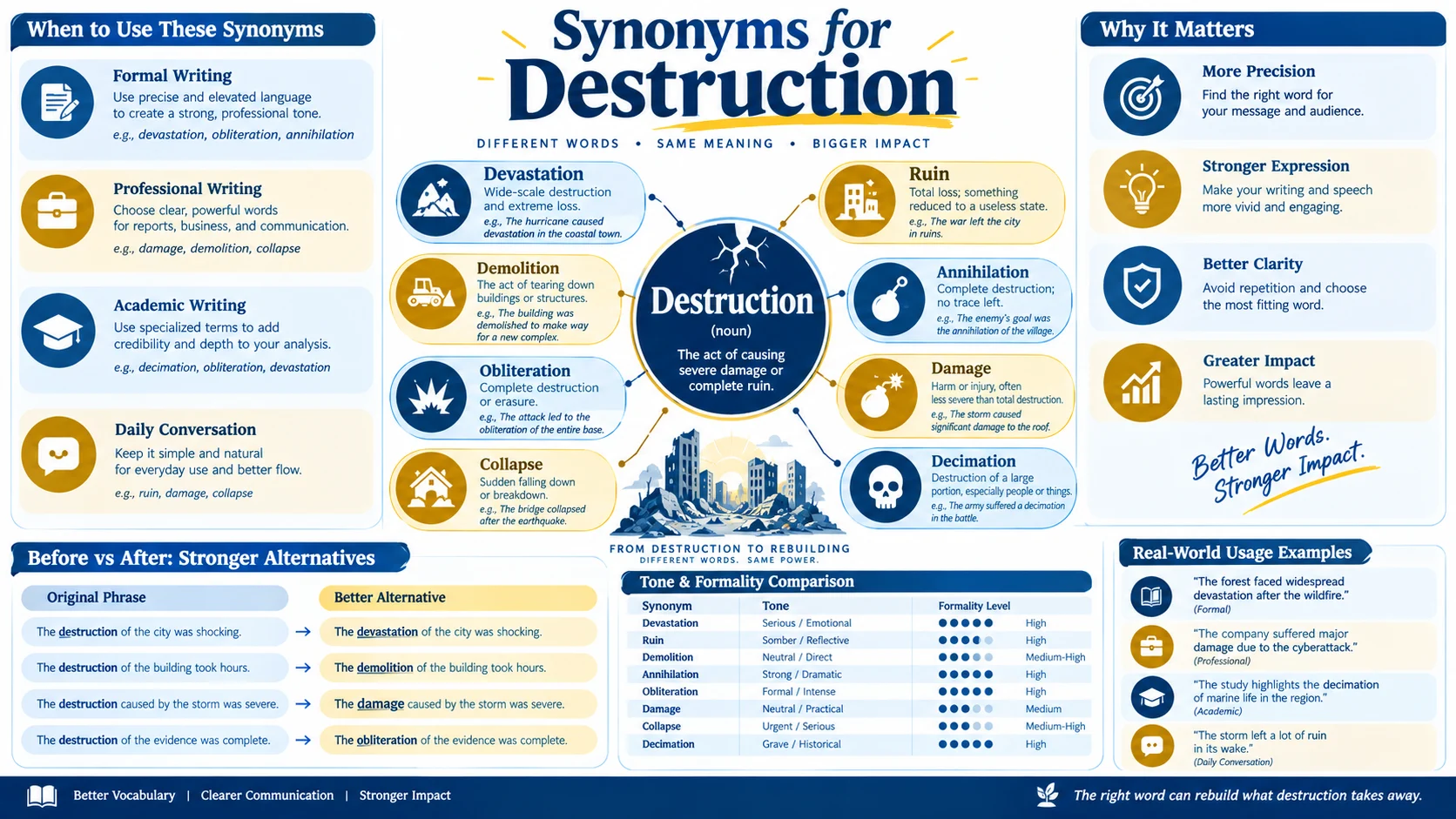
Another word for destruction is devastation, ruin, demolition, annihilation, wreckage, damage, collapse, or obliteration, depending on the context. The best replacement depends on whether you’re describing physical damage, complete elimination, economic loss, environmental harm, or emotional devastation.
What Does Destruction Mean?
Definition
Destruction refers to the act of damaging, ruining, or completely eliminating something so that it no longer exists in its original form or can no longer function properly.
The word is commonly used when discussing:
- Buildings and structures
- Property damage
- Environmental disasters
- Economic losses
- Warfare and conflict
- Relationships and reputations
- Digital or data removal
Common Uses
Examples include:
- The destruction of historic buildings.
- A hurricane caused widespread destruction.
- The company suffered financial destruction after bankruptcy.
- The wildfire left a path of destruction across the region.
Best Synonyms for Destruction
| Synonym | Meaning | Best Used When | Example |
|---|---|---|---|
| Devastation | Severe damage or suffering | Natural disasters and tragedies | The tornado caused massive devastation. |
| Ruin | Complete decline or collapse | Financial or personal situations | Poor decisions led to the company’s ruin. |
| Demolition | Intentional tearing down | Buildings and structures | The old stadium underwent demolition. |
| Annihilation | Total destruction | Military or dramatic contexts | The army faced near annihilation. |
| Obliteration | Complete removal or erasure | Formal or technical writing | The evidence was lost through obliteration. |
| Damage | Harm or impairment | Everyday situations | The storm caused extensive damage. |
| Wreckage | Remains after destruction | Physical disasters | Rescue teams searched the wreckage. |
| Collapse | Failure or breakdown | Systems, economies, structures | The bridge collapse disrupted traffic. |
| Decimation | Severe reduction or destruction | Populations or resources | Disease caused the decimation of wildlife. |
| Eradication | Complete removal | Diseases, pests, threats | The program focused on eradication. |
Synonyms by Context
Formal Writing
Formal alternatives to destruction include:
- Obliteration
- Annihilation
- Decimation
- Eradication
- Devastation
Example:
“The conflict resulted in the widespread obliteration of infrastructure.”
Professional Writing
In business and workplace communication, these alternatives often sound more appropriate:
- Damage
- Loss
- Collapse
- Failure
- Deterioration
Example:
“The cyberattack caused significant operational damage.”
Academic Writing
Academic papers frequently use:
- Degradation
- Decimation
- Eradication
- Dismantling
- Devastation
Example:
“Researchers examined the environmental degradation caused by industrial expansion.”
Daily Conversation
For everyday speech, people often choose:
- Damage
- Ruin
- Mess
- Wreckage
- Disaster
Example:
“The storm left the backyard in complete ruin.”
Professional Alternatives for Destruction
In workplace reports, presentations, and business communication, the word destruction can sometimes sound too dramatic.
Better professional alternatives include:
Damage
Best when describing harm that is not total.
Example:
“The flood caused property damage throughout the district.”
Loss
Useful for financial and operational contexts.
Example:
“The organization experienced substantial inventory loss.”
Deterioration
Appropriate when decline happens gradually.
Example:
“The report highlighted the deterioration of public infrastructure.”
Collapse
Often used for markets, systems, or organizations.
Example:
“The collapse of the supply chain affected production.”
Failure
Suitable when discussing projects, processes, or equipment.
Example:
“The equipment failure resulted in production delays.”
Simple Alternatives for Destruction
When writing for a broad audience, these words are often easier to understand.
Damage
The most common and versatile alternative.
Ruin
Suggests serious harm or loss.
Disaster
Highlights a destructive event.
Wreckage
Refers to what remains after something is destroyed.
Breakdown
Useful for systems, machines, and processes.
Example:
“The breakdown of the network disrupted communications.”
Stronger Alternatives for Destruction
Sometimes you need a more powerful word.
Annihilation
Meaning: Complete destruction.
Tone: Intense
Difficulty: Advanced
Usage Frequency: Common
Best For: Essays, formal reports, historical writing
Business Example:
“The acquisition resulted in the annihilation of several competing brands.”
Academic Example:
“The study examined the cultural annihilation of indigenous communities.”
Daily Example:
“The video game featured the annihilation of an entire enemy fleet.”
Obliteration
Meaning: Total removal or elimination.
Tone: Formal
Difficulty: Advanced
Usage Frequency: Common
Best For: Academic and professional writing
Business Example:
“The new technology led to the obliteration of outdated processes.”
Academic Example:
“The event contributed to the obliteration of historical records.”
Daily Example:
“The heavy rain caused the obliteration of the footprints.”
Devastation
Meaning: Extreme destruction and suffering.
Tone: Emotional
Difficulty: Medium
Usage Frequency: Very Common
Best For: News, reports, storytelling
Business Example:
“The economic downturn caused devastation across several industries.”
Academic Example:
“The paper analyzed the devastation caused by major earthquakes.”
Daily Example:
“The wildfire left widespread devastation behind.”
Difference Between Similar Synonyms
Many synonyms for destruction have different meanings.
Destruction vs Damage
Damage means something is harmed but may still exist or function.
Destruction suggests complete or near-complete loss.
Example:
- The car suffered damage.
- The building suffered destruction.
Destruction vs Demolition
Demolition is usually intentional.
Destruction can be intentional or accidental.
Example:
- The city approved demolition of the warehouse.
- The earthquake caused destruction of the warehouse.
Destruction vs Devastation
Devastation emphasizes emotional impact and widespread suffering.
Destruction focuses on the act or result of being destroyed.
Destruction vs Annihilation
Annihilation implies total elimination.
Destruction may be complete or partial depending on context.
Opposite Words
Common antonyms for destruction include:
| Opposite Word | Meaning |
|---|---|
| Creation | Bringing something into existence |
| Construction | Building or developing something |
| Restoration | Returning something to its former condition |
| Preservation | Protecting from harm |
| Protection | Keeping safe from damage |
| Renewal | Making new again |
| Repair | Fixing damage |
| Rebuilding | Constructing again after damage |
Example:
“Community volunteers focused on restoration rather than destruction.”
FAQs
What is another word for destruction?
Some of the best alternatives include devastation, ruin, demolition, annihilation, damage, collapse, wreckage, and obliteration.
What is a formal synonym for destruction?
Formal options include obliteration, eradication, annihilation, dismantling, and decimation.
What is a professional alternative for destruction?
In business writing, words such as damage, loss, deterioration, collapse, or failure are often more appropriate.
What is a stronger word than destruction?
Annihilation and obliteration are generally considered stronger because they imply complete elimination.
Is devastation the same as destruction?
Not exactly. Devastation emphasizes severe damage and emotional impact, while destruction refers more broadly to the act of destroying.
What synonym works best in essays?
Devastation, obliteration, eradication, and decimation are often effective in academic writing.
What is the opposite of destruction?
Common opposites include creation, construction, restoration, preservation, and renewal.
Can destruction refer to non-physical things?
Yes. It can describe damage to reputations, economies, relationships, systems, cultures, or digital information.
Conclusion
The best synonym for destruction depends on what you want to communicate. For everyday situations, damage and ruin work well. For professional writing, loss, failure, and collapse are often stronger choices. In academic or formal contexts, devastation, obliteration, annihilation, and decimation provide greater precision. Understanding these differences helps you select the most effective word for your audience and purpose.