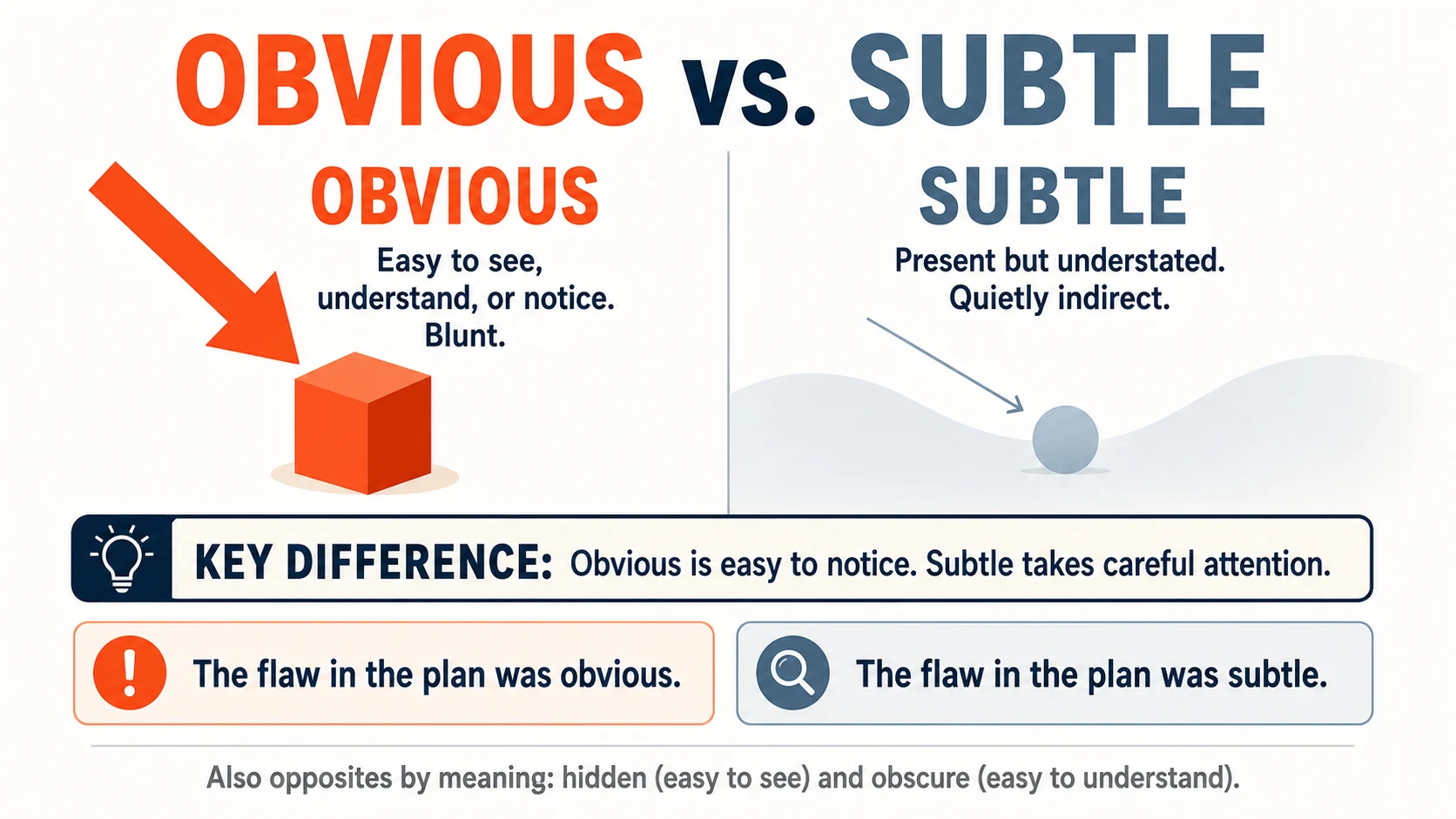
The opposite of obvious depends on meaning. When obvious means easy to notice or too heavy-handed, subtle is the strongest contextual opposite. When it means easy to understand, unclear or obscure fits best. When it means easy to see, hidden or inconspicuous works. No single antonym covers every sense.
Part of speech: Adjective
Primary opposite: Subtle (contextual). The strongest direct antonyms by meaning are obscure and hidden.
Obvious describes something that is easy to see, easy to understand, or lacking in restraint. Because those meanings pull in different directions, no single word opposes all of them. When obvious means easy to understand, obscure is the strongest direct antonym. When it means easy to see, hidden fits best. When it describes something blunt or heavy-handed, subtle is the clearest opposite. It is also the natural contrast for hints, flavors, changes, and messages.
Direct and Strong Antonyms
These words oppose obvious in at least one established meaning.
| Antonym | Tone or Nuance | Example Sentence |
|---|---|---|
| Obscure | Formal; hard to grasp or little known | The clause was so obscure that even the lawyers disagreed about it. |
| Unclear | Plain and everyday; lacks clarity | Her directions were unclear, so the team asked for details. |
| Hidden | Neutral; kept out of sight | The extra fee was hidden in the fine print. |
| Inconspicuous | Formal; not easily noticed | He picked an inconspicuous seat near the back of the room. |
Contextual and Subtle Opposites
The best opposite changes with the meaning you intend. Everything in this table is contextual, not a universal antonym.
| Context | Best Opposite | Why It Fits |
|---|---|---|
| Easy to see | Hidden, inconspicuous | Both describe things that do not catch the eye. |
| Easy to understand | Obscure, unclear | Both describe meaning that takes effort to grasp. |
| Blunt or heavy-handed | Subtle, understated | Both describe quiet, indirect delivery. |
| Expected or predictable | Surprising, unconventional | Both describe choices people would not anticipate. |
One sentence can flip depending on which sense you mean. “The flaw in the plan was obvious” becomes “The flaw in the plan was hidden” if you mean nobody could see it. It becomes “The flaw in the plan was subtle” if you mean it took careful attention to catch. Both are correct, but they say different things.
Subtle is the best opposite when the issue is delivery. A movie with an obvious message hits you over the head with it. A movie with a subtle message lets you find it yourself. Subtle describes something present but understated, which makes it a contextual opposite rather than a strict antonym.
Ambiguous is also a contextual opposite when meaning is the problem. If an instruction is not obvious because it can be read two ways, ambiguous is the more precise word: “The email’s ambiguous wording left us unsure who was in charge.”
For the expected-choice sense, consider “obvious choice.” Here the opposite is surprising or unconventional: “She skipped the obvious candidate and hired someone from an unrelated field.”
Words That Seem Opposite But Are Not
Oblivious. This word looks and sounds similar, so people sometimes treat it as a contrast. It is not an antonym. Oblivious means unaware, and it describes people, not things. The two words often appear together: “He was oblivious to the obvious hints.”
Secret. Secret means deliberately kept from others. Obvious describes how easy something is to notice or grasp, not who knows about it. A surprise party can be a secret while the planning is obvious to everyone except the guest of honor. Something can also be hard to notice without anyone hiding it, which is why secret fails as a true opposite.
Subtle Tone Differences
Choosing among opposites changes the feel of a sentence, not only its meaning.
Obscure leans formal and often suggests something hard to grasp or little known. “An obscure reference” sounds academic. Unclear is plainer and suggests a gap that someone could fix: “The timeline is unclear” invites a follow-up question.
Subtle usually carries approval. Calling a flavor or a performance subtle is a compliment. Calling an argument obscure is usually a complaint. Obvious itself can be neutral or critical, as in “an obvious attempt to flatter the boss.” The mirror image would be a subtle attempt at flattery, which sounds skillful instead of clumsy.
Strength matters too. Hidden is stronger than inconspicuous. A hidden camera is concealed on purpose. An inconspicuous camera simply does not stand out.
Frequently Asked Questions
What is the direct antonym of obvious?
No single direct antonym covers every meaning. For easy to understand, obscure is strongest. For easy to see, hidden works best. In everyday writing, subtle is the most natural contextual opposite when obvious means blunt or heavy-handed.
What is the opposite meaning of obvious in “obvious choice”?
In that phrase, obvious means expected or predictable, so surprising, unconventional, or unlikely works as the opposite. “She skipped the obvious choice and hired a candidate from an unrelated field” shows the contrast clearly.
Can I use subtle instead of obscure as the opposite of obvious?
Only sometimes. Use subtle when something is present but understated, such as a hint or a flavor. Use obscure when meaning is hard to grasp or little known. Subtle often praises, while obscure often criticizes.
Practical Word Choice
- Identify the intended meaning. Ask whether obvious means easy to see, easy to understand, or blunt. Then choose hidden, obscure, or subtle accordingly.
- Match context, tone, strength, and formality. Use unclear in plain workplace writing, obscure in formal or academic prose, and subtle when you want to praise restraint.
Final Thoughts
Obvious has no single perfect antonym because it covers several ideas at once. Hidden opposes visibility, obscure opposes clarity, and subtle opposes bluntness. Treating them as interchangeable is the most common mistake.
Context decides which opposite works. The same plan can have a hidden flaw, a subtle flaw, or an unclear flaw, and each phrase tells the reader something different about what went wrong.
Before you reach for a synonym finder, name the sense you mean. That one step usually points straight to the right word. What is your favorite example of something that was obvious to everyone except the people involved.