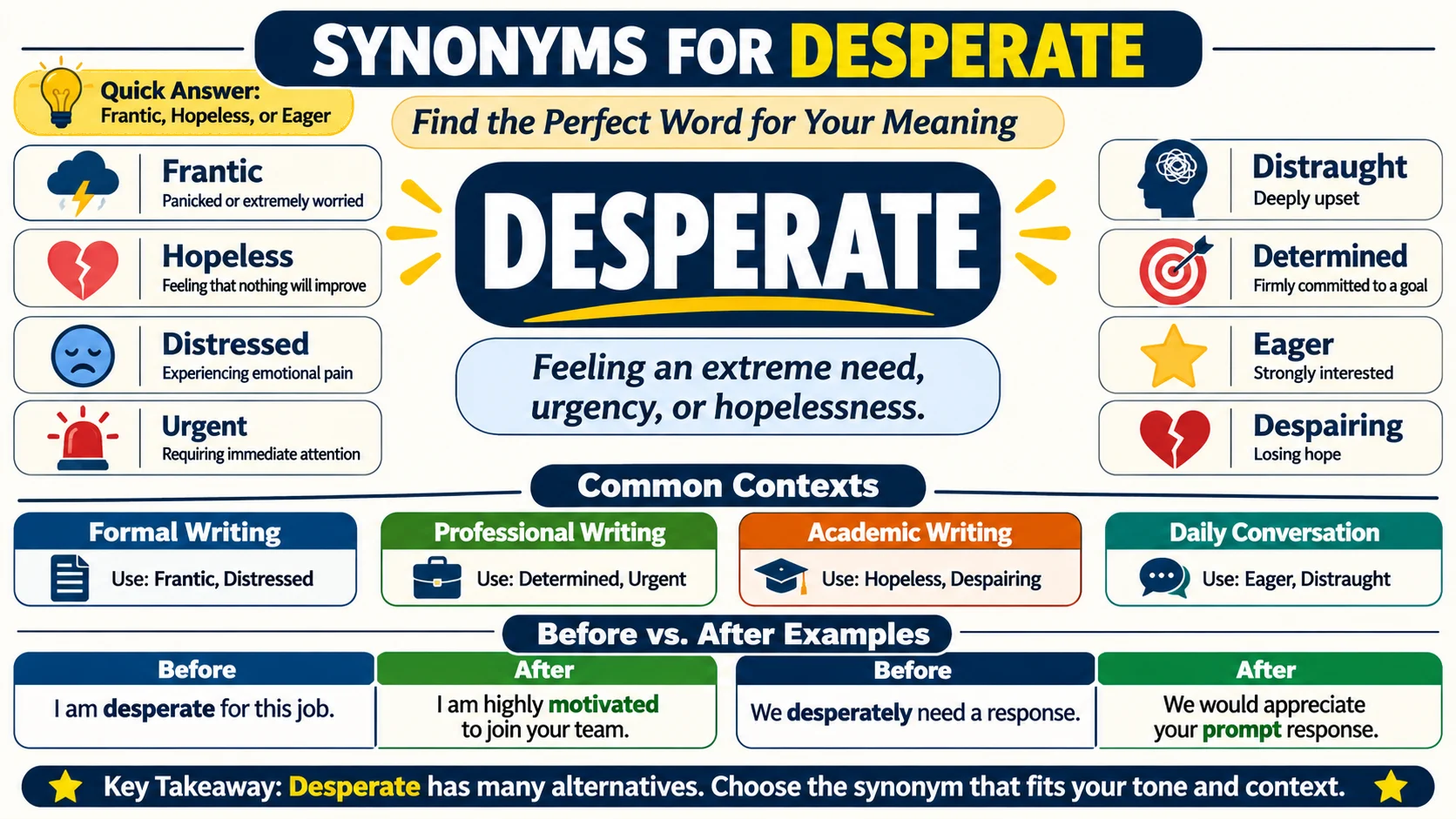
Desperate means feeling an extreme need, hopelessness, or urgency. The best synonyms for desperate include frantic, hopeless, distressed, urgent, needy, determined, and distraught. Each word expresses a different kind of desperation. Use frantic for panic, hopeless for despair, urgent for immediate need, and determined for someone willing to do whatever it takes.
What Does Desperate Mean?
Definition
The word desperate is an adjective that describes a person, situation, or action involving extreme need, fear, hopelessness, or urgency.
Someone who is desperate may feel that ordinary solutions are no longer enough. They might be struggling to find a job, trying to save a relationship, facing a financial crisis, or searching for immediate help.
Desperate can also describe actions taken because someone feels they have no other choice.
For example:
- She was desperate for a second chance.
- The company made a desperate attempt to avoid bankruptcy.
- He sounded desperate when he asked for help.
The word can carry a negative, sympathetic, or neutral tone depending on its context.
Common Uses
Desperate commonly appears in these expressions:
| Expression | Meaning |
|---|---|
| Desperate need | An extremely strong need |
| Desperate attempt | A final or risky effort |
| Desperate situation | A difficult situation with few options |
| Desperate measures | Extreme actions taken to solve a problem |
| Desperate for attention | Strongly wanting recognition |
| Desperate to succeed | Extremely eager to achieve a goal |
Understanding these expressions helps writers select synonyms that preserve the original meaning.
Best Synonyms for Desperate
The following words are useful alternatives to desperate in American English.
| Synonym | Meaning | Best Used When | Example |
|---|---|---|---|
| Frantic | Extremely worried or excited | Someone is panicking | She made a frantic phone call. |
| Hopeless | Feeling that nothing will improve | A person feels defeated | He felt hopeless after losing his job. |
| Distressed | Experiencing emotional pain | Someone is upset or suffering | The distressed employee asked for support. |
| Urgent | Requiring immediate attention | Time is limited | We have an urgent need for assistance. |
| Distraught | Deeply upset or troubled | Strong emotional suffering | She was distraught over the news. |
| Despairing | Losing hope | Someone expects a bad outcome | His despairing voice revealed his pain. |
| Determined | Firmly committed to a goal | Someone refuses to give up | She was determined to finish her degree. |
| Needy | Requiring help or support | Someone lacks essential resources | The organization helps needy families. |
| Impulsive | Acting without careful thought | Desperation leads to rash choices | He made an impulsive decision. |
| Exasperated | Extremely frustrated | Repeated problems cause anger | She sounded exasperated after the delay. |
| Anxious | Worried or uneasy | Someone fears an outcome | He was anxious about the interview. |
| Feverish | Intensely energetic or excited | Activity becomes unusually intense | They made a feverish effort to finish. |
Not every synonym is interchangeable. Urgent describes a pressing need, while distraught describes emotional suffering. Choosing the right word makes writing more accurate and natural.
Synonyms by Context
Formal Writing
Formal writing often requires precise language rather than emotional exaggeration. These alternatives work well in reports, essays, official documents, and professional communication.
Distressed: Suitable for describing emotional or financial hardship.
Example: The distressed applicant requested additional assistance.
Despairing: Appropriate when someone has lost hope.
Example: The report describes the despairing outlook of affected communities.
Urgent: Best for situations requiring immediate action.
Example: The organization identified an urgent need for additional funding.
Grave: Useful when describing a serious or dangerous situation.
Example: The region faces a grave humanitarian crisis.
Critical: Appropriate when a situation requires immediate attention or is extremely serious.
Example: The patient was in critical need of medical assistance.
Professional Writing
In professional communication, desperate may sound overly emotional or suggest a lack of confidence. More measured alternatives often work better.
| Alternative | Professional Example |
|---|---|
| Eager | I am eager to contribute to your team. |
| Highly motivated | Our team is highly motivated to achieve its goals. |
| Committed | We remain committed to completing the project. |
| Urgent | This matter requires urgent attention. |
| Strongly interested | I am strongly interested in the position. |
| Determined | We are determined to improve customer satisfaction. |
For resumes and cover letters, eager, motivated, and determined often communicate enthusiasm without making the applicant sound desperate.
Academic Writing
Academic writing benefits from neutral, evidence-based vocabulary. The word desperate may be appropriate when describing human behavior, but stronger alternatives can improve precision.
- Severe: The region experienced severe economic hardship.
- Acute: The study identified an acute shortage of resources.
- Critical: The research highlights a critical need for further investigation.
- Compelling: The findings provide a compelling reason for additional research.
- Pressing: Climate change remains a pressing global concern.
Use acute for intense or sharply felt conditions, severe for serious problems, and pressing for issues requiring timely attention.
Daily Conversation
Everyday conversations often use simple, expressive alternatives.
| Synonym | Example |
|---|---|
| Frantic | I was frantic when I couldn’t find my phone. |
| Worried | She was worried about her exam results. |
| Panicked | He panicked when he missed the flight. |
| Needy | The child seemed needy after the move. |
| Eager | I’m eager to see you again. |
| Fed up | I’m fed up with waiting. |
| At my wit’s end | I’m at my wit’s end trying to fix this. |
The expression at my wit’s end is particularly useful when someone feels overwhelmed and cannot find a solution.
Professional Alternatives for Desperate
A professional alternative should communicate the intended meaning without creating an unwanted impression.
For Job Applications
Instead of writing, “I am desperate for this job,” use:
- I am highly motivated to join your organization.
- I am enthusiastic about this opportunity.
- I am eager to contribute my skills.
- I am strongly interested in this position.
Resume example:
Before: Desperate to find a challenging position.
After: Highly motivated to pursue a challenging position that supports professional growth.
For Business Emails
Instead of “We desperately need your response,” consider:
- We would appreciate your prompt response.
- Your timely feedback is essential.
- We require your immediate attention to this matter.
- We are seeking an urgent resolution.
These alternatives maintain professionalism while clearly communicating the need for action.
Synonym Analysis
Synonym: Determined
Meaning: Firmly committed to achieving something.
Best Used For: Goals, personal achievements, career ambitions, and difficult tasks.
Tone: Positive, confident, and purposeful.
Difficulty: Easy.
Usage Frequency: Very Common.
Best For: Resume, email writing, essay writing, marketing copy, and business writing.
Business Example: Our team is determined to deliver the project on schedule.
Academic Example: The researcher was determined to examine the issue from multiple perspectives.
Daily Conversation Example: I’m determined to pass my driving test.
Synonym: Frantic
Meaning: Extremely anxious, worried, or hurried.
Best Used For: Panic, emergencies, stressful situations, and rushed activity.
Tone: Emotional, intense, and urgent.
Difficulty: Medium.
Usage Frequency: Common.
Best For: Email writing, essay writing, marketing copy, and daily conversation. Less suitable for resumes.
Business Example: The staff made a frantic effort to resolve the system failure.
Academic Example: The participants displayed frantic behavior during the emergency simulation.
Daily Conversation Example: I was frantic because I thought I had lost my wallet.
Synonym: Distressed
Meaning: Experiencing significant emotional pain, worry, or difficulty.
Best Used For: Emotional suffering, hardship, and situations requiring support.
Tone: Serious, sympathetic, and formal.
Difficulty: Medium.
Usage Frequency: Common.
Best For: Email writing, essay writing, academic writing, and business writing.
Business Example: The distressed customer requested assistance from management.
Academic Example: The study examined the experiences of distressed caregivers.
Daily Conversation Example: She seemed distressed after hearing the news.
Synonym: Hopeless
Meaning: Feeling or appearing to have no possibility of improvement or success.
Best Used For: Despair, discouragement, and situations with little perceived chance of success.
Tone: Negative, emotional, and sometimes pessimistic.
Difficulty: Easy.
Usage Frequency: Very Common.
Best For: Essay writing, email writing, marketing copy, and daily conversation.
Business Example: The company considered the investment hopeless after repeated losses.
Academic Example: Participants reported feeling hopeless during prolonged periods of unemployment.
Daily Conversation Example: I felt hopeless when every solution failed.
Simple Alternatives for Desperate
If you need an easy synonym, choose a word that most readers understand immediately.
| Simple Word | Meaning | Example |
|---|---|---|
| Worried | Feeling concern | She was worried about her family. |
| Needy | In need of help | The needy family received support. |
| Eager | Wanting something strongly | He was eager to start. |
| Scared | Feeling fear | She was scared of losing her home. |
| Upset | Feeling unhappy or troubled | He was upset about the decision. |
| Rushed | Done in a hurry | They made a rushed attempt. |
| Panicked | Suddenly overwhelmed by fear | I panicked when the alarm rang. |
These alternatives work well in everyday communication, school assignments, and simple writing.
Stronger Alternatives for Desperate
Sometimes desperate does not fully express the intensity of a situation. Stronger alternatives can communicate deeper emotions.
| Stronger Word | Meaning | Example |
|---|---|---|
| Despairing | Deeply lacking hope | Her despairing words revealed her struggle. |
| Distraught | Extremely upset | He was distraught after the accident. |
| Frenzied | Wildly excited or uncontrolled | A frenzied search began immediately. |
| Agonized | Experiencing intense emotional pain | She made an agonized decision. |
| Beside oneself | Overwhelmed by emotion | He was beside himself with worry. |
| At one’s wit’s end | Unable to find a solution | They were at their wit’s end. |
Use these terms carefully. Strong emotional words can make writing more vivid, but they may exaggerate the situation if used unnecessarily.
Difference Between Similar Synonyms
Several synonyms for desperate appear similar, but they express distinct meanings.
Desperate vs. Frantic
Desperate describes an extreme need or feeling of having few options. Frantic emphasizes panic, anxiety, or uncontrolled activity.
Example:
- Desperate: She was desperate for financial support.
- Frantic: She made frantic calls to find financial support.
Desperate vs. Hopeless
Desperate often involves a strong desire to change a situation. Hopeless suggests a belief that improvement is unlikely.
Example:
- Desperate: He was desperate to save his business.
- Hopeless: He felt hopeless after the business closed.
Desperate vs. Determined
Desperate often implies extreme need or emotional pressure. Determined expresses commitment and persistence.
Example:
- Desperate: She was desperate to escape the situation.
- Determined: She was determined to build a better future.
Desperate vs. Urgent
Desperate describes a strong emotional need. Urgent describes something that requires immediate action.
Example:
- Desperate: The family was desperate for help.
- Urgent: The family had an urgent need for medical care.
Desperate vs. Distraught
Desperate often involves extreme need or urgency. Distraught specifically describes intense emotional distress.
Example:
- Desperate: He was desperate to find his missing dog.
- Distraught: He was distraught after learning his dog had died.
Opposite Words
Antonyms of desperate depend on the meaning being expressed. Some opposites describe emotional states, while others describe the absence of urgency or need.
| Antonym | Meaning | Example |
|---|---|---|
| Calm | Free from agitation | She remained calm during the crisis. |
| Hopeful | Expecting a positive outcome | He felt hopeful about his future. |
| Content | Satisfied with one’s situation | She was content with her progress. |
| Relaxed | Free from tension | He felt relaxed after the meeting. |
| Patient | Able to wait without frustration | They remained patient during the delay. |
| Confident | Believing in one’s ability | She was confident about the interview. |
| Secure | Free from danger or uncertainty | The family felt secure in their home. |
The most direct opposite of desperate in the sense of hopelessness is hopeful. In the sense of panic, calm is often the best opposite.
FAQs
1. What is another word for desperate?
Another word for desperate is frantic, hopeless, distressed, urgent, or determined. The best choice depends on whether the situation involves panic, emotional suffering, urgency, or strong motivation.
2. What is a formal synonym for desperate?
Formal synonyms include distressed, despairing, urgent, severe, and critical. Use the word that best reflects the intended meaning.
3. What is a professional alternative for desperate?
Professional alternatives include eager, highly motivated, determined, committed, and strongly interested. These words are useful in resumes, cover letters, and business emails.
4. What word can replace desperate in an essay?
Depending on the context, use distressed, despairing, urgent, severe, or compelling. For example, “a desperate need for change” could become “an urgent need for change.”
5. What is a stronger word for desperate?
Distraught, despairing, frenzied, and agonized can express stronger emotions. Each word has a different meaning, so choose carefully.
6. Is desperate a positive or negative word?
Desperate is usually negative because it suggests extreme need, fear, or hopelessness. However, it can describe a positive goal when someone is desperate to succeed or determined to improve.
7. What is the opposite of desperate?
The opposite depends on the context. Hopeful contrasts with hopelessness, calm contrasts with panic, and content contrasts with dissatisfaction or extreme need.
8. What is another word for desperate for attention?
Possible alternatives include attention-seeking, needy, eager for recognition, and craving attention. The most appropriate choice depends on whether the description is neutral or critical.
9. What is another word for desperately trying?
Useful alternatives include struggling, striving, making a frantic effort, and trying relentlessly. For professional writing, working diligently may sound more appropriate.
10. What is the difference between desperate and eager?
Desperate suggests an extreme need or emotional pressure. Eager expresses enthusiasm or strong interest without necessarily implying fear, hopelessness, or a lack of options.
Conclusion
Desperate has many synonyms, but the best replacement depends on the emotion, situation, and intended tone. Frantic expresses panic, hopeless communicates despair, distressed describes emotional suffering, and urgent emphasizes immediate need. For professional writing, eager, motivated, and determined often create a more confident impression.
When selecting a synonym, consider what desperate actually means in your sentence. A precise word improves clarity, strengthens communication, and helps readers understand the intended message.