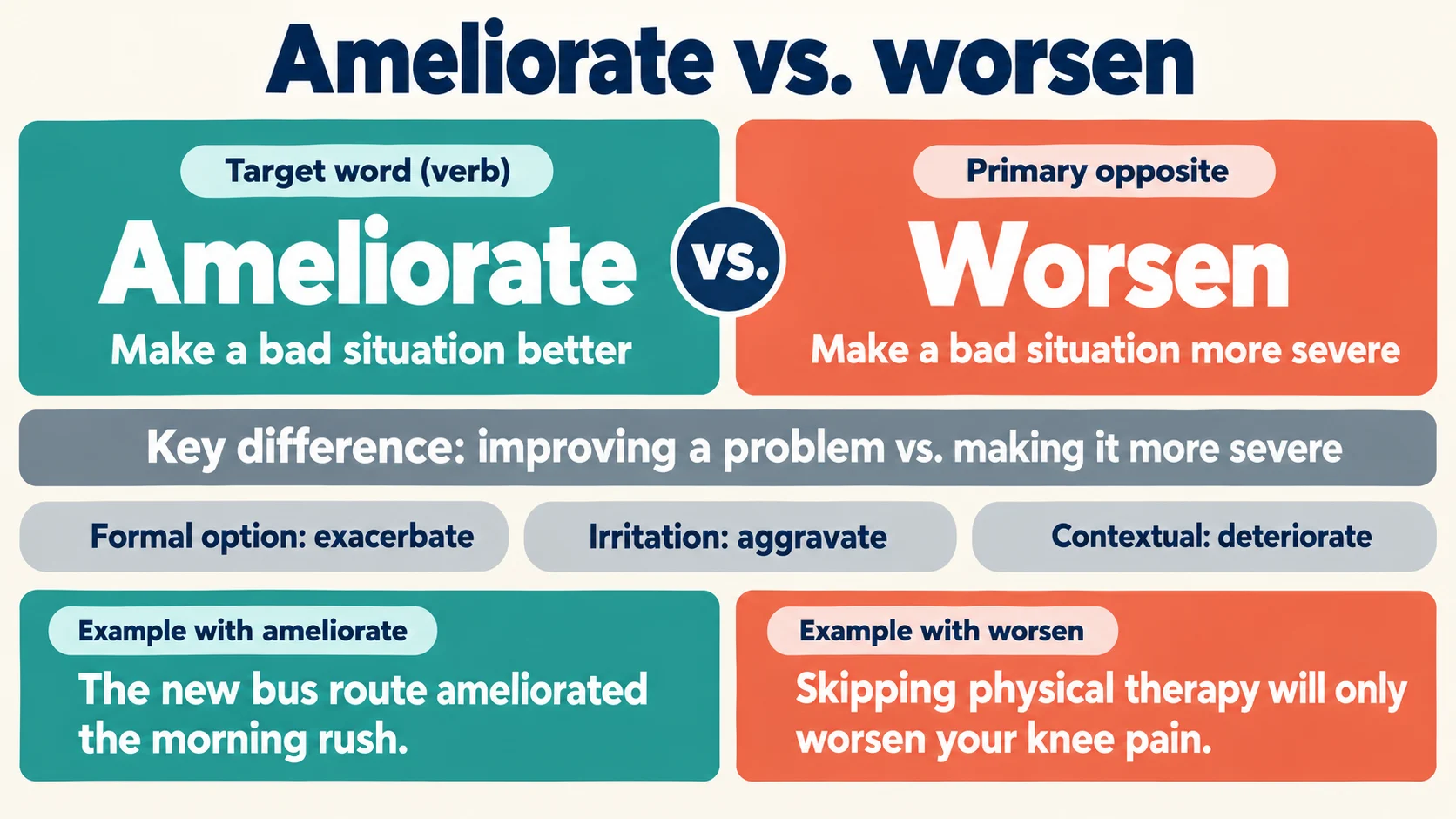
The opposite of ameliorate is worsen. Ameliorate means to make a bad or unsatisfactory situation better, so worsen is the clearest direct opposite. In more formal writing, aggravate and exacerbate also work, especially when a problem, symptom, or conflict becomes more severe instead of easing.
Part of speech: verb (transitive)
Primary opposite: worsen
Ameliorate means to make a bad, painful, or inadequate condition better. It nearly always takes an object, as in “ameliorate poverty” or “ameliorate the side effects of a medication.”
When ameliorate means to improve a problem, worsen is the strongest direct opposite. Both are common verbs that describe a change in how bad something is, just in opposite directions. Worsen also fits nearly any everyday situation, while aggravate and exacerbate suit more formal or pointed contexts.
Direct and Strong Antonyms
These three verbs are genuine opposites. Each is transitive, like ameliorate, so each can replace it in a sentence without changing the grammar.
| Antonym | Tone or Nuance | Example Sentence |
|---|---|---|
| Worsen | Neutral and everyday, fits speech and writing | Skipping physical therapy will only worsen your knee pain. |
| Aggravate | Slightly formal, often used for injuries, irritations, and conflicts | Spicy food can aggravate acid reflux. |
| Exacerbate | Formal, common in medical, policy, and academic writing | Budget cuts exacerbated the staffing shortage at the clinic. |
Swapping them shows the contrast clearly. “The new bus route ameliorated the morning rush” describes relief. “The new bus route exacerbated the morning rush” describes the reverse.
Collocations help too. People ameliorate conditions, shortages, and symptoms, and the same nouns pair naturally with these opposites: worsen conditions, aggravate symptoms, exacerbate shortages.
Contextual and Subtle Opposites
Ameliorate has one core sense, so the best opposite depends on context, tone, and formality rather than on meaning. Worsen is the closest all-purpose match. No single perfect antonym exists, however, because ameliorate is a formal word and worsen is a plain one. In formal writing, exacerbate often matches its register better.
| Context | Best Opposite | Why It Fits |
|---|---|---|
| General problem or situation | worsen | Plain, neutral, and widely understood |
| Pain, symptoms, or irritation | aggravate | Commonly pairs with injuries and sensitivities |
| Crisis, conflict, or policy problem | exacerbate | Formal and implies adding to an existing problem |
| Decline with no cause named (contextual) | deteriorate | Intransitive, so it works only when nothing acts on the problem |
Deteriorate is a contextual opposite, not a direct one. You can ameliorate something, but you cannot deteriorate something. Compare “Aid ameliorated the shortage” with “Conditions in the camp deteriorated.” Both describe opposite trends, but the grammar differs.
In a hospital setting, a nurse might say, “Cold air can aggravate his cough.” In a city council meeting, a speaker might argue, “Raising fees will exacerbate the housing crisis.” In everyday life, “Waiting another week will only worsen the problem” sounds natural.
Words That Seem Opposite But Are Not
Common Grammatical or Semantic Confusions
Two words often get offered as opposites, but neither is exact.
Neglect. To neglect a problem is to fail to address it. The problem may linger or decline, but neglect does not itself make anything worse. “The landlord neglected the leak” describes inaction, while exacerbate describes an action that adds to harm. Neglect is a related contrast, not an antonym.
Maintain. To maintain a condition is to keep it as it is. “The city maintained water quality at current levels” involves no change at all, so it sits between ameliorate and worsen instead of opposing ameliorate. It is also a related contrast.
Subtle Tone Differences
Even among true antonyms, the choice changes the feel of a sentence.
Worsen is plain and direct. In a workplace email, you might write, “I worry the extra meetings will worsen our backlog.” That sounds natural at any level of the company.
Exacerbate sounds more analytical. A research summary might say, “Social isolation can exacerbate symptoms of depression.” The verb suggests an existing problem growing more severe.
Aggravate works well for physical or emotional irritation: “Don’t aggravate your shoulder by lifting that box.” Be careful, though. In casual speech, aggravate also means to annoy, so exacerbate is clearer when precision matters.
Frequently Asked Questions
What is the direct opposite of ameliorate?
Worsen is the direct opposite of ameliorate. Ameliorate means to make a bad situation better, while worsen means to make it more severe. Aggravate and exacerbate are more formal alternatives that suit problems, symptoms, and conflicts.
Is deteriorate the opposite of ameliorate?
Only in certain contexts. Deteriorate means to become worse and takes no object, while ameliorate needs one. Use deteriorate when a condition declines on its own, and worsen or exacerbate when something causes the decline.
Which opposite of ameliorate works best in formal writing?
Exacerbate usually works best in formal writing, especially for problems, symptoms, or crises. It matches the formal register of ameliorate, while worsen suits everyday prose and aggravate can be misread as meaning annoy.
Practical Word Choice
- Identify the intended meaning. Decide whether you need the reverse of improving a problem (worsen, aggravate, exacerbate) or a decline with no cause named (deteriorate).
- Match the context, tone, strength, and formality. Choose worsen for everyday writing, exacerbate for formal or technical writing, and aggravate for physical or emotional irritation.
Final Thoughts
The core distinction is simple. Ameliorate makes a bad situation better, and worsen makes it more severe. Aggravate and exacerbate express the same reversal with a more formal edge.
Context matters because ameliorate belongs to a formal register, and no single antonym matches it perfectly in both meaning and tone. A sentence in a clinical report, a grant proposal, or a friendly text can each call for a different opposite, even though the underlying idea stays the same. Deteriorate fits only when no one acts on the problem.
When in doubt, test your sentence by swapping in ameliorate. If the two verbs read as a clean reversal, you chose well. What example sentence would you write using one of these opposites?