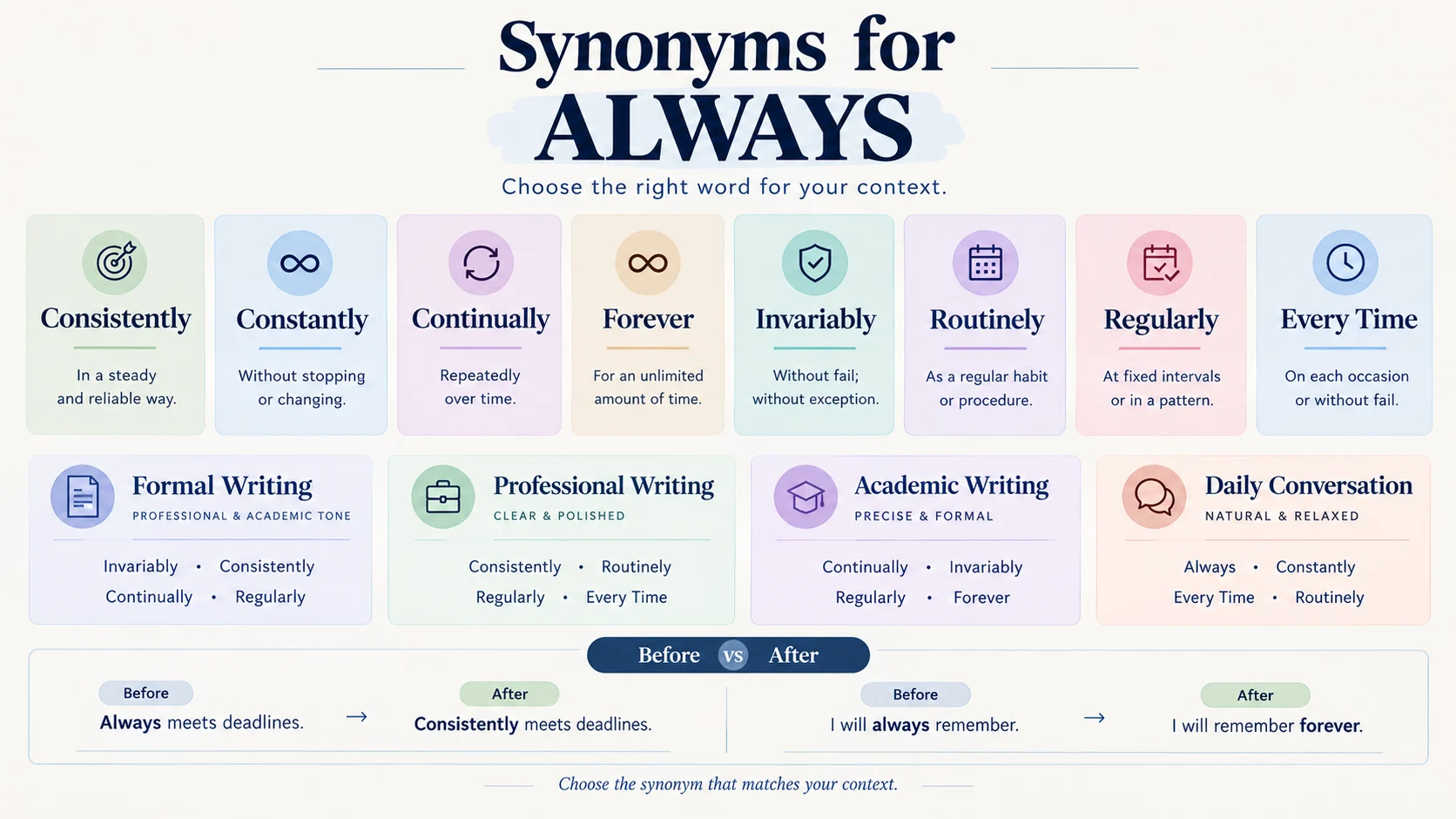
If you need another word for always, the best choice depends on what you mean. Common alternatives include forever, continually, constantly, consistently, perpetually, invariably, repeatedly, routinely, and every time. Some describe something happening without interruption, while others mean something happens regularly or on every occasion.
What Does Always Mean?
Definition
Always is an adverb that means at all times, on every occasion, continually, or as a regular and consistent pattern.
The exact meaning depends on context. For example:
- “She always arrives early.” means she does so consistently or nearly every time.
- “I will always remember you.” means forever or for all time.
- “The machine is always running.” suggests continuous operation.
Because of these different meanings, there is no single replacement for always that works perfectly in every sentence.
Common Uses
Always commonly describes:
Frequency: something happens every time or very regularly.
He always checks his email before work.
Continuity: something continues without stopping.
The lights are always on.
Permanence: something is intended to last forever.
I will always support you.
Consistency: someone repeatedly behaves in a particular way.
She is always helpful to new employees.
Choosing a synonym requires identifying which of these meanings you want to emphasize.
Best Synonyms for Always
| Synonym | Meaning | Best Used When | Example |
|---|---|---|---|
| Forever | For all time | Permanence or duration | I will love this place forever. |
| Constantly | Happening continuously or very frequently | Repeated or ongoing activity | He constantly checks his phone. |
| Continually | Happening repeatedly over time | Recurring activity | The company continually improves its service. |
| Consistently | Happening in a dependable way | Performance or behavior | She consistently meets her goals. |
| Invariably | Happening every time without exception | Formal or precise writing | He invariably arrives prepared. |
| Perpetually | Continuing indefinitely | Formal descriptions of ongoing states | The system seems perpetually busy. |
| Repeatedly | Happening again and again | Multiple occurrences | She repeatedly asked the same question. |
| Routinely | Happening as part of a regular routine | Work and everyday habits | He routinely reviews the reports. |
| Every time | On each occasion | Casual and direct language | She smiles every time she sees him. |
| Without fail | Happening reliably every time | Emphasizing reliability | He calls his parents without fail. |
Consistently
Meaning: In the same dependable or reliable manner.
Best Used For: Performance, behavior, results, habits, and professional communication.
Tone: Professional and positive
Difficulty: Easy
Usage Frequency: Very Common
Business example: The employee consistently meets project deadlines.
Academic example: The study consistently produced similar results.
Daily conversation: She consistently helps everyone around her.
This is often a better replacement for always when you want to emphasize reliability rather than literally mean every single time.
Constantly
Meaning: Continuously or very frequently.
Best Used For: Repeated actions, ongoing situations, and frequent behavior.
Tone: Neutral, sometimes slightly negative
Difficulty: Easy
Usage Frequency: Very Common
Business example: Customer expectations are constantly changing.
Academic example: Environmental conditions are constantly changing.
Daily conversation: My phone is constantly ringing.
Be careful with constantly because it can suggest something happens so frequently that it becomes noticeable or annoying.
Forever
Meaning: For all time or for an indefinitely long period.
Best Used For: Emotional statements, permanence, relationships, and duration.
Tone: Emotional or conversational
Difficulty: Easy
Usage Frequency: Very Common
Business example: The brand hopes its partnership will last forever.
Academic example: Historical records do not necessarily remain available forever.
Daily conversation: I could stay here forever.
Forever works particularly well when always refers to permanence rather than frequency.
Invariably
Meaning: Always or almost always, with little or no variation.
Best Used For: Formal, academic, analytical, and professional writing.
Tone: Formal
Difficulty: Advanced
Usage Frequency: Less Common
Business example: Successful projects invariably require clear communication.
Academic example: The results invariably depend on the quality of the available data.
Daily conversation: He invariably orders the same meal.
It is a precise alternative when you want a more formal version of “always.”
Synonyms by Context
Formal Writing
For formal writing, consider:
- Invariably
- Consistently
- Continually
- Perpetually
- Without exception
Example:
The organization always follows its internal procedures.
More formal:
The organization consistently follows its internal procedures.
Or, when there are genuinely no exceptions:
The organization follows its internal procedures without exception.
The last version is stronger, so use it only when the statement is accurate.
Professional Writing
In workplace communication, consistently, routinely, regularly, and continually are often more precise than always.
Instead of:
Our team always reviews customer feedback.
You could write:
Our team regularly reviews customer feedback.
Or:
Our team consistently reviews customer feedback.
Regularly emphasizes frequency, while consistently emphasizes dependable behavior.
Academic Writing
Academic writing usually benefits from precise alternatives rather than absolute statements.
Useful choices include:
- Consistently
- Continually
- Invariably
- Typically
- Repeatedly
- Routinely
For example:
Researchers always consider potential limitations.
A more cautious academic version might be:
Researchers typically consider potential limitations.
This changes the strength of the claim. Always makes an absolute statement, while typically allows exceptions.
Daily Conversation
Simple alternatives include:
- Every time
- Forever
- Constantly
- All the time
- Without fail
- Whenever
Example:
You always make me laugh.
Natural alternatives:
You always make me laugh.
You make me laugh every time.
You make me laugh all the time.
The most natural choice depends on whether you mean every occasion or very frequently.
Professional Alternatives for Always
When writing a resume, email, report, or business document, stronger alternatives can make your meaning more specific.
For reliable performance
Use consistently.
Always delivers projects on time.
Better:
Consistently delivers projects on time.
For recurring responsibilities
Use routinely.
Always reviews weekly performance data.
Better:
Routinely reviews weekly performance data.
For ongoing improvement
Use continually.
Always improves customer service processes.
Better:
Continually improves customer service processes.
For formal certainty
Use invariably when the statement genuinely has no meaningful exceptions.
The process always requires careful documentation.
Better:
The process invariably requires careful documentation.
Simple Alternatives for Always
If you want an easy word that most readers immediately understand, choose:
Every time: means on each occasion.
All the time: means very frequently or continuously.
Forever: means for all time.
Regularly: means at consistent or repeated intervals.
Usually: means in most cases, although not every time.
Whenever: means every time a particular condition occurs.
For everyday writing, these options often sound more natural than advanced words such as invariably or perpetually.
Stronger Alternatives for Always
Some alternatives can make a statement sound more emphatic.
Without fail emphasizes reliability.
She always remembers my birthday.
She remembers my birthday without fail.
Invariably emphasizes a consistent pattern with no meaningful variation.
The manager always arrives prepared.
The manager invariably arrives prepared.
Forever emphasizes permanence.
I will always remember this moment.
I will remember this moment forever.
Constantly emphasizes ongoing or very frequent activity.
The website is always changing.
The website is constantly changing.
These words are not interchangeable in every sentence because they emphasize different aspects of “always.”
Difference Between Similar Synonyms
Always vs. Constantly
Always can mean every time, while constantly usually emphasizes continuous or extremely frequent activity.
She always checks the door.
This could mean she does it every time she leaves.
She constantly checks the door.
This suggests she checks it very frequently.
Always vs. Consistently
Always can be absolute. Consistently focuses on a dependable pattern.
He always performs well.
He consistently performs well.
The second sentence is especially natural in professional writing.
Always vs. Forever
Always can describe frequency, while forever focuses on unlimited duration.
She always supports her friends.
She will support her friends forever.
The first describes a recurring behavior. The second describes permanence.
Always vs. Continually
Continually generally suggests something happens repeatedly over time.
The company continually updates its policies.
This does not necessarily mean the policies are being changed every second. It describes an ongoing pattern of updates.
Always vs. Usually
These words should not be treated as exact synonyms.
Always means every time or at all times.
Usually means most of the time.
I always drink coffee in the morning.
means there are no intended exceptions.
I usually drink coffee in the morning.
allows for exceptions.
Opposite Words
Common opposites of always include:
- Never
- Rarely
- Seldom
- Occasionally
- Sometimes
- Hardly ever
- Not usually
The appropriate opposite depends on how frequently something occurs.
For example, never means at no time, while sometimes means on some occasions. These represent very different frequencies.
FAQs
What is another word for always?
Common alternatives for always include consistently, constantly, continually, forever, invariably, routinely, regularly, every time, and without fail. The best replacement depends on whether you mean frequency, continuity, reliability, or permanence.
What is a formal synonym for always?
Invariably is one of the strongest formal synonyms for always. Consistently, continually, and perpetually can also work depending on the sentence and intended meaning.
What is a professional alternative for always?
Consistently is often an effective professional alternative because it emphasizes reliable performance or behavior without sounding unnecessarily dramatic.
What word can replace always in an essay?
Depending on the meaning, you can use consistently, regularly, continually, invariably, typically, repeatedly, or routinely. Choose the word that accurately reflects the evidence rather than simply replacing “always.”
What is another word for always in a sentence?
Possible replacements include every time, constantly, consistently, forever, regularly, continually, invariably, and without fail. The correct choice depends on the surrounding sentence.
Is constantly the same as always?
Not exactly. Constantly usually emphasizes something happening continuously or very frequently, while always can mean every time, at all times, or permanently.
What is a stronger word than always?
There is no single stronger replacement in every context. Without fail, invariably, and forever can create stronger emphasis, but each has a different meaning.
What is a simple synonym for always?
Simple alternatives include every time, all the time, forever, regularly, and whenever, depending on context.
What is the opposite of always?
The most direct opposite is never. Other contrasting words include rarely, seldom, occasionally, and sometimes.
Can always and forever be used interchangeably?
Sometimes, but not always. Forever refers primarily to duration or permanence, while always can refer to frequency, continuity, or permanence.
Conclusion
The best synonym for always depends on the idea you want to communicate. Use consistently for dependable performance, constantly for frequent or ongoing activity, continually for repeated change or action, forever for permanence, and invariably for formal statements about something that occurs without variation.
For everyday writing, simpler choices such as every time, regularly, and all the time often sound natural. In professional and academic writing, more precise alternatives can make your sentence clearer because they show exactly what you mean instead of relying on the broad word always.