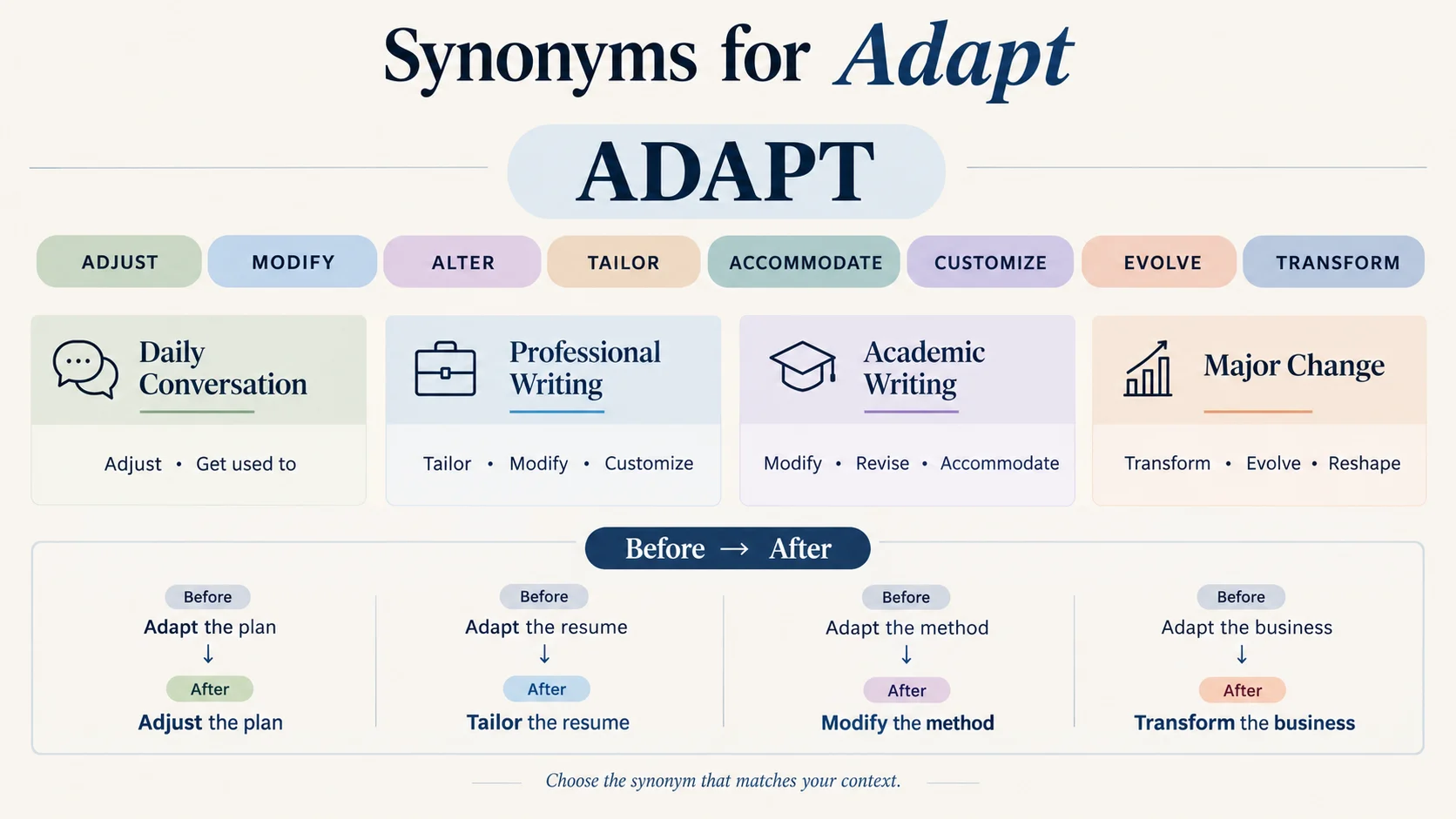
The best synonyms for adapt include adjust, modify, alter, accommodate, tailor, customize, revise, evolve, and transform. The right choice depends on context. Adjust works for small changes, modify for deliberate changes, tailor for personalization, accommodate for meeting needs, and transform for major changes.
What Does Adapt Mean?
Definition
Adapt means to change something or yourself so that it works better in a new situation, environment, condition, or purpose. It can describe changing behavior, modifying an object, adjusting a plan, or becoming comfortable with new circumstances.
For example:
- Employees must adapt to new technology.
- She quickly adapted to her new workplace.
- We need to adapt the lesson for younger students.
- The company adapted its strategy after customer needs changed.
The best synonym depends on what is being changed and why. Adjust usually suggests a small change, while modify can mean deliberately changing something. Accommodate focuses on meeting someone’s needs, and tailor means making something suitable for a particular person or purpose.
Common Uses
The word adapt commonly appears in four situations:
- Changing behavior: adapt to a new environment or situation.
- Changing an object or plan: adapt a design, strategy, or system.
- Responding to circumstances: adapt to changing market conditions.
- Making something suitable: adapt a lesson for different learners.
Best Synonyms for Adapt
| Synonym | Meaning | Best Used When | Example |
|---|---|---|---|
| Adjust | Make a small change | Changing settings, plans, or behavior | We adjusted the schedule. |
| Modify | Make partial changes | Changing a design, document, or system | We modified the proposal. |
| Alter | Change something | Describing a noticeable change | The company altered its strategy. |
| Accommodate | Make suitable for someone’s needs | People, accessibility, or requirements | The school accommodated different learning needs. |
| Tailor | Make specifically suitable | Business, resumes, marketing, and services | Tailor your resume to the position. |
| Customize | Change for a particular user or purpose | Products, software, and services | Customers can customize their profiles. |
| Revise | Change to improve or correct | Writing, plans, policies, and academic work | The student revised the essay. |
| Transform | Change substantially | Major changes in form or function | Technology transformed the industry. |
| Evolve | Develop gradually over time | Ideas, organizations, systems, or behavior | The strategy evolved over several years. |
| Acclimate | Become accustomed to a new environment | People adjusting to unfamiliar surroundings | It took time to acclimate to the climate. |
| Assimilate | Become integrated into a group or environment | Culture, communities, or organizations | New employees gradually assimilated into the team. |
| Respond | React appropriately to circumstances | Problems, changes, or demands | Businesses must respond to customer expectations. |
The Most Useful Choices
Adjust is one of the closest everyday alternatives to adapt. It works well when the change is relatively minor.
Modify is useful when you deliberately change part of something while keeping its basic structure.
Tailor is especially effective when something is designed for a particular person, audience, job, or purpose.
Accommodate works when the goal is to meet another person’s needs or requirements.
Evolve emphasizes gradual development rather than an immediate adjustment.
Transform is stronger than adapt because it suggests a significant or fundamental change.
Synonyms by Context
Formal Writing
In formal writing, alternatives such as modify, alter, accommodate, adjust, revise, and transform can provide more precise wording.
For example:
- Original: The organization adapted its policies.
- More specific: The organization modified its policies.
- Stronger: The organization transformed its policies.
Choose the word according to the degree and purpose of the change. Avoid replacing adapt simply for variety if it is already the most accurate word.
Professional Writing
Business communication often uses adjust, modify, tailor, customize, respond, and evolve.
Examples:
- We adapted our marketing strategy to changing customer behavior.
- We adjusted our marketing strategy based on recent data.
- We tailored our marketing strategy to younger customers.
- We modified the campaign to address new requirements.
For resumes, tailored is particularly useful:
I tailored client presentations to meet different stakeholder needs.
This communicates purposeful adjustment rather than simply saying something was changed.
Academic Writing
Academic writing frequently uses modify, adjust, revise, alter, evolve, and accommodate.
Examples:
- Researchers adapted the methodology to suit the available data.
- Researchers modified the methodology to suit the available data.
- The theory has evolved over several decades.
- The researchers adjusted the experimental conditions.
In academic work, precision matters. Revise is generally better for changing written work, while modify is often more suitable for research methods, models, or procedures.
Daily Conversation
For casual conversations, adjust, change, get used to, and acclimate can work naturally.
Examples:
- I had to adapt to my new schedule.
- I had to adjust to my new schedule.
- It took me a few weeks to get used to my new schedule.
In everyday American English, get used to is often more conversational than acclimate.
Professional Alternatives for Adapt
If you need a professional alternative, consider the exact meaning:
- Adjust for a practical change
- Modify for a deliberate change
- Tailor for personalization
- Customize for user-specific changes
- Accommodate for meeting requirements
- Revise for improving an existing plan
- Evolve for gradual development
- Respond for reacting to changing conditions
For a resume, instead of writing:
Adapted company procedures to improve efficiency.
You could write:
Modified company procedures to improve efficiency.
Or:
Tailored company procedures to meet changing operational needs.
The strongest option depends on what you actually did. Your wording should accurately represent the action rather than simply sound more impressive.
Simple Alternatives for Adapt
If you want an easy replacement for adapt, use:
Change, adjust, alter, modify, fit, or get used to.
Examples:
- You need to adapt to the new rules.
- You need to adjust to the new rules.
- We adapted the plan.
- We changed the plan.
Adjust is usually the easiest one-word replacement when you mean becoming suitable for a new situation.
Stronger Alternatives for Adapt
When you want to emphasize a major or purposeful change, consider:
Transform, reshape, reinvent, restructure, or reconfigure.
These words are not exact synonyms in every situation.
For example:
- The business adapted to digital commerce.
- The business transformed its operations for digital commerce.
The second sentence suggests a much larger change.
Similarly:
- Restructure emphasizes reorganizing something.
- Reconfigure emphasizes changing how parts are arranged.
- Reshape emphasizes influencing the form or direction of something.
- Reinvent suggests creating a substantially new version.
Difference Between Similar Synonyms
Adapt vs. Adjust
Adapt often suggests becoming suitable for a new situation. Adjust usually suggests making a smaller or more specific change.
She adapted to remote work.
This describes becoming comfortable or effective in a new working environment.
She adjusted her desk for remote work.
This describes a particular physical change.
Adapt vs. Modify
Modify focuses on deliberately changing something. Adapt can describe either changing something or becoming able to function in new circumstances.
We modified the software.
We adapted the software for mobile devices.
The second sentence emphasizes making the software suitable for a new purpose.
Adapt vs. Alter
Alter simply means to change. It does not necessarily communicate the idea of becoming suitable for a new situation.
The designer altered the layout.
The designer adapted the layout for mobile users.
The second example explains the purpose behind the change.
Adapt vs. Accommodate
Accommodate means making room for, allowing for, or meeting someone’s needs or requirements.
The hotel adapted its services.
The hotel accommodated guests with accessibility needs.
The second sentence focuses specifically on meeting guest requirements.
Adapt vs. Evolve
Evolve usually describes gradual development over time.
The company’s strategy adapted to market changes.
The company’s strategy evolved over several years.
Use evolve when the development is gradual rather than a single deliberate adjustment.
Adapt vs. Transform
Transform indicates a much more substantial change.
The company adapted its workflow.
The company transformed its entire business model.
Transform is therefore a stronger word and should not be used when only a minor adjustment occurred.
Synonym Analysis
Adjust
Meaning: Make a change so something works or fits better.
Best Used For: Plans, settings, schedules, behavior, and everyday situations.
Tone: Neutral.
Difficulty: Easy.
Usage Frequency: Very Common.
Best For: Emails, business writing, essays, and conversation.
Modify
Meaning: Make changes to part of something.
Best Used For: Documents, systems, methods, products, and procedures.
Tone: Professional and precise.
Difficulty: Medium.
Usage Frequency: Common.
Best For: Academic, business, and technical writing.
Tailor
Meaning: Make something specifically suitable for a person, audience, or purpose.
Best Used For: Resumes, services, presentations, marketing, and communication.
Tone: Professional.
Difficulty: Medium.
Usage Frequency: Common.
Best For: Resume writing, marketing copy, emails, and business writing.
Accommodate
Meaning: Make adjustments to meet someone’s needs or requirements.
Best Used For: People, accessibility, schedules, policies, and different requirements.
Tone: Formal to neutral.
Difficulty: Medium.
Usage Frequency: Common.
Best For: Professional and academic writing.
Evolve
Meaning: Develop or change gradually over time.
Best Used For: Ideas, organizations, strategies, technology, and systems.
Tone: Neutral to professional.
Difficulty: Medium.
Usage Frequency: Common.
Best For: Essays, business writing, and analytical content.
Transform
Meaning: Change something significantly in form, character, or function.
Best Used For: Major changes and substantial improvements.
Tone: Strong and impactful.
Difficulty: Easy.
Usage Frequency: Very Common.
Best For: Marketing, business writing, presentations, and essays.
Business, Academic, and Daily Examples
Business Example:
The company adapted its pricing strategy after analyzing customer behavior.
Possible alternatives include adjusted, modified, or tailored, depending on the exact change.
Academic Example:
The researchers adapted the experimental procedure to account for environmental conditions.
Here, modified may be more precise if the researchers deliberately changed specific parts of the procedure.
Daily Conversation Example:
It took me a while to adapt to my new routine.
A more casual version would be:
It took me a while to get used to my new routine.
Opposite Words
Common opposites of adapt include:
- Resist
- Maintain
- Preserve
- Remain unchanged
- Reject
- Ignore
- Stay the same
The appropriate opposite depends on the meaning. If adapt means changing behavior to fit circumstances, resist may be an opposite. If it means changing an object, preserve or maintain may provide a stronger contrast.
FAQs
What is another word for adapt?
Common alternatives for adapt include adjust, modify, alter, accommodate, tailor, customize, revise, evolve, and transform. The best choice depends on the type and degree of change.
What is a formal synonym for adapt?
Modify, alter, accommodate, revise, and adjust can work as formal alternatives. Modify is especially useful when describing deliberate changes to a process, document, system, or method.
What is a professional alternative for adapt?
Adjust, modify, tailor, customize, accommodate, and evolve are useful professional alternatives. Tailor is particularly effective when describing something designed for a specific audience or purpose.
What word can replace adapt in a resume?
Depending on the achievement, use tailored, modified, adjusted, customized, or restructured. Choose the word that accurately describes the action you performed.
What is a simple word for adapt?
Change or adjust are simple alternatives. In casual conversation, get used to can also replace adapt to when discussing becoming comfortable with a new situation.
What is a stronger word than adapt?
Transform, reinvent, restructure, or reshape can express a more substantial change. These are stronger than adapt because they generally suggest a larger or more fundamental transformation.
Is adjust the same as adapt?
They are closely related but not identical. Adjust often refers to a specific or relatively small change, while adapt can describe becoming suitable for a new environment, situation, or purpose.
Is modify a synonym for adapt?
Yes, in contexts involving deliberate changes to an object, plan, system, or method. However, modify emphasizes the act of changing something, while adapt often emphasizes making it suitable for a new situation or purpose.
What is another word for adapt to change?
Depending on the sentence, you can use adjust to, respond to, accommodate, evolve with, or get used to. For example, Employees must adjust to changes in technology.
What is the opposite of adapt?
Possible opposites include resist, maintain, preserve, reject, and remain unchanged. The correct antonym depends on the specific meaning of adapt in the sentence.
Conclusion
The best synonym for adapt depends on what kind of change you want to describe. Adjust works well for everyday changes, modify suits deliberate alterations, tailor emphasizes personalization, accommodate focuses on meeting needs, evolve suggests gradual development, and transform communicates a major change.
Instead of choosing a synonym simply because it sounds more sophisticated, consider the exact action, purpose, and tone of your sentence. The most effective replacement is the one that preserves your intended meaning while making the context clearer.