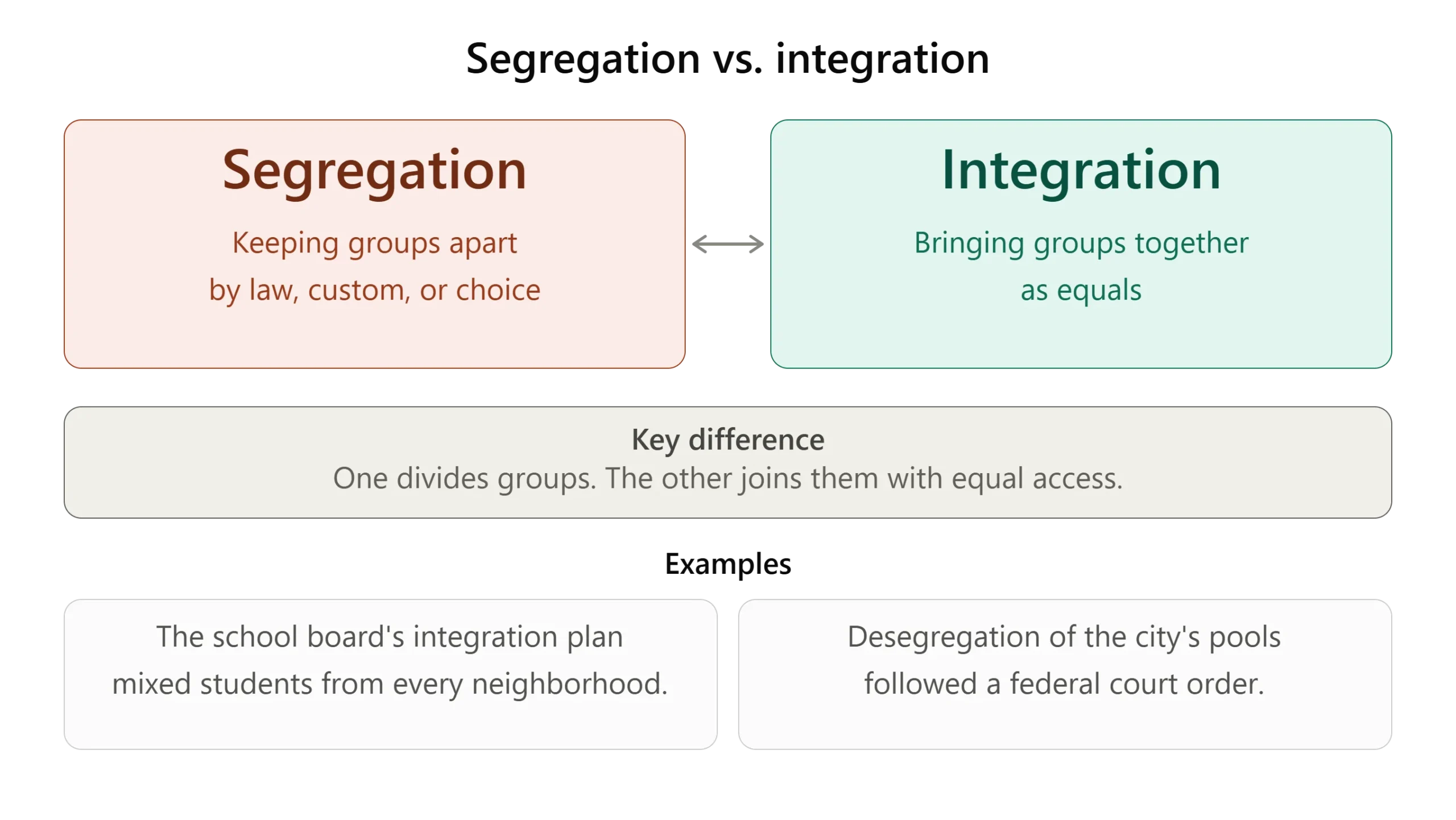
The opposite of segregation is integration. Segregation means the forced or customary separation of people or things into distinct groups, especially by race. Integration brings those groups together as equals. In the context of ending legal separation, desegregation is the closest process word, while inclusion describes a broader, welcoming ideal.
Part of speech: noun
Primary opposite: integration
Segregation is the practice of keeping groups apart, whether by law, custom, or choice. When it describes separating people by race, class, religion, or another group identity, integration is the strongest direct opposite. Segregation divides groups into separate spaces. Integration joins them into one shared community with equal access.
The word has a second, broader sense: separating things, as in “waste segregation” or “segregation of duties.” In that sense, no single antonym fits every case, and the best opposite shifts toward words like combination or consolidation. Context decides.
Direct and Strong Antonyms
Only a few words are genuine opposites of segregation. Each one carries a different shade of meaning.
| Antonym | Tone or Nuance | Example Sentence |
|---|---|---|
| Integration | Neutral and standard. Names the state of groups sharing space as equals. | The school board’s integration plan placed students from every neighborhood in the same classrooms. |
| Desegregation | Formal, legal, and historical. Names the process of ending segregation. | Desegregation of the city’s public pools followed a federal court order. |
| Mixing | Plain and conversational. Less formal and less precise. | Our new neighborhood has a lot of mixing between old residents and newcomers. |
Integration is the best all-purpose choice. Desegregation is technically the act of undoing segregation, so it works as an opposite in historical and legal writing, but it describes the removal of barriers rather than the result. Mixing is accurate in casual speech but lacks the weight of the first two.
Contextual and Subtle Opposites
The best opposite depends on which meaning of segregation you intend. The words below are contextual opposites, not universal ones.
| Context | Best Opposite | Why It Fits |
|---|---|---|
| Race and civil rights | Integration | It names the shared, equal participation that segregation denied. |
| Schools and housing by income | Integration or mixing | Both describe different groups living and learning side by side. |
| Teams and social groups | Inclusion (contextual) | It describes welcoming people who were set apart, though it is broader than a strict antonym. |
| Finance and accounting | Commingling | It describes combining funds that were required to stay apart. |
| Job roles and responsibilities | Consolidation | It describes merging tasks that were kept separate. |
Here is how the contextual choices look in real sentences. An auditor might write, “The firm’s commingling of client money with operating funds violated its own segregation rules.” A manager might say, “We consolidated approval and payment duties in one role, which removed a key safeguard.” A community organizer might say, “Inclusion means the new families are invited into the planning meetings, not just allowed in the building.”
Notice that these opposites only work in their own settings. Commingling would sound strange in a discussion of school policy, and integration would sound vague in a discussion of audit controls.
Words That Seem Opposite But Are Not
Diversity
Diversity describes the presence of varied groups in a place. It does not describe how those groups relate. A city can be highly diverse and still deeply segregated if each group lives in its own district. Diversity is a related contrast, not an antonym.
Assimilation
Assimilation means a group gradually adopting the habits and culture of a larger group. It is about cultural change, not physical or social separation. A community can be integrated without assimilating, because people can share schools and workplaces while keeping their own traditions. Assimilation is a related contrast, not an antonym.
Subtle Tone Differences
Choosing among the real opposites changes how your sentence lands.
Desegregation sounds historical and official. “Desegregation began in the district in 1971” reads like a timeline entry. It tells readers what was removed, not what was built.
Integration sounds forward-looking and complete. “The company is working toward true integration of its sales teams” implies equal participation, not just open doors.
Inclusion sounds personal and values-driven. “She felt a real sense of inclusion at her new job” focuses on belonging rather than on policy or structure.
Mixing sounds casual and can feel imprecise. “There was a lot of mixing at the festival” describes a moment, not a system. In formal writing, it can undersell the idea.
Strength matters too. Desegregation is a narrow, concrete term. Integration is broader and carries moral weight. Inclusion is the softest and most flexible, which is why it can drift away from the original meaning.
Frequently Asked Questions
What is the direct antonym of segregation?
Integration is the most widely used direct antonym. It means bringing separated groups together into one community with equal access and participation. It works especially well when segregation refers to race, class, or other social divisions.
Is desegregation the opposite of segregation?
Desegregation is the process of ending segregation, so it works as an opposite in legal and historical writing. Integration better describes the lasting result, where groups share space as equals. Use desegregation for the action and integration for the outcome.
What is the opposite of segregation of duties?
In accounting and workplace controls, the opposite is the consolidation of duties, where one person handles tasks that were deliberately split among several people. Integration is not the usual choice in this setting.
Practical Word Choice
Identify the intended meaning. Decide first whether segregation refers to separating people or separating things. People point toward integration. Things such as money, waste, or duties point toward commingling, combination, or consolidation.
Match context, tone, strength, and formality. Use desegregation for legal or historical writing, integration for general and academic writing, inclusion for workplace or community values, and mixing for casual speech.
Final Thoughts
Segregation keeps groups apart, and integration brings them together as equals. That pairing is the clearest and most reliable opposite, especially in discussions of schools, housing, and civil rights. Desegregation describes the work of removing barriers, and integration describes what that work is meant to create.
Context matters because segregation has more than one meaning. A word that fits a civil rights discussion may sound out of place in an audit report, and the reverse is also true. Terms like diversity and assimilation often get mistaken for opposites, but they describe different ideas.
When you are unsure, ask what the sentence is really about, then choose the word that matches. What example of segregation and its opposite have you come across in your own reading or work?