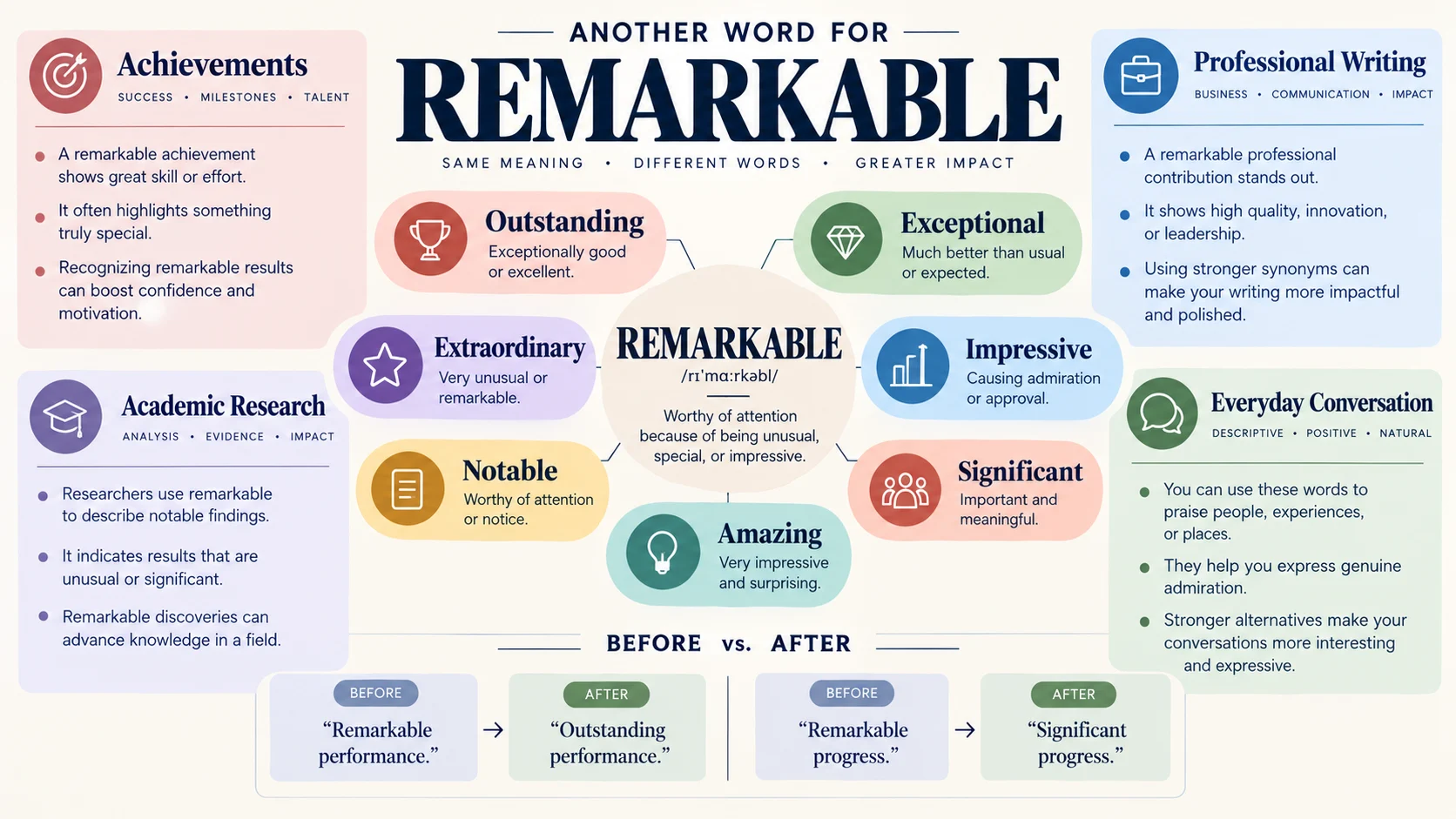
Another word for remarkable depends on what you want to describe. Common synonyms include outstanding, exceptional, extraordinary, impressive, notable, amazing, and striking. Use outstanding for excellent performance, exceptional for unusually high quality, notable for something worth mentioning, and extraordinary for something far beyond the ordinary.
What Does Remarkable Mean?
Definition
The word remarkable is an adjective that describes someone or something worthy of attention because it is unusual, impressive, significant, or exceptionally good. It often expresses admiration, although it can also describe an unusual event, change, or characteristic without necessarily praising it.
For example:
- She made remarkable progress in her studies.
- The company achieved remarkable results this year.
- His memory is remarkable.
- Researchers observed a remarkable change in the results.
The best synonym depends on the reason something deserves attention. A remarkable achievement may be outstanding, a remarkable discovery may be groundbreaking, and a remarkable detail may simply be notable.
Common Uses
People commonly use remarkable to describe:
- Achievements: Exceptional results, accomplishments, or progress.
- People: Impressive abilities, qualities, or contributions.
- Changes: Significant improvements or unusual developments.
- Events: Unexpected, memorable, or extraordinary occurrences.
- Ideas and discoveries: Important findings or original thinking.
- Personal qualities: Unusual patience, courage, talent, or resilience.
Because the word covers several meanings, choosing a more specific synonym can make your writing more vivid and precise.
Best Synonyms for Remarkable
| Synonym | Meaning | Best Used When | Example |
|---|---|---|---|
| Outstanding | Exceptionally good | Performance, achievements, and results | She delivered an outstanding presentation. |
| Exceptional | Unusually excellent or rare | Skills, quality, and accomplishments | He demonstrated exceptional leadership. |
| Extraordinary | Far beyond what is usual | Unusual events, abilities, or experiences | They achieved extraordinary progress. |
| Impressive | Likely to inspire admiration | Skills, results, and presentations | The team produced impressive results. |
| Notable | Worth noticing or mentioning | Important facts, events, or contributions | The study revealed a notable difference. |
| Amazing | Extremely surprising or impressive | Casual conversation and enthusiastic descriptions | She did an amazing job. |
| Striking | Immediately noticeable or attention-grabbing | Appearance, contrasts, and differences | The report showed a striking contrast. |
| Significant | Important or meaningful | Research findings, changes, and outcomes | The project made a significant contribution. |
| Phenomenal | Exceptionally impressive | Extraordinary success or performance | The business experienced phenomenal growth. |
| Magnificent | Exceptionally beautiful or impressive | Art, scenery, architecture, and achievements | They admired the magnificent building. |
| Incredible | Difficult to believe because of its quality or scale | Surprising achievements and experiences | Her recovery was incredible. |
| Admirable | Deserving respect or approval | Character, effort, and behavior | His honesty was admirable. |
| Distinguished | Recognized for excellence or achievement | Careers, reputations, and professional contributions | She had a distinguished academic career. |
| Unparalleled | Having no equal or close comparison | Rare accomplishments or exceptional quality | The organization provided unparalleled service. |
| Groundbreaking | Introducing important new ideas or methods | Research, innovation, and discoveries | The team developed a groundbreaking technology. |
Synonyms by Context
Formal Writing
For formal writing, exceptional, notable, significant, distinguished, and extraordinary are useful alternatives.
Exceptional works well when describing quality or ability that exceeds normal expectations.
Example: The candidate demonstrated exceptional analytical skills.
Notable is more restrained and is useful when identifying something worthy of attention without exaggerating its importance.
Example: The report identified several notable developments in renewable energy.
Significant emphasizes importance or meaningful impact.
Example: The policy produced significant improvements in public services.
In formal writing, select the word that matches the evidence. A result may be significant because it matters, but that does not automatically mean it is exceptional.
Professional Writing
In business communication, strong alternatives include outstanding, impressive, exceptional, significant, and distinguished.
Outstanding works especially well for performance and accomplishments.
Business example: The sales team delivered outstanding results during the final quarter.
Impressive describes results that inspire admiration.
Business example: The company achieved impressive customer retention rates.
Significant is appropriate when discussing measurable changes or business impact.
Business example: The new process led to a significant reduction in processing time.
For resumes, choose specific language that accurately represents your contribution. Phrases such as outstanding performance, significant improvement, and exceptional customer service can be effective when supported by concrete examples.
Academic Writing
Academic writing benefits from precise alternatives such as notable, significant, exceptional, groundbreaking, and striking.
Notable is useful when describing an observation or finding that deserves attention.
Academic example: The researchers identified a notable difference between the two groups.
Significant describes an important result or effect. In statistical writing, however, statistically significant has a specific technical meaning and should only be used when supported by the appropriate analysis.
Academic example: The intervention produced a significant improvement in test performance.
Groundbreaking is suitable for research that introduces a genuinely important new approach or discovery.
Academic example: The study introduced a groundbreaking method for analyzing complex data.
Avoid calling every interesting finding groundbreaking. Strong academic writing distinguishes between an observation that is noteworthy and a discovery that changes established understanding.
Daily Conversation
In everyday English, amazing, incredible, impressive, fantastic, and outstanding are natural alternatives.
Examples:
- Instead of “That was remarkable,” say “That was amazing.”
- Instead of “She made remarkable progress,” say “She made impressive progress.”
- Instead of “He did remarkable work,” say “He did outstanding work.”
- Instead of “The view was remarkable,” say “The view was incredible.”
These choices sound conversational and expressive. Amazing and incredible often convey more excitement than notable or significant.
Professional Alternatives for Remarkable
When writing a resume, cover letter, business report, or academic document, consider the exact quality you want to highlight.
Outstanding
Meaning: Exceptionally good compared with typical performance or expectations.
Best Used For: Achievements, professional performance, customer service, and results.
Tone: Confident and professional
Difficulty: Easy
Usage Frequency: Very Common
Best For: Resume, Email Writing, Marketing Copy, Business Writing
- Business example: The department delivered outstanding results during the annual review.
- Academic example: The student demonstrated outstanding analytical ability.
- Daily conversation example: You did an outstanding job on the presentation.
Exceptional
Meaning: Unusually good or significantly different from the usual standard.
Best Used For: Skills, quality, performance, and accomplishments.
Tone: Formal and complimentary
Difficulty: Medium
Usage Frequency: Common
Best For: Resume, Essay Writing, Academic Writing, Business Writing
- Business example: She demonstrated exceptional problem-solving skills.
- Academic example: The researcher made an exceptional contribution to the field.
- Daily conversation example: He has an exceptional memory.
Significant
Meaning: Important, meaningful, or large enough to matter.
Best Used For: Results, progress, contributions, and measurable changes.
Tone: Neutral to formal
Difficulty: Easy
Usage Frequency: Very Common
Best For: Resume, Essay Writing, Academic Writing, Business Writing
- Business example: The team achieved a significant improvement in customer satisfaction.
- Academic example: The study found a significant relationship between the variables.
- Daily conversation example: That was a significant step forward.
Impressive
Meaning: Inspiring admiration because of quality, scale, ability, or achievement.
Best Used For: Presentations, results, skills, and accomplishments.
Tone: Positive and professional
Difficulty: Easy
Usage Frequency: Very Common
Best For: Resume, Email Writing, Marketing Copy, Business Writing
- Business example: The candidate presented an impressive portfolio.
- Academic example: The project demonstrated impressive technical progress.
- Daily conversation example: Your artwork looks impressive.
Simple Alternatives for Remarkable
If you want a clear, everyday replacement, consider these words:
- Amazing: Extremely impressive or surprising.
- Great: Very good or enjoyable.
- Excellent: Of very high quality.
- Special: Different from the usual or personally meaningful.
- Unusual: Different from what is commonly expected.
- Impressive: Inspiring admiration.
- Memorable: Worth remembering.
- Noteworthy: Worth attention or recognition.
For example, “She made remarkable progress” could become “She made impressive progress” or “She made excellent progress.”
The best option depends on whether you want to emphasize quality, surprise, uniqueness, or importance.
Stronger Alternatives for Remarkable
Sometimes a more powerful word creates a stronger impression.
Phenomenal emphasizes an extraordinary level of success, growth, or performance.
Example: The company achieved phenomenal growth in three years.
Unparalleled suggests that something has no equal or close competitor.
Example: The organization built an unparalleled reputation for service.
Groundbreaking highlights an important innovation or discovery that changes how people approach a subject.
Example: The researchers introduced a groundbreaking diagnostic technique.
Extraordinary describes something far beyond ordinary expectations.
Example: She showed extraordinary courage during a difficult period.
Magnificent emphasizes impressive beauty, grandeur, or excellence.
Example: The architect designed a magnificent public library.
Use these stronger alternatives selectively. A word such as unparalleled makes a much bigger claim than impressive and should be supported by the facts.
Difference Between Similar Synonyms
Remarkable vs. Outstanding: Remarkable means worthy of attention, while outstanding usually emphasizes superior quality or performance.
Remarkable vs. Exceptional: Both suggest something beyond the ordinary. Exceptional more directly emphasizes rarity or unusually high quality.
Remarkable vs. Extraordinary: Extraordinary stresses how far something exceeds normal expectations. Remarkable emphasizes that it deserves attention.
Remarkable vs. Impressive: Impressive specifically suggests that something inspires admiration. Remarkable can also describe unusual or noteworthy events without implying praise.
Remarkable vs. Notable: Notable is more restrained and often suitable for objective writing. Remarkable can express a stronger sense of surprise or importance.
Remarkable vs. Significant: Significant emphasizes importance or impact rather than how unusual or impressive something is.
Remarkable vs. Groundbreaking: Groundbreaking means innovative in a way that can change a field or practice. Something may be remarkable without being innovative.
Opposite Words
The opposite of remarkable depends on the intended meaning.
| Meaning of Remarkable | Opposite | Example |
|---|---|---|
| Worthy of attention | Unremarkable | The design was simple and unremarkable. |
| Exceptionally good | Ordinary | The performance was ordinary. |
| Unusual | Common | The plant is common in this region. |
| Impressive | Mediocre | The results were mediocre. |
| Memorable | Forgettable | The presentation was forgettable. |
| Extraordinary | Typical | It was a typical day at work. |
These words express different kinds of contrast. Ordinary and typical suggest a lack of unusual qualities, while mediocre specifically suggests average or below-average quality.
FAQs
What is another word for remarkable?
Common synonyms include outstanding, exceptional, extraordinary, impressive, notable, amazing, striking, and significant. The best choice depends on whether you want to emphasize quality, importance, uniqueness, or surprise.
What is a formal synonym for remarkable?
Formal alternatives include exceptional, notable, significant, distinguished, and extraordinary. Notable is useful for objective writing, while exceptional emphasizes unusually high quality.
What is a professional alternative for remarkable?
Use outstanding for performance, significant for measurable impact, exceptional for skills, and impressive for achievements. Choose a word that accurately reflects the results or contribution.
What word can replace remarkable in an essay?
Useful choices include notable, significant, exceptional, extraordinary, and striking. For academic writing, select the word that best matches the evidence and intended meaning.
What is another word for a remarkable person?
Depending on the person’s qualities, you can use exceptional, extraordinary, admirable, distinguished, talented, or inspiring.
What is another word for remarkable achievement?
Common alternatives include outstanding accomplishment, exceptional achievement, extraordinary success, and significant milestone.
What is another word for remarkable improvement?
Consider significant improvement, substantial progress, impressive growth, or exceptional development. Use substantial when the improvement is considerable in amount or degree.
Is remarkable a positive word?
Usually, yes. It often expresses admiration or praise. However, it can also describe something unusual or noteworthy without being positive, such as a remarkable decline in sales.
What is a stronger word than remarkable?
Depending on the context, extraordinary, phenomenal, unparalleled, and groundbreaking can be stronger alternatives. Each adds a different meaning, so choose carefully.
What is the opposite of remarkable?
Common opposites include ordinary, unremarkable, typical, common, forgettable, and mediocre. The most accurate antonym depends on whether remarkable refers to uniqueness, quality, or importance.
Conclusion
The best another word for remarkable depends on the quality you want to emphasize. Choose outstanding for excellent performance, exceptional for unusually high quality, significant for meaningful impact, impressive for achievements that inspire admiration, and notable for something worth mentioning.
For stronger writing, avoid using the same adjective repeatedly. Select a synonym that reflects the actual achievement, finding, person, or event. This approach makes resumes, academic essays, business reports, and everyday communication clearer and more convincing.