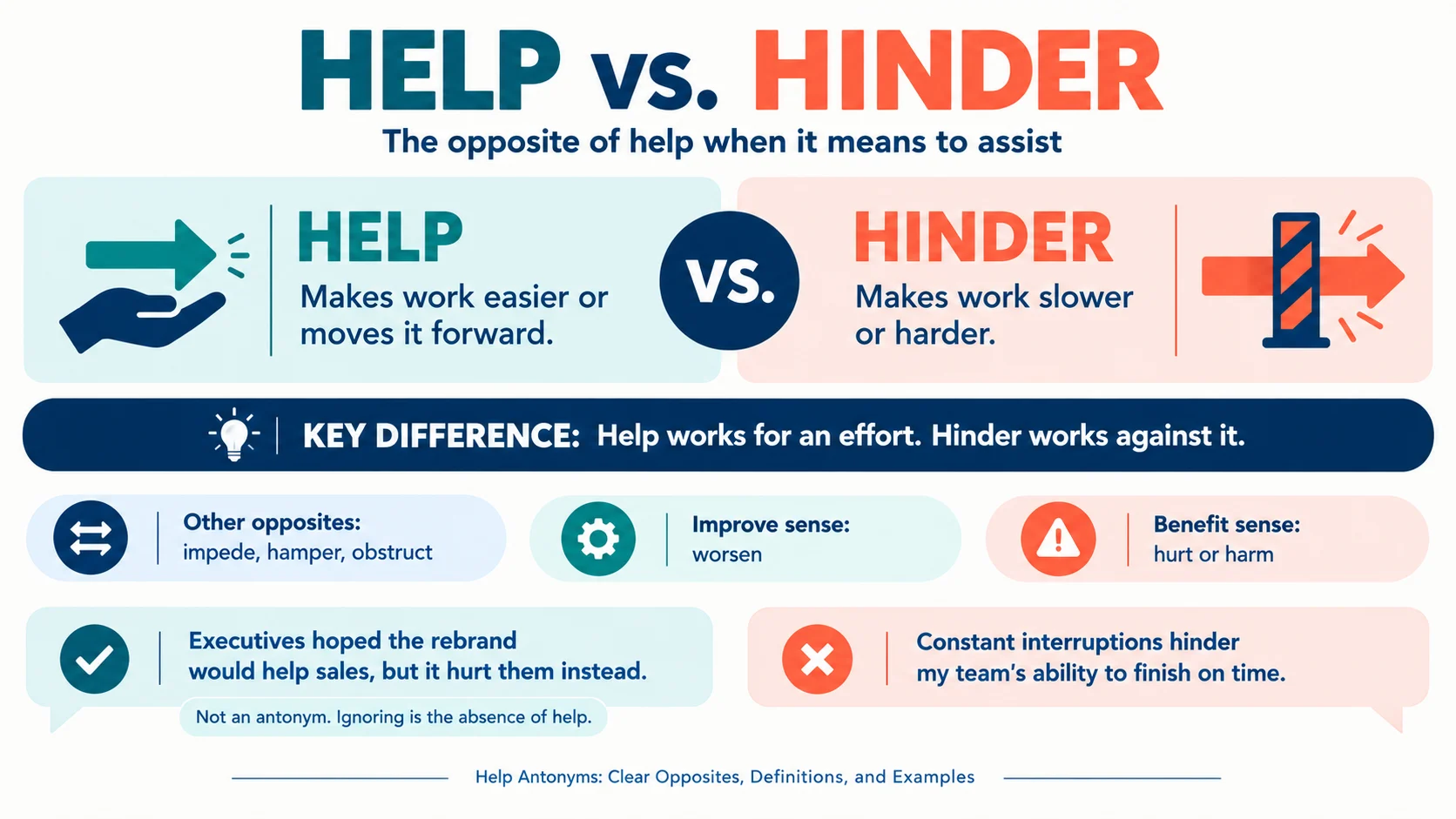
The opposite of help is hinder when help means to assist or make something easier. Help is a verb and noun meaning to give aid or support. When help means to benefit or improve, harm is the contextual opposite. Impede and obstruct are close alternatives for slowing or blocking someone’s progress.
Part of Speech: Verb (with a related noun sense)
Primary Opposite: Hinder
As a verb, help means to make something easier for another person or to contribute to a good outcome. When help means to assist, hinder is the strongest direct opposite. To hinder is to slow someone down or make a task harder. Help moves work forward, and hinder holds it back.
No single antonym covers every sense of help. Reference works list several, including hinder, hamper, impede, and hurt, and the best choice depends on whether the sentence is about assistance or benefit. The noun follows the same pattern. When help means assistance, hindrance is the closest opposite, as in “The extra paperwork was a hindrance, not a help.”
Direct and Strong Antonyms
These words work against an effort, so they fit best when help means assist.
| Antonym | Tone or Nuance | Example Sentence |
|---|---|---|
| Hinder | Neutral and widely used | Constant interruptions hinder my team’s ability to finish on time. |
| Impede | Formal, common in news and legal writing | Road construction impeded emergency crews on Main Street. |
| Hamper | Casual, suggests restriction | A weak Wi-Fi signal hampered the remote interview. |
| Obstruct | Forceful, often implies blocking on purpose | The senator was accused of obstructing the committee’s work. |
| Hindrance (noun) | Neutral, names the thing that gets in the way | Her broken laptop was more hindrance than help. |
Hinder is the safest default. Impede, hamper, and obstruct are close relatives that differ mostly in formality and force.
Contextual and Subtle Opposites
The best opposite of help changes with its meaning. Help and hinder are gradable opposites, so a person can do neither. A bystander who only watches is not helping, but is not hindering either.
| Context | Best Opposite | Why It Fits |
|---|---|---|
| Assisting with a task | Hinder (direct) | It makes the work slower or harder. |
| Improving a condition, as in “the cream helped” | Worsen (contextual) | It produces the reverse result. |
| Benefiting a goal, as in “the ad helped sales” | Hurt or harm (contextual) | It damages instead of benefits. |
| Deliberate interference | Sabotage (contextual) | It undermines the effort on purpose. |
| Hired help, meaning workers | None established | Reliable sources do not give a clear opposite. |
Here is how this plays out in real sentences. “The new cream helped her rash, but a second product worsened it.” Here worsen answers the improvement sense. “Executives hoped the rebrand would help sales, though customers disliked it and it hurt them instead.” Here hurt answers the benefit sense. Neither sentence is about assisting a person, so hinder would sound off in both.
Words That Seem Opposite But Are Not
Ignore
Ignoring a request for help leaves the problem untouched, but it does not make the work harder. Ignore describes inaction, while hinder describes interference. “Dana ignored the message asking for help, so Priya finished the report alone.” Dana did not get in Priya’s way. She simply did not assist.
Refuse
Refuse means to decline a request. “The landlord refused to help with the broken heater.” Refusing withholds help, but withholding is the absence of help, not active opposition. Hinder requires some effort to slow or block. A refusal alone does not.
Both words are related contrasts, not antonyms. They describe what happens when help is missing, while true opposites describe working against someone.
Subtle Tone Differences
Related choices differ in strength, formality, and intent.
Hamper is casual and suggests limitation. “Bad weather hampered the search.”
Hinder is neutral and fits both conversation and workplace writing. “Long meetings hinder deep work.”
Impede sounds more formal. “A court order impeded the merger.”
Obstruct is forceful and often implies deliberate blocking. “He was charged with obstructing an investigation.”
Sabotage is the strongest and always implies intent. “Someone sabotaged the launch by deleting the files.”
Pick the word that matches how deliberate and serious the interference was. Calling an honest mistake sabotage overstates it, and calling deliberate blocking hampering understates it.
Frequently Asked Questions
What is the direct opposite of help?
Hinder is the direct opposite of help when help means to assist. Hinder means to make progress slower or harder. For the noun sense, the closest opposite is hindrance.
What is the opposite of help when it means to improve something?
In that sense, worsen is the contextual opposite. If a treatment helps a condition, the reverse is that it worsens or aggravates it. Hinder fits assistance better than improvement.
Can I use hurt as the opposite of help in a sentence?
Yes, when help means to benefit, as in “the delay hurt sales.” Avoid it when help means to assist someone with a task. In that case, hinder or impede is more precise.
Practical Word Choice
- Identify the intended meaning. Ask whether help means assist, improve, or benefit. Assist points to hinder, improve points to worsen, and benefit points to hurt or harm.
- Match the context, tone, strength, and formality. Use hamper in casual speech, impede in formal writing, obstruct for forceful blocking, and sabotage only for deliberate damage.
Final Thoughts
The main distinction is simple. Help works for an effort, and hinder works against it. Words like ignore and refuse describe the absence of help, which is a different thing from opposing it.
Context matters because help covers several meanings. A sentence about assisting a coworker needs a different opposite than a sentence about a medicine or a marketing campaign. Choosing by meaning first keeps your writing accurate.
Before you reach for an antonym, ask whether you mean “did not help” or “made it worse.” That one question usually settles the choice. What is a sentence where you had to pick between hinder and hurt?