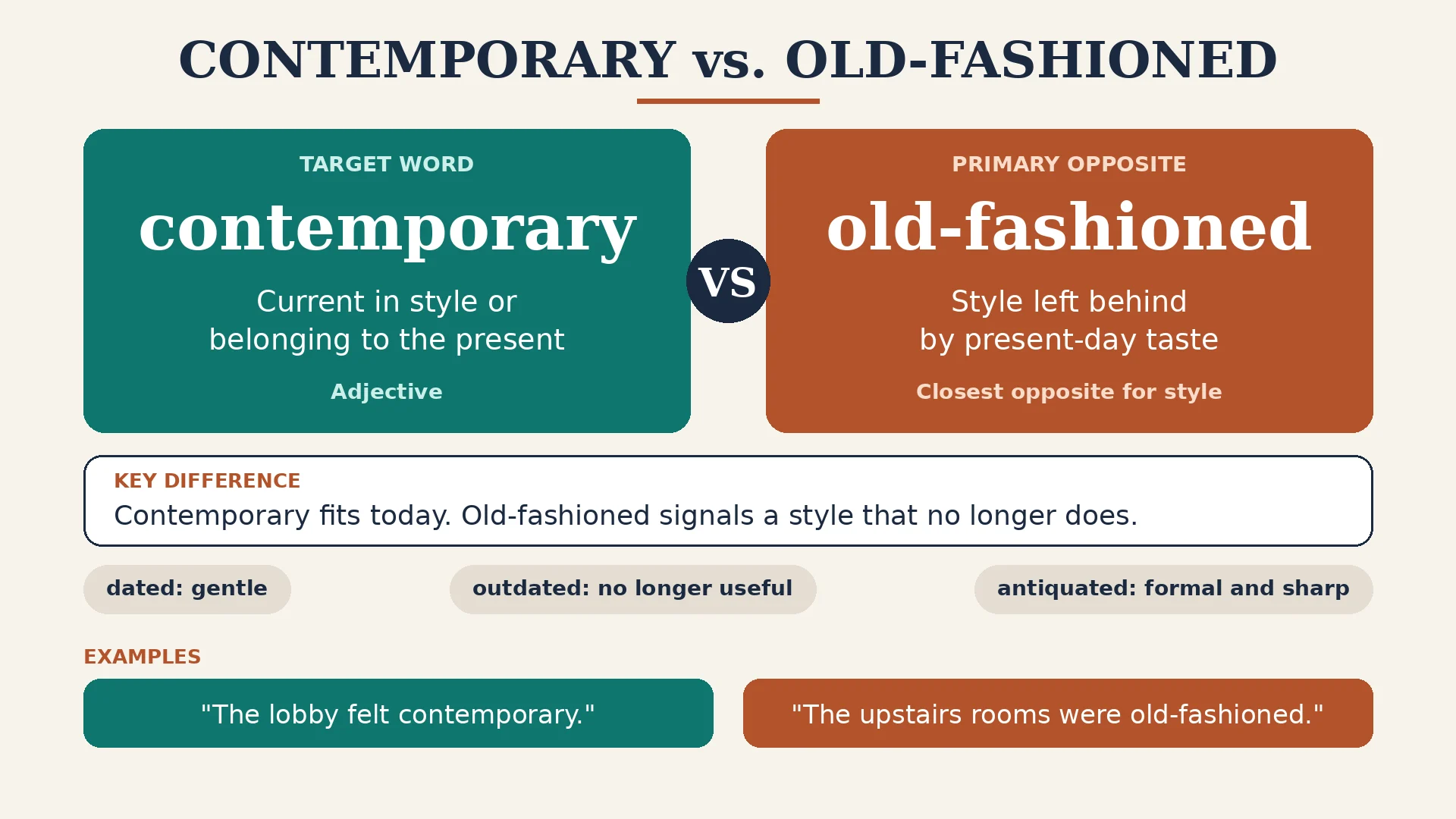
When contemporary means modern or current in style, the strongest opposite is old-fashioned. Contemporary also means existing at the same time as something else, a sense with no single antonym. Depending on tone and context, dated, outdated, and traditional can also work as contrasts.
Part of Speech: Adjective (also used as a noun)
Primary Opposite: old-fashioned
Contemporary most often describes something that belongs to the present era or reflects current taste. It also means existing at the same time as another person or event.
When contemporary means current in style, old-fashioned is the strongest direct opposite. Both words judge how well something matches present-day tastes, and old-fashioned says a style has been left behind. Dictionaries do not agree on one perfect antonym, because contemporary is a time-based word and its opposite shifts with the sense. The words below are the closest established contrasts, not a single fixed answer.
Example: “The lobby felt contemporary, but the guest rooms upstairs were frankly old-fashioned.”
Direct and Strong Antonyms
These words work best when contemporary means modern or current in style. They are gradable opposites, so each one sits at a different point on the scale.
| Antonym | Tone or Nuance | Example Sentence |
|---|---|---|
| old-fashioned | Neutral to mildly critical, common in everyday speech | “My grandfather still uses an old-fashioned razor and a brush.” |
| dated | Gentle, suggests a look tied to an earlier era | “The kitchen looked dated, with orange countertops and brass handles.” |
| outdated | Stronger, implies no longer useful or accurate | “Our outdated scheduling software slowed down the whole team.” |
| antiquated | Formal and sharp, often used in criticism | “The report called the county’s filing system antiquated.” |
Contextual and Subtle Opposites
No single word opposes every sense of contemporary. Start by deciding which meaning you need. The table below labels each pairing as contextual, because the opposite only works in that setting.
| Context | Best Opposite (Contextual) | Why It Fits |
|---|---|---|
| Style or design | old-fashioned, dated | Both signal a look that no longer feels current. |
| Technology or methods | outdated | It stresses that something has been replaced by better options. |
| Art, music, or literature | classical, traditional | These often serve as category labels set against present-day work. |
| Existing at the same time | earlier, later, or “from a different era” | English has no one-word antonym for this sense. |
| Noun: a peer from the same period | predecessor, successor | They describe people from other periods rather than the same one. |
The time sense deserves a closer look. Historians say a source is contemporary when it was written during the events it describes. Something written a century afterward is a later account, and no tidy single word captures that gap. A sentence like “Jane Austen and her contemporaries wrote about social class” contrasts best with a phrase such as “writers of earlier centuries.”
Strength and formality also change the pick. In a casual chat, you might call a haircut old-fashioned. In a business memo, you would more likely call a procedure outdated.
Words That Seem Opposite But Are Not
Common Grammatical or Semantic Confusions
Traditional is the most common mix-up. It is a related contrast, not an antonym. A tradition describes a practice handed down over time, and many traditions are alive and well today. A wedding can follow traditional customs and still be thoroughly contemporary in its photography, music, and venue. Traditional works as a contextual opposite only when people use it as a category in art or design.
Futuristic is the other frequent confusion. It points ahead of the present, while contemporary sits in the present, so the two are neighbors rather than opposites. A concept car can look futuristic while the showroom around it looks contemporary. Treating futuristic as an antonym would suggest that the present and the future cancel each other out, which they do not.
Subtle Tone Differences
Choosing among the opposites changes how your sentence lands.
Dated is the softest option. It describes a look more than a failure. “The logo feels a little dated” sounds like a design note, not an insult.
Outdated carries more weight. It suggests the thing has been overtaken. “The outdated safety manual no longer matches current regulations” is a practical complaint with real consequences.
Antiquated is the harshest of the four and fits formal writing or pointed criticism. Used in casual speech, it can sound theatrical.
Vintage and retro are related contrasts, not antonyms. They describe older styles that people often admire or choose on purpose. “She furnished the apartment with vintage lamps” is a compliment, while “dated lamps” is not.
Frequently Asked Questions
What is the opposite of contemporary?
There is no single perfect antonym. For style, old-fashioned is the closest opposite, and outdated or dated fit when something feels stale. For the sense of happening at the same time, phrases like earlier or from a different era work better than any one word.
What is the opposite of contemporary in art or design?
In art and design, contemporary labels present-day work, so traditional or classical often supplies the contrast. These are contextual opposites, not strict antonyms, because traditional work can still be made, bought, and enjoyed today.
Which opposite of contemporary should I use in a sentence?
Use outdated when something is no longer accurate or useful, such as software or a policy. Use old-fashioned for taste and personal style. Choose dated for a gentle design critique and antiquated for formal, sharper criticism.
Practical Word Choice
Tip 1: Identify the intended meaning. Ask whether you mean current in style, current in time, or simultaneous with something else. Each sense calls for a different opposite, and the simultaneous sense often needs a phrase instead of a single word.
Tip 2: Match the context, tone, strength, and formality. Pick dated for a light touch, old-fashioned for conversation, outdated for functional problems, and antiquated for formal criticism. If the word you pick sounds harsher than you intend, move one step down the scale.
Final Thoughts
The main distinction is simple. Contemporary describes what fits the present moment, and old-fashioned names the closest opposite when style is the point. Because the word also carries a time sense, one antonym cannot cover every use, and good writers say so plainly rather than forcing a match.
Context decides everything here. A decor choice, a software system, and a museum collection each call for a different contrast, and the tone you want determines how hard the word should hit. Words like traditional and futuristic sit nearby but describe different relationships, so they rarely make safe substitutes.
Before you settle on an opposite, name the exact sense you mean. That one habit prevents most word choice errors. What is the best example of something that feels contemporary in one setting and old-fashioned in another? Share yours in the comments.