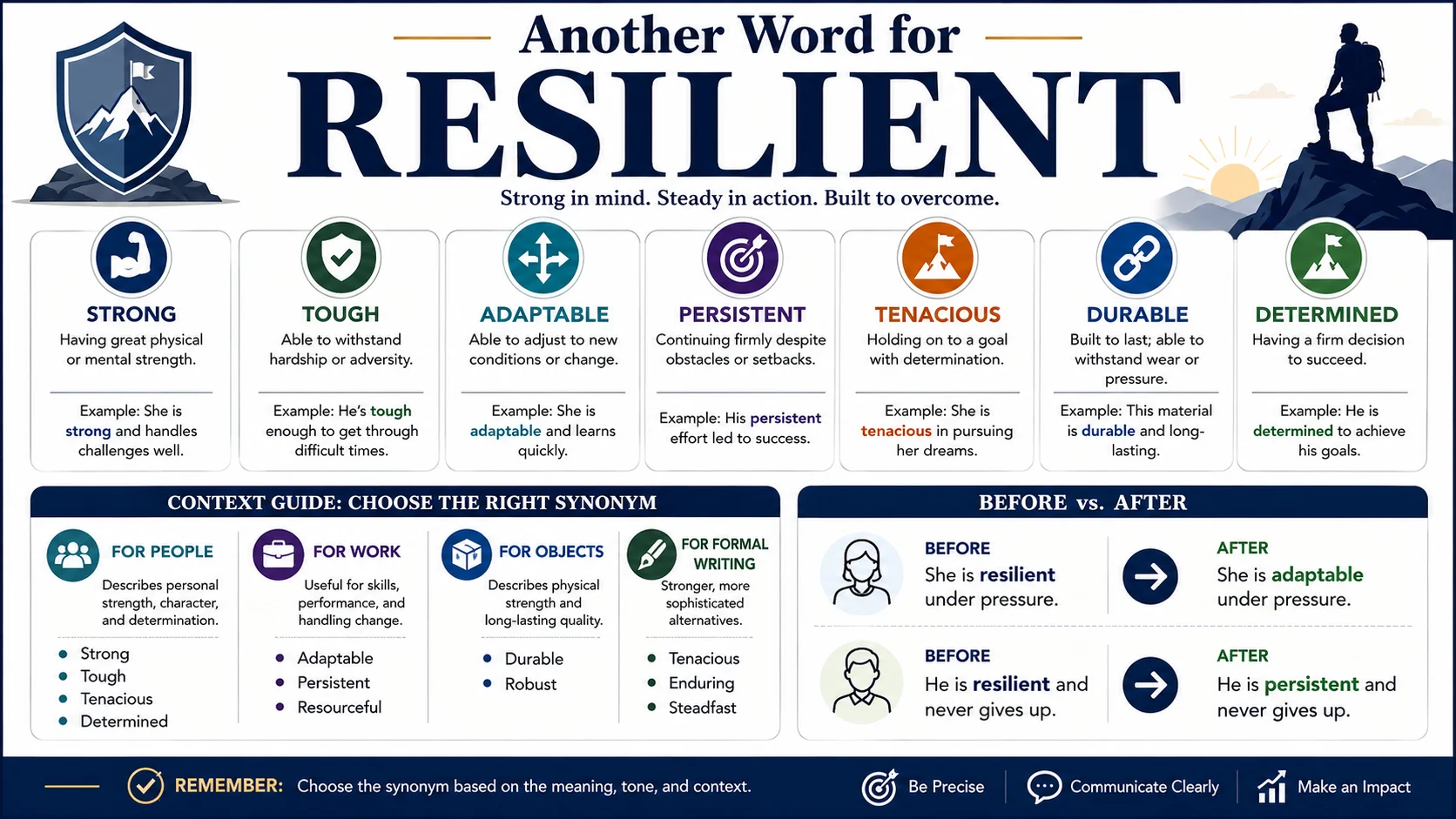
Another word for resilient is strong, tough, adaptable, persistent, tenacious, durable, or determined. The best synonym depends on the context. Use adaptable for handling change, persistent for continuing despite obstacles, tenacious for strong determination, and durable for something that withstands damage or wear.
What Does Resilient Mean?
Definition
Resilient describes someone or something that can recover, adapt, or continue functioning after facing difficulty, stress, damage, or change. It often suggests strength, flexibility, and the ability to bounce back rather than simply survive a difficult situation.
For example, you might describe a person as resilient after they recover from a major setback, or call a business resilient when it successfully adapts to difficult market conditions.
Common Uses
The word resilient commonly describes:
- People who recover from hardship
- Employees who handle workplace pressure
- Businesses that survive difficult conditions
- Communities that recover after disasters
- Materials that return to their original shape
- Systems that continue working after disruption
The best replacement depends on what kind of resilience you mean. Strong, tough, adaptable, persistent, and tenacious can all work, but they are not exact substitutes in every sentence.
Quick Answer: What Is Another Word for Resilient?
Another word for resilient is strong, tough, adaptable, persistent, tenacious, durable, flexible, or determined. The best choice depends on context. Use adaptable for handling change, persistent for continuing despite difficulty, and durable when describing something that withstands damage or wear.
Best Synonyms for Resilient
| Synonym | Meaning | Best Used When | Example |
|---|---|---|---|
| Strong | Able to withstand difficulty | General situations | She remained strong during a difficult year. |
| Tough | Able to handle hardship or pressure | People and difficult situations | He is tough enough to handle the challenge. |
| Adaptable | Able to adjust to change | Work, business, and changing circumstances | Successful employees are highly adaptable. |
| Persistent | Continuing despite obstacles | Goals, work, and personal effort | Her persistent approach helped her succeed. |
| Tenacious | Determined and unwilling to give up | Ambitious or challenging situations | The tenacious researcher continued testing the theory. |
| Durable | Able to withstand wear, damage, or pressure | Objects, products, and materials | This material is durable enough for outdoor use. |
| Flexible | Able to adjust easily | Plans, people, and systems | The flexible team quickly changed its strategy. |
| Determined | Firmly committed to achieving something | Personal goals | She was determined to finish the project. |
Strong
Strong is the simplest general alternative to resilient. It can describe physical strength, emotional strength, or the ability to withstand pressure.
Tone: Neutral
Difficulty: Easy
Usage Frequency: Very Common
Best for: Everyday conversation, essays, emails, and general writing
Business example: The company remained strong despite declining sales.
Academic example: Strong communities often recover more effectively after major disruptions.
Daily example: She stayed strong after the unexpected setback.
Adaptable
Adaptable is one of the best professional alternatives to resilient when the main idea involves adjusting to change.
Tone: Professional
Difficulty: Medium
Usage Frequency: Common
Best for: Resumes, business writing, workplace communication, and essays
Business example: We need adaptable employees who can respond quickly to changing customer needs.
Academic example: Adaptable organizations are often better prepared for technological changes.
Daily example: He’s very adaptable and can handle changes in plans without a problem.
Persistent
Persistent emphasizes continuing an effort even when something becomes difficult.
Tone: Neutral to positive
Difficulty: Medium
Usage Frequency: Common
Best for: Resumes, essays, academic writing, and professional communication
Business example: Her persistent efforts helped the team reach its sales target.
Academic example: Persistent research can eventually produce meaningful results.
Daily example: He was persistent and eventually solved the problem.
Tenacious
Tenacious is stronger than persistent. It suggests determination, resolve, and a refusal to give up.
Tone: Strong and positive
Difficulty: Advanced
Usage Frequency: Common
Best for: Resumes, professional writing, business profiles, and formal descriptions
Business example: The company succeeded because of its tenacious approach to solving customer problems.
Academic example: The tenacious researcher continued investigating the issue despite repeated failures.
Daily example: She’s a tenacious person who rarely gives up.
Synonyms by Context
Formal Writing
For formal writing, consider:
- Robust
- Durable
- Enduring
- Adaptable
- Tenacious
- Steadfast
Robust works particularly well when describing systems, organizations, methods, or structures that can withstand difficult conditions.
Example: The organization developed a robust response strategy for future disruptions.
Professional Writing
The strongest professional alternatives include:
- Adaptable
- Persistent
- Tenacious
- Flexible
- Determined
- Resourceful
For resumes, adaptable, persistent, and resourceful often sound more specific than simply saying someone is resilient.
Instead of:
I am a resilient employee.
Try:
I am an adaptable professional who performs effectively under changing conditions.
The second version tells the reader what the resilience looks like in practice.
Academic Writing
Academic alternatives depend on the subject.
Use persistent when discussing continued effort, adaptable when discussing responses to change, robust for systems or methods, and enduring for something that continues over time.
Example:
Resilient communities can recover from environmental disruption.
Could become:
Adaptable communities can respond effectively to environmental disruption.
Daily Conversation
In casual conversation, simpler words usually sound more natural.
Good choices include:
- Strong
- Tough
- Determined
- Flexible
- Persistent
Example:
She’s really resilient.
Natural alternatives:
She’s really strong.
She’s tough.
She doesn’t give up easily.
She always finds a way to move forward.
Professional Alternatives for Resilient
If you are writing a resume, cover letter, LinkedIn profile, or professional bio, choose a word that explains how someone demonstrates resilience.
Adaptable emphasizes handling change.
Resourceful emphasizes finding solutions when resources or options are limited.
Persistent emphasizes continued effort.
Tenacious emphasizes determination.
Steadfast emphasizes consistency and commitment.
Robust works better for systems, processes, strategies, and organizations than for describing a person.
For example:
Adaptable professional with experience managing changing priorities.
This is usually more informative than:
Resilient professional with experience managing changing priorities.
Simple Alternatives for Resilient
If you need an easy replacement, use:
- Strong
- Tough
- Flexible
- Determined
- Persistent
Strong is the broadest and easiest choice. Tough sounds more conversational. Flexible focuses on adjustment, while determined focuses on commitment.
Stronger Alternatives for Resilient
When you want to communicate exceptional resilience, consider:
- Tenacious
- Unyielding
- Steadfast
- Indomitable
- Unshakable
- Enduring
These words carry more intensity than ordinary alternatives.
For example:
She is resilient.
is relatively neutral.
She is tenacious.
suggests that she actively refuses to give up.
She is unyielding.
suggests that she does not easily change or surrender.
She is indomitable.
suggests an exceptionally strong ability to resist defeat.
Difference Between Similar Synonyms
Resilient vs. Strong:
Strong is broader. Resilient specifically suggests recovering or continuing after difficulty.
Resilient vs. Tough:
Tough emphasizes the ability to tolerate hardship. Resilient places more emphasis on recovery and adaptation.
Resilient vs. Persistent:
Persistent means continuing an effort. Resilient means recovering and functioning after setbacks.
Resilient vs. Adaptable:
Adaptable means adjusting to change. Resilient can include adaptation but also implies recovering from adversity.
Resilient vs. Durable:
Durable is usually used for physical objects, materials, products, or systems. Resilient is more commonly used for people, communities, organizations, and systems.
Resilient vs. Tenacious:
Tenacious describes someone who refuses to give up. Resilient focuses more on bouncing back after difficulty.
Resilient vs. Flexible:
Flexible means able to change or adjust. Resilient suggests the ability to withstand disruption and recover.
Opposite Words
Common opposites of resilient include:
- Fragile
- Vulnerable
- Weak
- Delicate
- Inflexible
- Unstable
- Defeated
- Susceptible
The exact opposite depends on context. Fragile works well for physical objects, while vulnerable often works better for people, organizations, and systems.
FAQs
What is another word for resilient?
Common alternatives include strong, tough, adaptable, persistent, tenacious, durable, flexible, and determined. The best synonym depends on whether you want to emphasize strength, recovery, adaptation, or persistence.
What is a formal synonym for resilient?
Robust, adaptable, enduring, tenacious, and steadfast can work as formal alternatives. Robust is especially useful for systems and organizations, while tenacious often describes people.
What is a professional alternative for resilient?
Adaptable is one of the best professional alternatives. Resourceful, persistent, tenacious, and flexible are also useful depending on the specific quality you want to emphasize.
What word can replace resilient on a resume?
Use adaptable, resourceful, persistent, tenacious, or determined. Choose the word that describes your actual behavior rather than simply replacing resilient with another vague adjective.
What is a stronger word for resilient?
Tenacious, unyielding, steadfast, indomitable, and unshakable can express stronger forms of resilience.
What is a simple word for resilient?
Strong or tough are the simplest alternatives. Strong works in more situations, while tough sounds more casual.
Is adaptable the same as resilient?
Not exactly. Adaptable means able to adjust to change, while resilient means able to withstand difficulty and recover or continue afterward. They overlap, but they emphasize different qualities.
Is persistent a synonym for resilient?
Persistent is a related synonym but not an exact match. Persistent emphasizes continuing an effort despite obstacles, while resilient emphasizes recovering from adversity or disruption.
What is the opposite of resilient?
Common opposites include fragile, vulnerable, weak, delicate, unstable, and inflexible. The most appropriate opposite depends on the sentence.
Which synonym for resilient is best for a resume?
Adaptable is often an excellent resume choice because it communicates the ability to handle change. Resourceful, persistent, and tenacious may be better when your experience specifically demonstrates problem-solving or determination.
Conclusion
The best alternative for resilient depends on the exact meaning you want to communicate. Choose strong for a simple general replacement, tough for a conversational tone, adaptable for handling change, persistent for continued effort, tenacious for exceptional determination, and durable for physical objects or systems.
When replacing resilient in professional or academic writing, avoid choosing a synonym only because it sounds impressive. The strongest word is the one that accurately describes the quality you want your reader to notice.