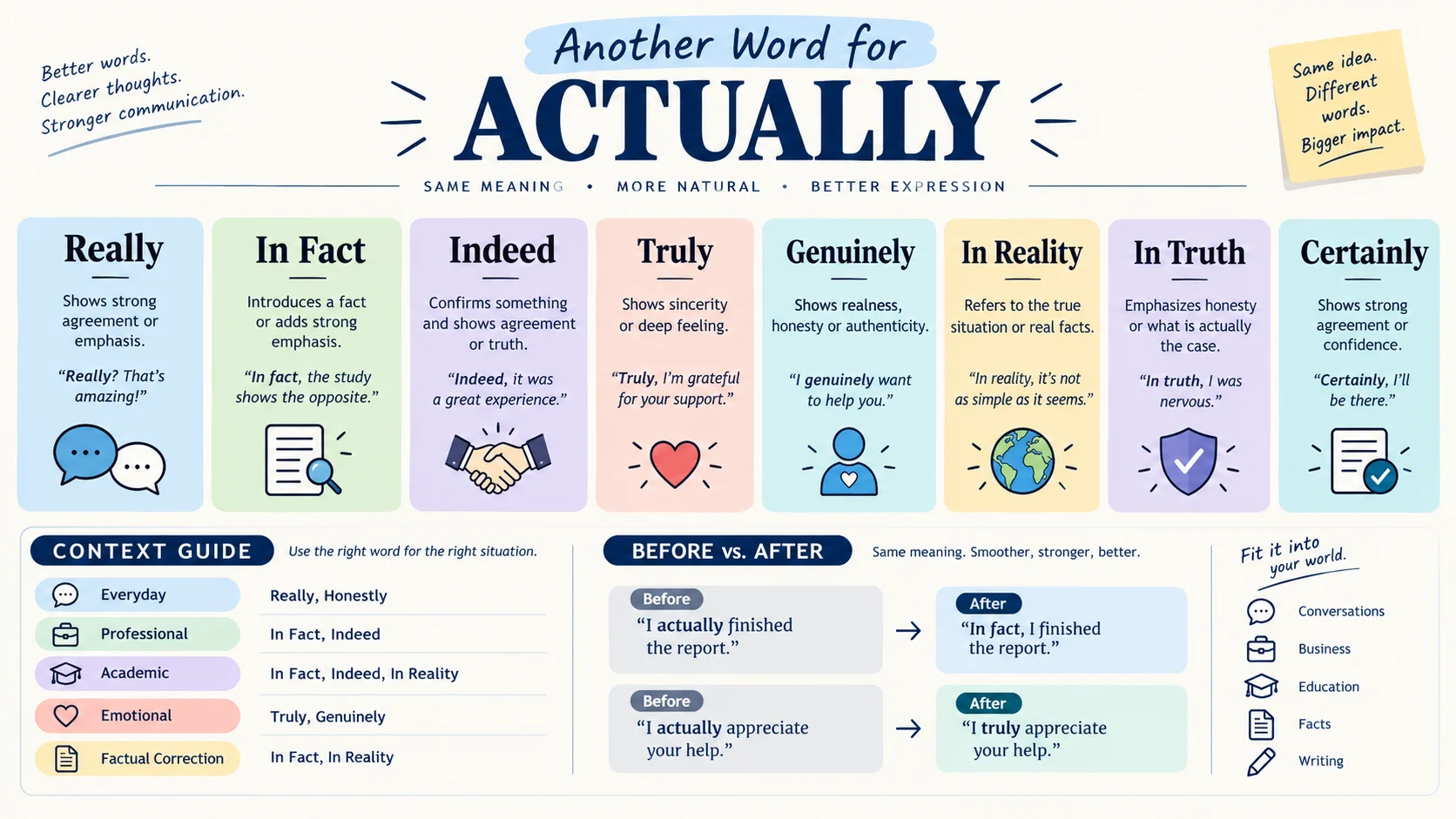
If you need another word for actually, the best choice depends on what you mean. Common alternatives include really, in fact, indeed, truly, genuinely, in reality, as a matter of fact, and in truth. For formal or academic writing, in fact, in reality, and indeed often work well, while really sounds more natural in everyday conversation.
What Does Actually Mean?
Definition
Actually is an adverb used to show that something is true, real, or different from what someone may have expected. It can also introduce a correction, clarification, or surprising fact.
For example:
- “I actually enjoyed the meeting.”
- “She thought I lived in Chicago, but I actually live in Dallas.”
- “The project was actually completed ahead of schedule.”
The word can emphasize the reality of a situation or correct an assumption.
Common Uses
Actually has several common uses in American English.
To state a fact:
“I actually finished the report yesterday.”
To correct information:
“Actually, the meeting starts at 10 a.m.”
To show surprise:
“He actually remembered my birthday.”
To emphasize truth:
“She actually knows the CEO.”
To contrast expectation with reality:
“The job was actually easier than I expected.”
Because its meaning changes slightly with context, there is no single replacement that works perfectly in every sentence.
Best Synonyms for Actually
| Synonym | Meaning | Best Used When | Example |
|---|---|---|---|
| Really | In truth; genuinely | Everyday conversation | “I really enjoyed the movie.” |
| In fact | In reality; as a matter of fact | Formal and factual writing | “In fact, sales increased by 20%.” |
| Indeed | Truly; certainly | Formal or polished writing | “The results were indeed impressive.” |
| Truly | Genuinely; sincerely | Emotional or formal contexts | “She is truly talented.” |
| Genuinely | Honestly; sincerely | Authentic feelings or qualities | “He was genuinely surprised.” |
| In reality | In the real situation | Contrast or clarification | “In reality, the process takes longer.” |
| In truth | Honestly; in reality | Reflective or formal writing | “In truth, the decision was difficult.” |
| As a matter of fact | In fact; emphasizing truth | Strong factual emphasis | “As a matter of fact, we already agreed.” |
| Certainly | Without doubt | Confident statements | “She certainly deserves recognition.” |
| Practically | Almost; nearly | When actually means nearly in a specific context | “The room was practically empty.” |
Really
Meaning: In truth, genuinely, or to a significant degree.
Best used for: Everyday speech, casual writing, conversations, and informal emails.
Tone: Natural and conversational
Difficulty: Easy
Usage Frequency: Very Common
Best for: Resume: Limited | Email: Yes | Essay: Sometimes | Marketing: Yes | Business: Yes
Business example: “We really value your feedback.”
Academic example: “The results really demonstrate the importance of early intervention.”
Daily conversation: “I really thought you were joking.”
“Really” is one of the most natural replacements for “actually,” but it does not always preserve the exact meaning. When “actually” corrects a misconception, in fact may be more precise.
In Fact
Meaning: In reality; used to emphasize that something is true.
Best used for: Factual, professional, academic, and explanatory writing.
Tone: Formal to neutral
Difficulty: Easy
Usage Frequency: Very Common
Business example: “In fact, customer satisfaction increased during the quarter.”
Academic example: “In fact, previous studies reported similar findings.”
Daily conversation: “In fact, I already told him.”
“In fact” is often one of the strongest direct alternatives when “actually” introduces a fact or correction.
Indeed
Meaning: Truly, certainly, or as stated.
Best used for: Formal writing, academic work, professional communication, and polished prose.
Tone: Formal
Difficulty: Medium
Usage Frequency: Common
Business example: “The proposal was indeed valuable to the organization.”
Academic example: “The evidence indeed supports this conclusion.”
Daily conversation: “Indeed, that was a surprising result.”
“Indeed” can sound more formal than “actually,” so it may feel unnatural in casual conversation.
Truly
Meaning: Genuinely, sincerely, or really.
Best used for: Emotional statements, formal writing, and expressions of sincerity.
Tone: Neutral to formal
Difficulty: Easy
Usage Frequency: Common
Business example: “We are truly grateful for your continued support.”
Academic example: “The discovery was truly significant.”
Daily conversation: “I truly appreciate your help.”
Genuinely
Meaning: In a sincere, authentic, or real way.
Best used for: Describing authentic emotions, reactions, interest, or qualities.
Tone: Neutral
Difficulty: Medium
Usage Frequency: Common
Business example: “The manager was genuinely interested in employee feedback.”
Academic example: “Participants were genuinely concerned about the issue.”
Daily conversation: “I was genuinely surprised.”
In Reality
Meaning: In the real situation, rather than what was assumed or believed.
Best used for: Contrast, clarification, reports, essays, and analytical writing.
Tone: Formal
Difficulty: Easy
Usage Frequency: Common
Business example: “The forecast appeared positive, but in reality, costs were rising.”
Academic example: “The theory appears simple, but in reality, several factors influence the outcome.”
Daily conversation: “It looks easy, but in reality, it takes a lot of practice.”
Synonyms by Context
Formal Writing
For formal writing, choose words that clearly communicate facts without sounding overly conversational.
Good choices include:
- In fact
- Indeed
- In reality
- In truth
- As a matter of fact
Example:
Instead of:
“The results actually show a significant difference.”
You could write:
“In fact, the results show a significant difference.”
Professional Writing
In business communication, clarity usually matters more than emphasis.
Useful alternatives include:
- In fact
- Indeed
- Genuinely
- In reality
- Certainly
Example:
“We actually completed the project ahead of schedule.”
Professional alternative:
“In fact, we completed the project ahead of schedule.”
Academic Writing
Academic writing benefits from precise language. Depending on the sentence, in fact, indeed, in reality, and in truth can replace “actually.”
Example:
“The study actually produced different results.”
More formal:
“In fact, the study produced different results.”
However, academic writers should avoid replacing every occurrence mechanically. Sometimes removing “actually” altogether produces a cleaner sentence.
Daily Conversation
In casual American English, really is usually the most natural alternative.
Other options include:
- Honestly
- Truly
- In fact
- For real
- Genuinely
Example:
“I actually like this restaurant.”
Natural alternatives:
“I really like this restaurant.”
or
“Honestly, I like this restaurant.”
Professional Alternatives for Actually
When writing an email, report, presentation, or workplace message, consider these alternatives:
In fact is useful when correcting or emphasizing information.
Indeed works when you want a more formal tone.
In reality works when contrasting expectations with what happened.
Certainly works when expressing confidence.
Genuinely works when discussing authentic feelings or interest.
As a matter of fact strongly emphasizes a factual point, although it can sound somewhat conversational.
For example:
“We actually received more applications than expected.”
Professional versions include:
“In fact, we received more applications than expected.”
“The organization received more applications than expected.”
The second version also demonstrates an important writing principle: sometimes the strongest replacement for “actually” is no replacement at all.
Simple Alternatives for Actually
If you want easy words that most readers immediately understand, use:
- Really
- Truly
- In fact
- Honestly
- Certainly
- Indeed
For example:
Original: “She actually completed the assignment.”
Simple: “She really completed the assignment.”
Clearer: “She completed the assignment.”
The best choice depends on whether “actually” adds useful meaning. If removing it does not change the message, deleting it may make the sentence stronger.
Stronger Alternatives for Actually
When you want stronger emphasis, these expressions can work:
- In fact
- Indeed
- As a matter of fact
- In reality
- Truly
- Genuinely
- Without a doubt
Example:
“The plan actually worked.”
Stronger:
“In fact, the plan worked.”
Or:
“The plan genuinely worked.”
These choices are not interchangeable in every situation. “Genuinely” emphasizes authenticity, while “in fact” emphasizes factual confirmation.
Difference Between Similar Synonyms
Actually vs. Really
Actually often corrects an assumption or highlights reality.
Really commonly emphasizes degree, sincerity, or personal reaction.
Compare:
“I actually live in Boston.”
This suggests someone assumed you lived somewhere else.
“I really live in Boston.”
This can sound less natural if the goal is to correct an assumption.
Actually vs. In Fact
These are often interchangeable when introducing or emphasizing a fact.
“Actually, the store closes at 8.”
“In fact, the store closes at 8.”
“In fact” generally sounds more deliberate and formal.
Actually vs. Indeed
“Indeed” tends to sound more formal.
“The results were actually impressive.”
“The results were indeed impressive.”
The second sentence has a more polished or formal tone.
Actually vs. Truly
“Truly” emphasizes sincerity or genuine quality.
“She actually cares about the project.”
“She truly cares about the project.”
The first may correct an assumption. The second emphasizes the sincerity of her feelings.
Actually vs. Literally
These words should not automatically be treated as synonyms.
Actually means in reality or in truth.
Literally traditionally means that something is true in the exact or non-figurative sense, although it is also widely used as an intensifier in informal English.
For precise writing, use them carefully.
Other Words You Can Use Instead of Actually
Depending on the sentence, these alternatives may work:
For factual emphasis:
- In fact
- Indeed
- In reality
- In truth
For sincerity:
- Truly
- Genuinely
- Honestly
For casual emphasis:
- Really
- Seriously
- For real
For certainty:
- Certainly
- Definitely
- Without a doubt
For correction:
- In fact
- Rather
- To be precise
- More accurately
Not every word in these groups is a direct synonym. The correct choice depends on the specific meaning of “actually” in the sentence.
Opposite Words
The opposite of actually depends on its meaning.
When “actually” means in reality, possible contrasts include:
- Apparently
- Supposedly
- Theoretically
- Hypothetically
- Fictionally
For example:
“The story supposedly happened.”
This contrasts with a statement presented as established reality.
When “actually” is used to correct an assumption, phrases such as as expected, apparently, or in theory may provide contextual contrasts, but they are not direct antonyms in every sentence.
FAQs
What is another word for actually?
Common alternatives for actually include really, in fact, indeed, truly, genuinely, in reality, and in truth. The best replacement depends on whether you are emphasizing a fact, correcting an assumption, expressing sincerity, or speaking casually.
What is a formal synonym for actually?
In fact, indeed, in reality, and in truth are useful formal alternatives. “In fact” is particularly natural in professional and academic writing when emphasizing or clarifying information.
What is a professional alternative for actually?
In fact is often the most useful professional alternative. Depending on the sentence, indeed, in reality, genuinely, or certainly may also work.
What word can replace actually?
You can replace “actually” with really, in fact, indeed, truly, genuinely, in reality, or honestly, depending on the intended meaning and tone.
What is another word for actually in an essay?
For an essay, consider in fact, indeed, in reality, or in truth. However, if “actually” does not add meaning, removing it can create a cleaner sentence.
What is another word for actually in a sentence?
The best replacement depends on the sentence. For example, “I actually finished it” can become “I really finished it,” while “Actually, the answer is different” can become “In fact, the answer is different.”
Is “really” the same as “actually”?
Not always. “Really” often expresses emphasis or degree, while “actually” commonly emphasizes reality or corrects an assumption. They overlap in some contexts but are not perfect synonyms.
Is “indeed” a synonym for actually?
Yes, in some contexts. “Indeed” can mean truly or certainly and can replace “actually” when the sentence calls for formal emphasis. It may sound more formal than the original word.
Can I use “in fact” instead of actually?
Yes. “In fact” is one of the closest alternatives when “actually” is being used to emphasize a fact or correct an assumption.
Is actually formal or informal?
“Actually” is neutral and works in both formal and informal English. However, repeated use in professional or academic writing can sometimes make sentences wordier, so alternatives such as “in fact” or simply removing the word may improve clarity.
Conclusion
The best another word for actually depends on what you want the sentence to communicate. Really is a natural choice for everyday conversation, while in fact works especially well for factual, professional, and academic writing. Indeed provides a more formal tone, truly emphasizes sincerity, and in reality works well when contrasting assumptions with what is true.
Before choosing a synonym, identify the purpose of “actually” in your sentence. If it corrects an assumption, try in fact. If it expresses genuine feeling, consider truly or genuinely. If it simply adds unnecessary emphasis, deleting it may be the clearest option.