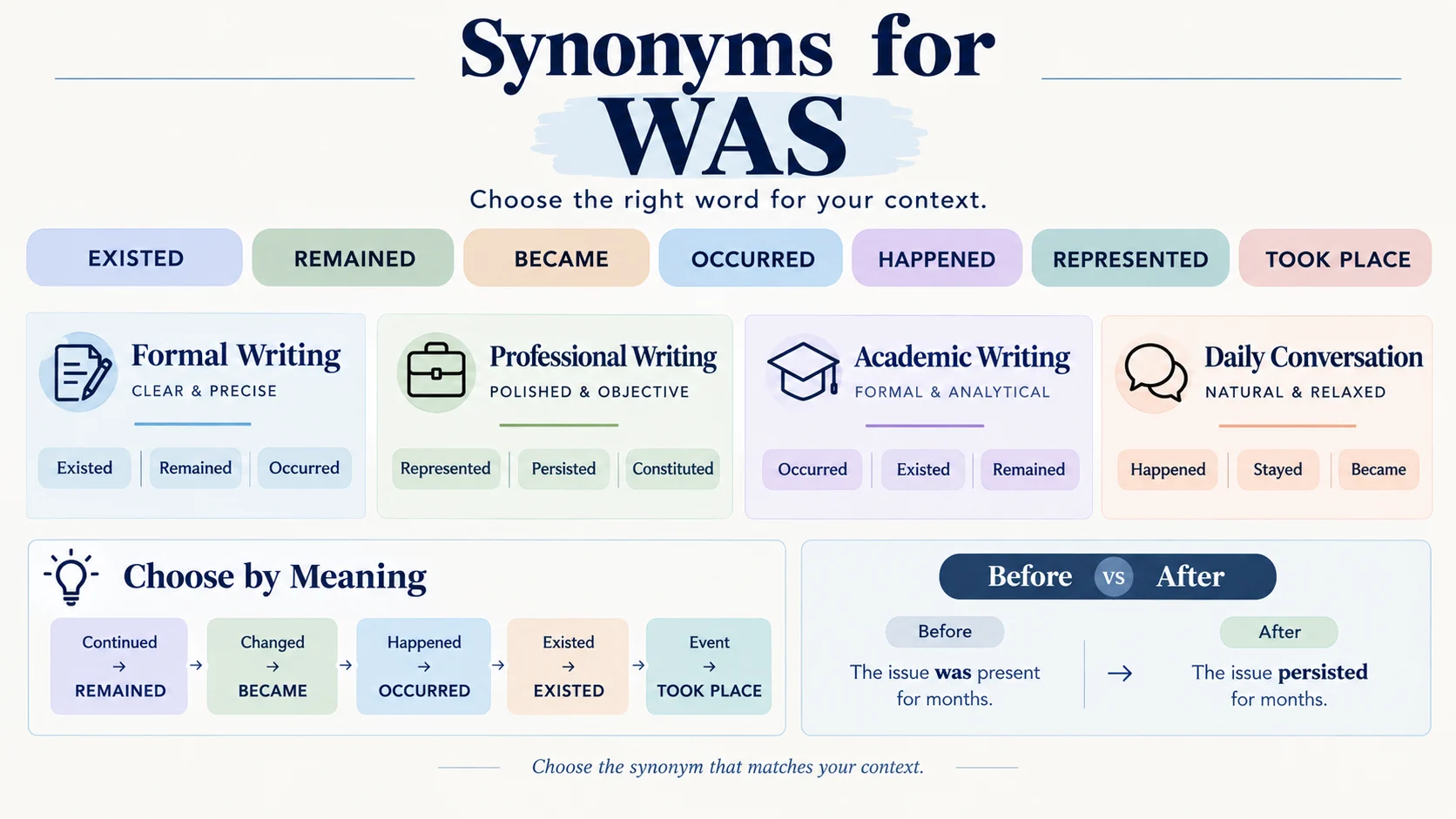
Another word for “was” depends on the context. Common alternatives include existed, remained, became, occurred, happened, represented, stood, lived, and took place. Since “was” can describe a past state, identity, location, or condition, the best replacement should match the exact meaning of the sentence.
What Does Was Mean?
Definition
Was is the past-tense form of “be” used with singular subjects such as I, he, she, it, and singular nouns. It describes a past state, condition, identity, location, or situation.
For example:
- I was tired.
- She was a teacher.
- The meeting was successful.
- He was at home.
- The report was completed yesterday.
Because was is a form of the verb be, it does not have many true one-word synonyms. Instead, the best replacement depends on what was means in the sentence. Words such as existed, remained, became, occurred, and represented may work in specific contexts, but they cannot replace was everywhere.
Common Uses
Was commonly expresses:
- A past condition: She was nervous.
- A past identity: He was the manager.
- A past location: The book was on the desk.
- A past description: The movie was exciting.
- A past situation: The company was in trouble.
- A passive construction: The project was completed.
- A past event or state: The conference was on Monday.
This context matters when choosing another word for was.
Quick Answer: What Is Another Word for Was?
Another word for was depends on the sentence. Possible alternatives include existed, remained, became, occurred, represented, stood, lived, happened, took place, and continued to be. However, these are contextual alternatives rather than exact synonyms, so the original sentence should always be checked for meaning and grammar.
Best Synonyms for Was
| Synonym or Alternative | Meaning | Best Used When | Example |
|---|---|---|---|
| Existed | Had a real presence | Talking about existence | A similar problem existed before. |
| Remained | Continued in the same state | Describing an unchanged condition | The issue remained unresolved. |
| Became | Changed into a new state | Showing transformation | The situation became difficult. |
| Occurred | Happened | Describing an event | The incident occurred last night. |
| Happened | Took place | Everyday conversation | The meeting happened yesterday. |
| Took place | Happened at a particular time or location | Events and formal writing | The ceremony took place in June. |
| Represented | Stood for or symbolized | Business, academic, and analytical writing | The result represented a major change. |
| Stood | Was positioned or located | Physical location or condition | The building stood near the river. |
| Lived | Had a residence or existence | People and living things | She lived in Chicago. |
| Continued to be | Stayed in a particular state | Formal descriptions | The policy continued to be effective. |
Existed
Meaning: Had actual existence or presence.
Best Used For: Describing something that was present or real in the past.
Tone: Formal and neutral
Difficulty: Easy
Usage Frequency: Common
Business Example: A communication gap existed between the two departments.
Academic Example: Evidence of the phenomenon existed before the study began.
Daily Conversation Example: A small store existed here years ago.
Remained
Meaning: Continued to be in the same condition or position.
Best Used For: Situations where something did not change.
Tone: Neutral to formal
Difficulty: Easy
Usage Frequency: Very Common
Business Example: The contract remained valid throughout the year.
Academic Example: The results remained consistent across both groups.
Daily Conversation Example: She remained quiet during the conversation.
Became
Meaning: Changed into a particular state or condition.
Best Used For: Sentences involving change.
Tone: Neutral
Difficulty: Easy
Usage Frequency: Very Common
Business Example: The project became more expensive than expected.
Academic Example: The material became unstable under extreme conditions.
Daily Conversation Example: He became tired after the long drive.
Synonyms by Context
Formal Writing
In formal writing, replacing was can make a sentence more specific when the intended meaning involves existence, continuation, location, or transformation.
Useful alternatives include:
- Existed
- Remained
- Occurred
- Represented
- Constituted
- Comprised
- Took place
- Continued to be
For example:
Original: The problem was present throughout the study.
More specific: The problem persisted throughout the study.
Here, persisted is more precise because it tells the reader that the problem continued rather than simply existed.
Professional Writing
Professional writing benefits from precise verbs rather than unnecessary substitutions.
Instead of:
The company was successful in the previous year.
You might write:
The company performed well in the previous year.
Instead of:
The meeting was on Tuesday.
You could write:
The meeting took place on Tuesday.
The second version emphasizes the event itself.
Academic Writing
Academic writing often benefits from verbs that describe relationships, changes, or evidence more precisely.
Instead of:
The results were different between the groups.
Consider:
The results differed between the groups.
Instead of:
The research was an important contribution.
Consider:
The research represented an important contribution.
The best alternative depends on what the writer actually wants to communicate.
Daily Conversation
In everyday American English, was is often already the most natural choice.
For example:
I was tired yesterday.
Replacing it with a more formal expression can make the sentence sound unnatural.
However, alternatives can work when the meaning changes:
I was in New York last week.
can become:
I stayed in New York last week.
This changes the emphasis from location to the fact that the speaker stayed there.
Professional Alternatives for Was
When writing an email, report, resume, proposal, or business document, choose a verb that explains the action or condition more clearly.
Useful alternatives include:
Existed: Best for describing a problem, condition, or situation that had a presence.
Remained: Useful when something continued without changing.
Represented: Helpful when discussing importance, meaning, or significance.
Occurred: Appropriate for incidents, events, or processes.
Took place: A clear alternative for meetings, conferences, ceremonies, and other events.
Constituted: Formal alternative meaning “formed or made up.”
Comprised: Useful when describing what something consisted of, although sentence construction should be checked carefully.
Persisted: Strong choice when an undesirable condition continued over time.
For example:
The issue was present for several months.
could become:
The issue persisted for several months.
The second sentence gives the reader more information.
Simple Alternatives for Was
If you need easy words instead of was, consider:
- Existed
- Stayed
- Remained
- Happened
- Became
- Lived
- Stood
- Occurred
Remember that these words are not interchangeable in every sentence.
For example:
She was happy.
cannot normally become:
She existed happy.
The intended meaning must remain intact.
Stronger Alternatives for Was
A stronger alternative can make a sentence more precise rather than simply more complicated.
| Instead of | Consider | Why |
|---|---|---|
| was continuing | persisted | Shows continuation |
| was changing | transformed | Shows significant change |
| was happening | occurred | More formal |
| was successful | excelled | Shows strong performance |
| was important | mattered / proved significant | Adds meaning |
| was located | stood / sat | Can make location more vivid |
| was present | existed / persisted | Clarifies presence or continuation |
| was becoming | developed into | Shows progression |
The goal is not to eliminate was. The goal is to use a more precise verb when one improves the sentence.
Difference Between Similar Synonyms
Was vs. Existed
Was can describe a state, identity, condition, or location. Existed specifically emphasizes presence or reality.
The problem was serious.
The problem existed for years.
The second sentence focuses on the problem’s continued presence.
Was vs. Remained
Was simply describes a past state. Remained suggests that the state continued.
The door was open.
The door remained open.
The second sentence indicates that the door stayed open.
Was vs. Became
These words express different ideas.
Was describes a state.
The room was quiet.
Became describes a change.
The room became quiet.
Using became tells the reader that the room changed from another condition to quietness.
Was vs. Occurred
Was can describe many things. Occurred means something happened.
The accident was serious.
The accident occurred at noon.
These sentences communicate different information, so occurred cannot simply replace was.
Was vs. Happened
Happened is an everyday alternative for describing an event.
The incident happened yesterday.
A more formal version might be:
The incident occurred yesterday.
Neither word can replace was when was describes identity, condition, or location.
Opposite Words
Because was is a grammatical form of be, it does not have one universal opposite. The opposite depends on the meaning of the sentence.
Examples include:
- Was present → was absent
- Was open → was closed
- Was active → was inactive
- Was available → was unavailable
- Was alive → was dead
- Was successful → was unsuccessful
In some contexts, the present-tense form is may contrast with was, but is is not an opposite. It simply refers to a present state rather than a past one.
FAQs
What is another word for was?
Possible contextual alternatives include existed, remained, became, occurred, happened, represented, stood, lived, and took place. The correct choice depends on the meaning of the original sentence.
What is a formal synonym for was?
Formal alternatives include existed, remained, occurred, represented, constituted, and took place. However, each has a different meaning, so the original sentence should determine the replacement.
What is a professional alternative for was?
Professional alternatives include remained, represented, occurred, persisted, constituted, and took place. Specific verbs are often better than replacing was mechanically.
What word can replace was?
There is no single replacement that works in every sentence. Words such as existed, remained, became, occurred, and represented can replace was in particular contexts.
What is another word for was in an essay?
For an essay, consider precise verbs such as existed, remained, occurred, represented, constituted, or persisted when their meanings fit the sentence.
What is another word for was in a sentence?
The best alternative depends on the sentence. If was means “continued,” use remained. If it means “happened,” use occurred or happened. If it means “changed into,” use became.
Can “was” and “existed” be used interchangeably?
No. Was has many grammatical functions, while existed specifically describes something having existence or presence.
Is “became” a synonym for “was”?
Not exactly. Became describes a change into a new condition, while was describes a state or condition. They can overlap in some contexts but are not interchangeable.
What is a better word than was in professional writing?
A more specific verb may be better when it communicates the intended action or condition. Examples include remained, occurred, persisted, represented, and constituted.
Should I avoid using “was” in academic writing?
No. Was is grammatically correct and often necessary. Avoiding it simply to sound more sophisticated can make writing awkward. Replace it only when a more precise verb improves clarity.
Conclusion
There is no single perfect synonym for was. Since was is a past-tense form of be, its meaning changes according to the sentence. Existed emphasizes presence, remained emphasizes continuation, became describes change, occurred describes an event, and represented can express significance or meaning.
For everyday writing, was is often the clearest and most natural choice. In professional or academic writing, a more specific verb can make the sentence stronger when it adds useful information. The best replacement is therefore the word that preserves the original meaning while making the sentence clearer and more precise.