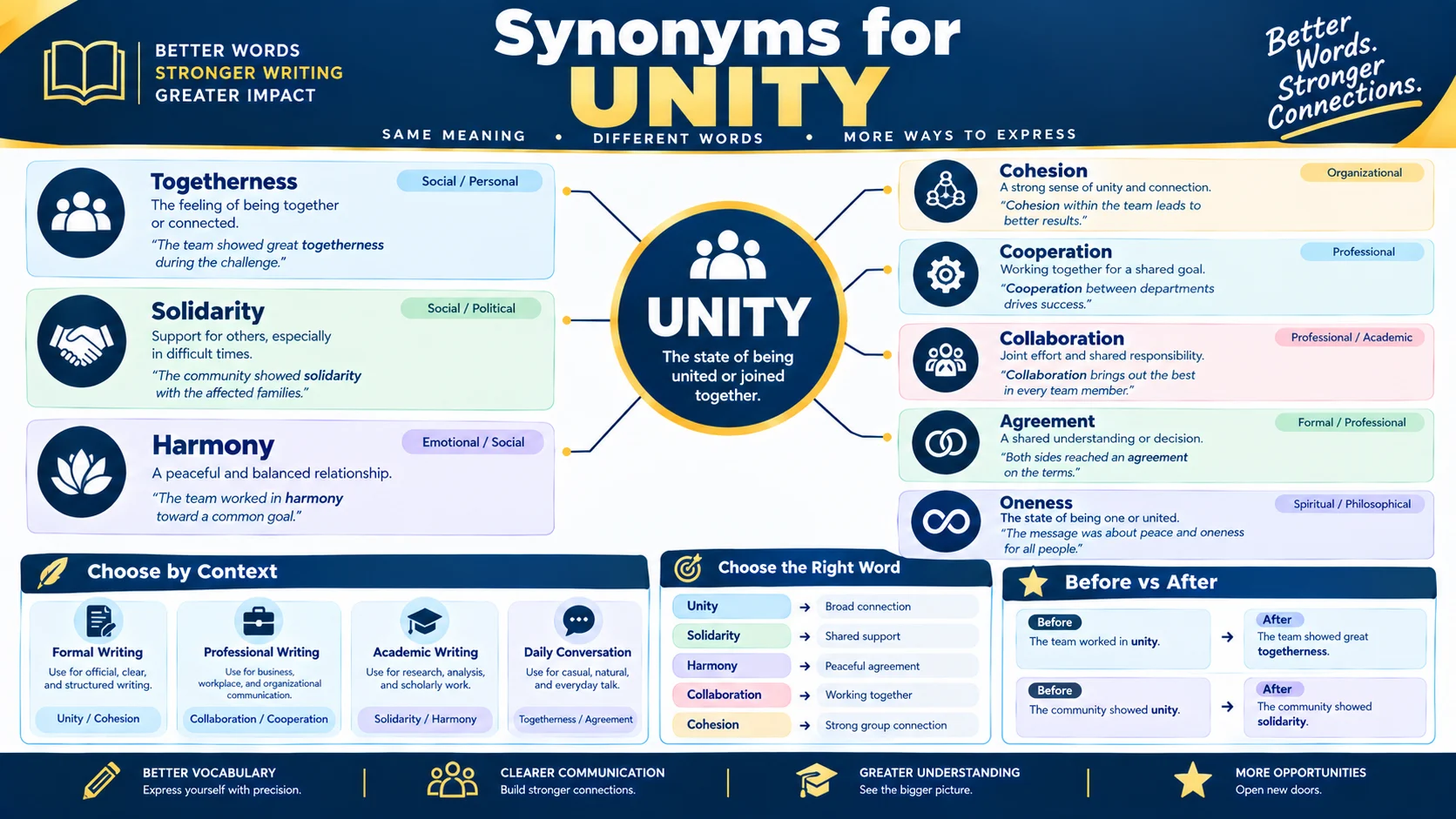
Another word for unity is solidarity, which refers to people standing together with a shared purpose or support for one another. Other common synonyms include togetherness, harmony, cohesion, cooperation, collaboration, agreement, and oneness. The best synonym depends on the context, whether you’re describing teamwork, peaceful relationships, community support, or a strong group connection.
What Does Unity Mean?
Definition
Unity means a state of being joined, connected, or in agreement around a shared purpose, idea, group, or goal. It can describe people working together, peaceful relationships, or different parts forming one whole.
For example, a community may show unity when its members work together after a difficult event. A company can demonstrate unity when employees cooperate toward the same objective.
The best synonym depends on what kind of unity you mean. Solidarity emphasizes mutual support, while harmony focuses on agreement and peaceful relationships. Togetherness sounds warmer and more personal, while cohesion is often more suitable for academic or professional writing.
Common Uses
The word unity commonly appears in discussions about:
- Communities and families
- Teamwork and cooperation
- Politics and social movements
- Business and organizations
- Schools and academic groups
- Relationships
- Peace and agreement
- Shared goals and values
- National or cultural identity
- Creative or visual design
Because the word covers several related ideas, choosing a more precise synonym can make your writing clearer and more natural.
Best Synonyms for Unity
Here are some of the most useful alternatives to unity in American English:
| Synonym | Meaning | Best Used When | Example |
|---|---|---|---|
| Togetherness | A feeling of being connected | Families, friends, communities | The holiday brought a sense of togetherness. |
| Solidarity | Mutual support for a shared cause | Social, political, or workplace contexts | The workers showed solidarity during the negotiations. |
| Harmony | Peaceful agreement or balance | Relationships and groups | The team worked together in harmony. |
| Cohesion | Strong connection among members or parts | Academic and professional writing | Team cohesion improved after the training. |
| Cooperation | Working together to achieve something | Business, school, and daily life | Cooperation helped the departments finish the project. |
| Collaboration | Working jointly on a task or project | Professional and academic settings | Collaboration between the two teams produced better results. |
| Agreement | Having the same opinion or decision | Discussions and decisions | The committee reached an agreement. |
| Oneness | A state of being one or closely connected | Philosophical, spiritual, or emotional contexts | The experience created a feeling of oneness. |
| Concord | Peaceful agreement or harmony | Formal or literary writing | The leaders sought concord between the communities. |
| Alliance | A partnership formed for a shared purpose | Organizations, countries, or groups | The companies formed an alliance. |
| Integration | Combining separate parts into one functioning whole | Organizations, systems, and society | The integration of the teams took several months. |
| Solidarity | Shared support and commitment | Causes, groups, and difficult situations | The community expressed solidarity with the affected families. |
Togetherness
Meaning: A feeling of closeness, connection, and shared belonging.
Tone: Warm and personal
Difficulty: Easy
Usage Frequency: Common
Best for: Family writing, personal messages, community stories, lifestyle content.
Business example: The company retreat encouraged togetherness among employees.
Academic example: Researchers examined how shared activities can strengthen social togetherness.
Daily conversation: Sunday dinners give our family a real sense of togetherness.
Solidarity
Meaning: Unity based on shared interests, goals, responsibilities, or support.
Tone: Strong and purposeful
Difficulty: Medium
Usage Frequency: Common
Best for: Professional writing, social issues, organizations, public statements, and formal communication.
Business example: Employees demonstrated solidarity during the organizational changes.
Academic example: The study explores solidarity among members of local communities.
Daily conversation: We stood in solidarity with our friend during a difficult time.
Harmony
Meaning: Peaceful agreement, cooperation, or balance between people or things.
Tone: Positive and balanced
Difficulty: Easy
Usage Frequency: Very Common
Best for: Relationships, teams, communities, music, design, and general writing.
Business example: Effective communication helps departments work in harmony.
Academic example: The paper examines the relationship between cultural diversity and social harmony.
Daily conversation: The siblings live together in harmony.
Cohesion
Meaning: The quality of sticking together as a connected or effective group.
Tone: Professional and analytical
Difficulty: Advanced
Usage Frequency: Common
Best for: Academic essays, business reports, organizational writing, and research.
Business example: Strong team cohesion can improve communication and productivity.
Academic example: Social cohesion is an important factor in building resilient communities.
Daily conversation: The group has more cohesion now that everyone understands their role.
Cooperation
Meaning: The act of working together toward a shared result.
Tone: Neutral and practical
Difficulty: Easy
Usage Frequency: Very Common
Best for: Business writing, school assignments, workplace communication, and everyday speech.
Business example: The project succeeded because of cooperation between the two departments.
Academic example: International cooperation can help address environmental challenges.
Daily conversation: Thanks for your cooperation while we sorted everything out.
Collaboration
Meaning: Working together to create, develop, or accomplish something.
Tone: Professional and constructive
Difficulty: Medium
Usage Frequency: Very Common
Best for: Resumes, business writing, academic work, marketing, and project descriptions.
Business example: The campaign was created through collaboration between the marketing and design teams.
Academic example: The research resulted from collaboration among several universities.
Daily conversation: We finished the presentation through close collaboration.
Synonyms by Context
Formal Writing
For formal writing, choose words that describe the specific type of unity rather than simply replacing unity with another general word.
Good options include solidarity, cohesion, concord, cooperation, collaboration, integration, and harmony.
For example:
The initiative promoted unity among community members.
A more precise version could be:
The initiative promoted social cohesion among community members.
Here, cohesion gives the sentence a more specific academic and social meaning.
Professional Writing
In business and workplace writing, collaboration, cooperation, cohesion, alignment, and solidarity can work well.
For example:
The project requires unity across departments.
You could write:
The project requires cross-departmental collaboration.
This version explains what the employees actually need to do.
For a resume, collaboration is often more action-oriented than unity:
Improved cross-functional collaboration to streamline project delivery.
Academic Writing
Academic writing benefits from precise terminology. Depending on the subject, useful alternatives include social cohesion, solidarity, integration, cooperation, concord, and collective agreement.
For example:
Community unity contributes to social stability.
A more specific version is:
Social cohesion contributes to community stability.
The second sentence identifies the particular type of connection being discussed.
Daily Conversation
In casual American English, togetherness, harmony, agreement, cooperation, and closeness usually sound natural.
For example:
The family showed unity during the crisis.
A warmer alternative is:
The family showed togetherness during the crisis.
If you are talking about people simply getting along, harmony may be a better choice.
Professional Alternatives for Unity
If you need a professional alternative to unity, consider:
Collaboration: Best for people actively working together.
Cooperation: Best for coordinated effort.
Cohesion: Best for describing a connected and effective group.
Alignment: Best when people or departments share goals, priorities, or strategies.
Solidarity: Best when people support one another around a shared interest or cause.
Integration: Best when separate groups or systems are combined.
For a resume, phrases such as team collaboration, cross-functional cooperation, organizational cohesion, and strategic alignment can communicate a more specific professional skill than simply saying unity.
Simple Alternatives for Unity
If you want an easy word that most readers will understand, use:
- Togetherness
- Agreement
- Teamwork
- Cooperation
- Harmony
- Closeness
- Team spirit
- Working together
For example:
Original: The event promoted unity.
Simple: The event promoted togetherness.
Original: Unity among employees improved.
Simple: Teamwork among employees improved.
Stronger Alternatives for Unity
Some alternatives communicate a stronger or more purposeful form of unity.
Solidarity suggests people actively supporting one another.
Alliance suggests a formal or strategic partnership.
Cohesion suggests a group is strongly connected and functions as a whole.
Collective action emphasizes people acting together toward a goal.
Concord suggests strong agreement and peaceful relations, although it has a more formal or literary tone.
The strongest choice depends on the sentence. Unity itself does not always imply active cooperation, while collective action does.
Difference Between Similar Synonyms
Unity vs. Solidarity
Unity is a broad term for being joined or acting as one.
Solidarity specifically emphasizes mutual support, often in response to a shared challenge, identity, interest, or cause.
Unity vs. Harmony
Unity emphasizes being joined together.
Harmony emphasizes peaceful agreement or balance.
A group can have unity because its members share a goal, while harmony suggests that they also interact peacefully.
Unity vs. Cooperation
Unity describes a state of being joined or united.
Cooperation describes the act of working together.
For example, a team can have unity, while its members demonstrate cooperation by sharing responsibilities.
Unity vs. Collaboration
Collaboration usually involves people actively working together on a project or task.
Use collaboration when you want to emphasize joint effort rather than simply being united.
Unity vs. Cohesion
Cohesion describes how strongly the members or parts of a group hold together.
It is especially useful in academic, organizational, scientific, and technical contexts.
Unity vs. Togetherness
Togetherness has a warmer, more emotional meaning.
It works especially well for families, friendships, communities, and personal experiences.
Opposite Words
Common antonyms of unity include:
- Division
- Disagreement
- Conflict
- Separation
- Disunity
- Discord
- Fragmentation
- Isolation
- Opposition
- Disconnection
The appropriate opposite depends on the context. For example, division describes people being separated into groups, while discord emphasizes disagreement or a lack of harmony.
FAQs
What is another word for unity?
Common synonyms for unity include togetherness, solidarity, harmony, cohesion, cooperation, collaboration, agreement, oneness, and concord. The best replacement depends on context. Use togetherness for emotional connection, solidarity for shared support, cohesion for groups, and collaboration for people working together.
What is a formal synonym for unity?
Cohesion, solidarity, concord, integration, and cooperation can serve as formal synonyms for unity. In academic writing, cohesion and social cohesion are particularly useful when discussing how strongly people or groups remain connected.
What is a professional alternative for unity?
Professional alternatives include collaboration, cooperation, cohesion, alignment, solidarity, and integration. Collaboration is useful when employees work together on a project, while alignment works well when teams share business goals or priorities.
What word can replace unity in an essay?
Depending on the meaning, you can replace unity with cohesion, solidarity, harmony, cooperation, collaboration, agreement, or togetherness. Choose the word that describes the exact relationship you want to communicate rather than using a synonym simply for variety.
What is another word for unity in a team?
Teamwork, collaboration, cooperation, cohesion, and team spirit are useful alternatives. Cohesion emphasizes how well team members function as a connected group, while collaboration emphasizes working jointly on tasks.
What is another word for unity in a family?
Togetherness, closeness, harmony, solidarity, and bond can describe unity within a family. Togetherness is especially natural when referring to shared experiences and emotional connection.
What is the opposite of unity?
Common opposites include division, disunity, conflict, discord, separation, fragmentation, and disagreement. The best antonym depends on whether you mean social separation, interpersonal conflict, or a lack of agreement.
Is solidarity the same as unity?
Not exactly. Solidarity is a type of unity based on shared support, interests, or commitments. Unity is broader and can describe people or things being joined without necessarily implying active support for a cause.
Is harmony a synonym for unity?
Yes, in some contexts. Harmony can mean unity or agreement, especially when people coexist peacefully. However, harmony places more emphasis on balance and peaceful relationships, whereas unity can simply mean being joined around a shared purpose.
What is a strong synonym for unity?
Solidarity can be a strong alternative when unity involves active mutual support. Cohesion can also communicate strong group connection, while collective action emphasizes people actively working together toward a common goal.
Conclusion
The best synonym for unity depends on what you want to emphasize. Use togetherness for warmth and emotional connection, solidarity for shared support, harmony for peaceful relationships, cooperation for working together, collaboration for joint projects, and cohesion for a strongly connected group.
Instead of replacing unity automatically, first identify the idea behind it. That small distinction can make a resume more precise, an essay more academic, a business document more professional, or everyday writing more natural.