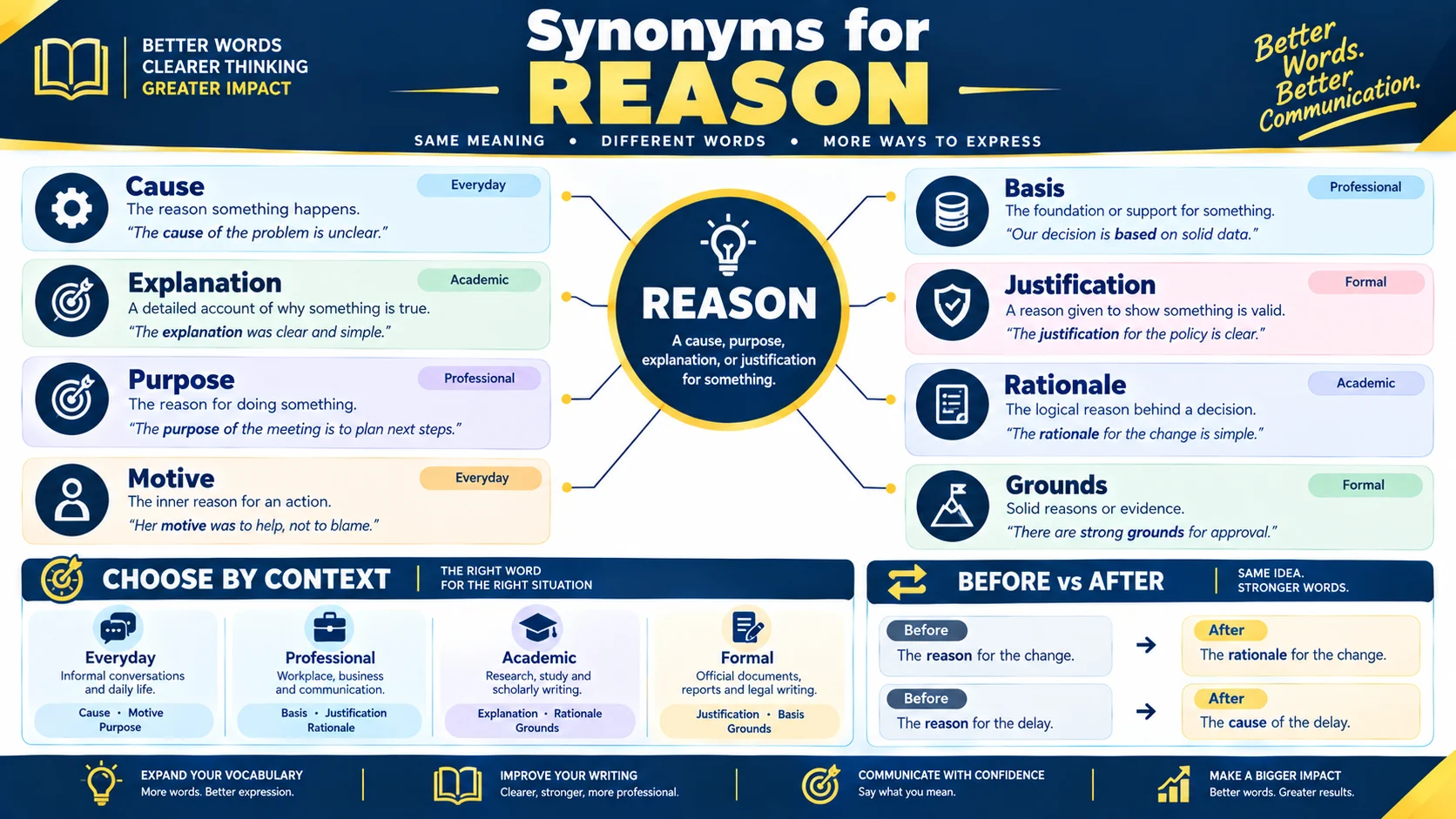
Another word for reason can be cause, explanation, purpose, motive, basis, justification, rationale, or grounds. The best synonym depends on context. Use cause for why something happened, purpose for an intended goal, motive for an underlying intention, and rationale or justification in formal and professional writing.
What Does Reason Mean?
Definition
The word reason generally refers to a cause, explanation, purpose, or justification for something. It can also describe the ability to think logically and make sensible judgments.
For example:
- There is a reason why the meeting was canceled.
- What is the reason for your decision?
- Her reason for applying was to gain professional experience.
- He used reason rather than emotion to solve the problem.
Because reason has several meanings, there is no single synonym that works in every sentence. Choosing the right alternative depends on what you mean.
Common Uses
Reason is commonly used to describe:
- The cause of an event
- An explanation for an action
- A purpose or objective
- A motive behind someone’s behavior
- A justification for a decision
- A logical basis for an argument
- Rational thinking or judgment
This distinction is important when choosing a synonym. For example, cause usually explains why something happened, while purpose explains what someone hopes to achieve.
Best Synonyms for Reason
| Synonym | Meaning | Best Used When | Example |
|---|---|---|---|
| Cause | Something that makes an event happen | Explaining an event | Lack of funding was the cause of the delay. |
| Explanation | Information that makes something clear | Giving details about why something happened | She provided an explanation for the error. |
| Purpose | The intended goal of an action | Discussing objectives | The purpose of the meeting is to review the project. |
| Motive | A reason behind someone’s action | Discussing intentions | Investigators examined his motive. |
| Basis | The foundation for an idea or decision | Formal and professional writing | The decision was made on the basis of new evidence. |
| Justification | A reason that supports or defends an action | Defending a decision | The manager requested justification for the expense. |
| Rationale | A logical explanation for a decision | Academic and professional writing | The report explains the rationale behind the policy. |
| Grounds | A factual or logical basis for something | Formal arguments and decisions | The complaint was filed on legal grounds. |
| Logic | A system of rational thinking | Arguments and reasoning | I understand the logic behind your proposal. |
| Consideration | A factor taken into account | Decisions and planning | Cost was an important consideration. |
| Incentive | Something that encourages an action | Business and motivation | The bonus was an incentive to improve performance. |
| Factor | Something that contributes to a result | Analysis and explanation | Weather was a major factor in the delay. |
Synonyms by Context
Formal Writing
In formal writing, stronger alternatives to reason include rationale, justification, grounds, basis, explanation, and cause.
For example:
Basic:
The reason for the change was unclear.
More formal:
The rationale for the change was unclear.
Basic:
The company explained the reason for its decision.
More formal:
The company explained the basis for its decision.
The best choice depends on what you are trying to communicate. Rationale emphasizes logical thinking, while justification suggests that an action or decision needs to be defended.
Professional Writing
In business communication, useful alternatives include basis, rationale, purpose, factor, justification, and cause.
Business example:
“The primary reason for the restructuring was increased operating costs.”
Possible alternatives:
- The primary cause of the restructuring was increased operating costs.
- The primary factor behind the restructuring was increased operating costs.
- The rationale for the restructuring was to reduce operating costs.
For resumes, reports, proposals, and workplace emails, choosing a precise synonym can make your writing clearer without making it unnecessarily complicated.
Academic Writing
Academic writing often benefits from words such as cause, basis, rationale, explanation, grounds, and factor.
For example:
Basic:
One reason for the decline was changing consumer behavior.
Academic:
One factor contributing to the decline was changing consumer behavior.
Another option is:
“The cause of the decline was linked to changes in consumer behavior.”
Use cause when you are identifying what produced an outcome. Use factor when several influences may have contributed to the outcome.
Daily Conversation
For everyday conversation, simple alternatives usually sound more natural.
Common choices include:
- Why
- Cause
- Explanation
- Purpose
- Point
For example:
“What’s the reason you left early?”
can naturally become:
“Why did you leave early?”
In casual speech, why is often the simplest replacement when reason means an explanation.
Professional Alternatives for Reason
If you need a professional alternative, consider the exact meaning:
Rationale
Meaning: The logical thinking behind a decision or action.
Tone: Formal and professional
Difficulty: Advanced
Usage Frequency: Common
Best for: Business writing, reports, academic writing, proposals.
Business Example:
“The director explained the rationale behind the revised pricing strategy.”
Academic Example:
“The study presents a clear rationale for selecting this methodology.”
Daily Conversation Example:
“I understand the rationale behind your choice.”
Basis
Meaning: The foundation or supporting grounds for an idea or decision.
Tone: Formal and neutral
Difficulty: Medium
Usage Frequency: Very Common
Best for: Business writing, academic writing, professional emails.
Business Example:
“The decision was made on the basis of customer feedback.”
Justification
Meaning: A reason or evidence used to defend an action or decision.
Tone: Formal
Difficulty: Medium
Usage Frequency: Common
Best for: Business writing, academic writing, formal communication.
Business Example:
“The finance team requested justification for the additional expense.”
Simple Alternatives for Reason
If you want an easy replacement, these words are usually the most accessible:
- Cause
- Why
- Purpose
- Explanation
- Point
- Motive
Cause works when something produces an outcome.
The storm was the cause of the flight cancellation.
Purpose works when someone explains the intended goal.
The purpose of the survey is to collect customer feedback.
Explanation works when someone provides information about why something happened.
She gave an explanation for the mistake.
Why is especially natural in everyday questions.
What is the reason you called?
becomes:
Why did you call?
Stronger Alternatives for Reason
Some alternatives provide a more specific or formal meaning than reason.
Rationale suggests logical thinking behind a decision.
Justification suggests support for an action that may need defending.
Grounds suggests a factual or legal basis.
Motive emphasizes the intention behind someone’s behavior.
Basis emphasizes the foundation supporting an idea, decision, or argument.
For example:
- “What was the reason for the decision?”
- “What was the rationale for the decision?”
- “What was the basis for the decision?”
- “What was the justification for the decision?”
These sentences are similar, but each highlights a slightly different idea.
Difference Between Similar Synonyms
Reason vs. Cause
Reason is broader. Cause specifically identifies something responsible for an event or result.
- The reason I missed the meeting was a scheduling conflict.
- The power outage was the cause of the system failure.
Reason vs. Purpose
Reason can explain why something happens. Purpose describes the intended goal.
- What is the reason for the delay?
- What is the purpose of the meeting?
Reason vs. Motive
Motive usually refers to the underlying intention behind someone’s behavior.
- The reason she moved was a new job.
- Investigators wanted to determine his motive.
Reason vs. Explanation
An explanation is information given to make something understandable.
- There must be a reason for the change.
- She gave an explanation for the change.
Reason vs. Rationale
Rationale is more specific and formal. It usually refers to the logical thinking supporting a decision.
- We need a reason for the change.
- We need to understand the rationale behind the change.
Reason vs. Justification
A justification supports or defends an action, especially when that action may be questioned.
- He gave a reason for missing the deadline.
- He provided a justification for missing the deadline.
Opposite Words
The appropriate opposite of reason depends on which meaning you intend.
When reason means logical thinking, possible opposites include:
- Irrationality
- Unreason
- Illogic
- Emotionality
When reason means a cause or explanation, there is no single perfect antonym. Depending on the sentence, concepts such as meaninglessness, randomness, or lack of explanation may provide the intended contrast.
FAQs
What is another word for reason?
Common alternatives for reason include cause, explanation, purpose, motive, basis, justification, rationale, grounds, and factor. The correct choice depends on whether you mean a cause, goal, explanation, intention, or supporting argument.
What is a formal synonym for reason?
Rationale, basis, justification, and grounds are strong formal synonyms for reason. Rationale is especially useful when discussing the logical thinking behind a decision.
What is a professional alternative for reason?
For professional writing, rationale, basis, factor, justification, cause, and purpose can replace reason. Choose the word according to the specific meaning of the sentence.
What word can replace reason in an essay?
Useful academic alternatives include cause, factor, rationale, basis, explanation, and grounds. Avoid replacing reason automatically because these words have different meanings.
What is another word for the reason why?
Depending on context, you can use cause, explanation, basis, rationale, or simply why. In many sentences, removing “the reason why” and using “why” creates a cleaner sentence.
What is another word for a good reason?
Depending on context, alternatives include valid basis, sound justification, compelling reason, strong rationale, or legitimate grounds.
What is another word for the main reason?
You can use primary cause, main factor, principal reason, underlying cause, or key factor. The best option depends on whether you are describing a direct cause or one contributing factor.
What is another word for reason in an argument?
Basis, rationale, grounds, justification, and support can work when reason refers to something supporting an argument or conclusion.
What is another word for reason for an action?
Motive, purpose, cause, justification, or rationale may work. Motive is particularly appropriate when discussing the intention behind someone’s behavior.
Is rationale the same as reason?
Not exactly. Rationale is a type of reason that explains the logical thinking behind a decision, plan, or action. It is more formal and specific than the general word reason.
Conclusion
The best synonym for reason depends on the meaning you want to express. Use cause for something that produces an outcome, purpose for an intended goal, motive for an underlying intention, explanation for clarifying information, basis for supporting grounds, and rationale for the logic behind a decision.
For everyday writing, simple words such as cause and explanation are often the clearest choices. For professional or academic writing, rationale, basis, justification, factor, and grounds can provide greater precision.