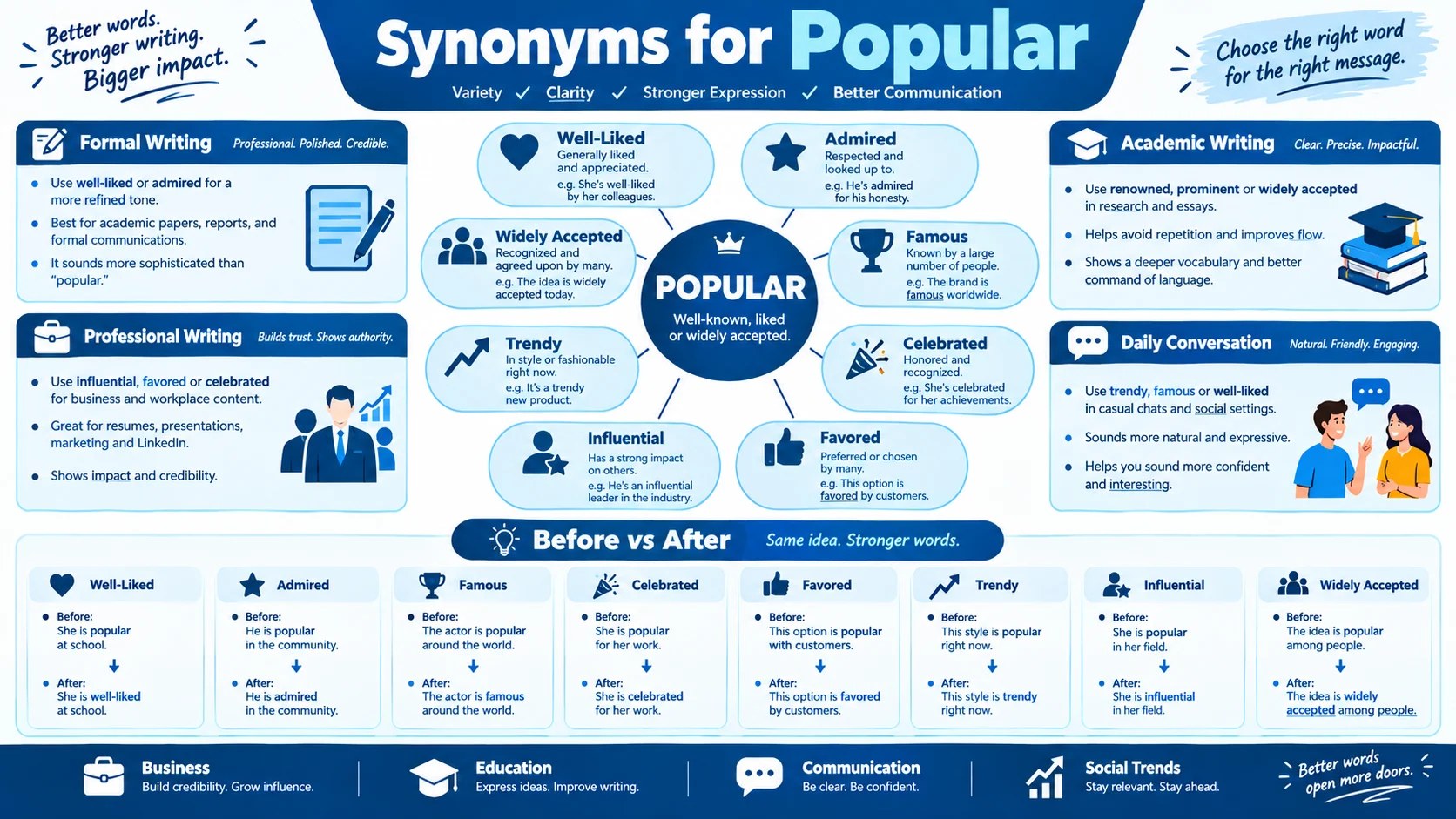
Another word for popular is well-liked. Depending on the context, you can also use famous, admired, celebrated, successful, favored, trendy, or widely accepted. The best synonym depends on whether you’re describing a person, product, idea, brand, trend, or achievement.
What Does Popular Mean?
Definition
The word popular describes someone or something that is liked, admired, accepted, supported, or enjoyed by many people. It can refer to people, products, entertainment, ideas, social trends, services, brands, or public figures.
Common Uses
The word appears in many everyday and professional situations:
- A popular student at school
- A popular restaurant in town
- A popular social media trend
- A popular product among customers
- A popular opinion among voters
- A popular television show
Because the word is used so often, writers frequently search for alternatives that provide more precision and variety.
Best Synonyms for Popular
| Synonym | Meaning | Best Used When | Example |
|---|---|---|---|
| Well-liked | Liked by many people | People and groups | She is well-liked by her coworkers. |
| Famous | Known by many people | Public figures and brands | The actor became famous worldwide. |
| Admired | Respected and appreciated | Professional and personal settings | He is admired for his leadership skills. |
| Celebrated | Widely recognized and praised | Achievements and accomplishments | She is a celebrated author. |
| Favored | Preferred over alternatives | Business and consumer contexts | This option is favored by customers. |
| Trendy | Currently fashionable | Fashion and social trends | Oversized jackets remain trendy. |
| Successful | Widely accepted and effective | Products and businesses | The campaign was highly successful. |
| Influential | Able to affect others’ decisions | Ideas and individuals | She is an influential content creator. |
| Widely accepted | Approved by many people | Academic and professional writing | The theory is widely accepted. |
| In demand | Frequently wanted | Products and services | The new device is in high demand. |
Synonyms by Context
Choosing the right replacement depends on how the word is being used.
Formal Writing
In formal writing, words such as widely accepted, favored, respected, and admired often work better than popular.
Examples:
- The methodology is widely accepted within the field.
- The professor is highly admired by colleagues.
- This approach remains favored among researchers.
Professional Writing
Business communication benefits from more specific alternatives.
Common choices include:
- Preferred
- In demand
- Successful
- Well-received
- Favored
Examples:
- The product remains in high demand across the market.
- The proposal was well-received by stakeholders.
- This software is preferred by large organizations.
Academic Writing
Academic writing usually avoids vague language whenever possible.
Useful alternatives:
- Widely accepted
- Established
- Recognized
- Influential
- Prominent
Examples:
- The theory is widely accepted by scholars.
- The researcher remains a prominent figure in the discipline.
- The framework has become highly influential.
Daily Conversation
For casual conversations, simple replacements often sound more natural.
Examples:
- Well-liked
- Loved
- Trendy
- Famous
- Favorite
Sentences:
- That coffee shop is everyone’s favorite.
- She’s one of the most well-liked people in the office.
- This song is really trendy right now.
Professional Alternatives for Popular
When writing resumes, business reports, emails, or marketing content, the following words can sound more polished.
Preferred
Indicates that people choose something over alternatives.
Business Example:
Customers preferred the updated mobile app.
Academic Example:
The preferred methodology produced consistent results.
Daily Example:
I prefer this restaurant because the service is faster.
Well-Received
Shows positive reactions from an audience.
Business Example:
The product launch was well-received by customers.
Academic Example:
The presentation was well-received by conference attendees.
Daily Example:
Her speech was well-received by everyone at the event.
In Demand
Highlights strong interest or market value.
Business Example:
Cybersecurity professionals remain in demand.
Academic Example:
Graduates with technical skills are increasingly in demand.
Daily Example:
Those concert tickets are in demand.
Favored
Suggests preference or support.
Business Example:
The premium package is favored by enterprise clients.
Academic Example:
The model is favored due to its reliability.
Daily Example:
Chocolate is favored over vanilla in our family.
Simple Alternatives for Popular
Sometimes straightforward language is best.
Well-Liked
Meaning: Liked by many people.
Tone: Friendly and conversational
Difficulty: Easy
Usage Frequency: Very Common
Best For: Emails, conversations, workplace communication
Business Example:
She is a well-liked manager.
Academic Example:
The instructor was well-liked by students.
Daily Example:
He’s well-liked in the neighborhood.
Loved
Meaning: Strongly liked or appreciated.
Tone: Warm and positive
Difficulty: Easy
Usage Frequency: Very Common
Best For: Marketing, social media, conversation
Business Example:
The product is loved by customers.
Academic Example:
The book remains loved by readers worldwide.
Daily Example:
That movie is loved by fans.
Favorite
Meaning: Most preferred among choices.
Tone: Casual
Difficulty: Easy
Usage Frequency: Very Common
Best For: Everyday communication
Business Example:
It’s a customer favorite.
Academic Example:
The text became a student favorite.
Daily Example:
Pizza is my favorite food.
Stronger Alternatives for Popular
Some situations require a more powerful word.
Celebrated
Meaning: Publicly praised and recognized.
Tone: Formal
Difficulty: Medium
Usage Frequency: Common
Best For: Awards, achievements, biographies
Business Example:
The company hired a celebrated designer.
Academic Example:
A celebrated historian led the research.
Daily Example:
The restaurant is celebrated for its cuisine.
Influential
Meaning: Able to shape opinions or behavior.
Tone: Professional
Difficulty: Medium
Usage Frequency: Common
Best For: Leadership, marketing, media
Business Example:
She is an influential industry leader.
Academic Example:
The paper became highly influential.
Daily Example:
He is influential within the community.
Prominent
Meaning: Important and widely recognized.
Tone: Formal
Difficulty: Medium
Usage Frequency: Common
Best For: Academic and professional writing
Business Example:
A prominent technology company sponsored the event.
Academic Example:
A prominent scholar reviewed the findings.
Daily Example:
He became a prominent figure in local politics.
Synonym Analysis System
Well-Liked
- Meaning: Liked by many people
- Best Used For: People and groups
- Tone: Friendly
- Difficulty: Easy
- Usage Frequency: Very Common
- Resume: Moderate
- Email Writing: Excellent
- Essay Writing: Good
- Marketing Copy: Good
- Business Writing: Good
Admired
- Meaning: Respected and appreciated
- Best Used For: Professionals and leaders
- Tone: Professional
- Difficulty: Medium
- Usage Frequency: Common
- Resume: Excellent
- Email Writing: Excellent
- Essay Writing: Excellent
- Marketing Copy: Good
- Business Writing: Excellent
Celebrated
- Meaning: Widely praised and recognized
- Best Used For: Major achievements
- Tone: Formal
- Difficulty: Medium
- Usage Frequency: Common
- Resume: Good
- Email Writing: Moderate
- Essay Writing: Excellent
- Marketing Copy: Excellent
- Business Writing: Good
Influential
- Meaning: Able to affect decisions and opinions
- Best Used For: Leaders and ideas
- Tone: Professional
- Difficulty: Medium
- Usage Frequency: Common
- Resume: Excellent
- Email Writing: Good
- Essay Writing: Excellent
- Marketing Copy: Excellent
- Business Writing: Excellent
Difference Between Similar Synonyms
Many synonyms of popular are related but not identical.
Popular vs Famous
Popular means liked by many people.
Famous means widely known.
Someone can be famous without being popular, and popular without being famous.
Example:
- The actor is famous worldwide.
- The teacher is popular among students.
Popular vs Trendy
Popular may remain true for years.
Trendy often describes something fashionable for a shorter period.
Example:
- Basketball is popular.
- A particular sneaker style may be trendy.
Popular vs Influential
Popular focuses on approval.
Influential focuses on impact.
Example:
- A singer may be popular.
- A researcher may be influential.
Opposite Words
Antonyms for popular include:
| Opposite Word | Meaning |
|---|---|
| Unpopular | Not liked by many people |
| Disliked | Viewed negatively |
| Rejected | Not accepted |
| Ignored | Receiving little attention |
| Unfavored | Not preferred |
| Obscure | Not widely known |
| Unknown | Not recognized by many people |
FAQs
What is another word for popular?
The most common alternatives include well-liked, famous, admired, favored, celebrated, and widely accepted.
What is a formal synonym for popular?
Formal alternatives include admired, respected, prominent, influential, and widely accepted.
What is a professional alternative for popular?
Professional writing often uses preferred, well-received, in demand, favored, or successful.
What word can replace popular in an essay?
Good essay alternatives include widely accepted, influential, prominent, recognized, and established.
Is famous the same as popular?
No. Famous means widely known, while popular means widely liked or supported.
What is the strongest synonym for popular?
Depending on context, strong choices include celebrated, influential, prominent, and admired.
Conclusion
The best synonym for popular depends entirely on context. For everyday situations, well-liked, favorite, and loved work naturally. In professional writing, preferred, well-received, and in demand often sound more precise. Academic and formal writing may benefit from alternatives such as widely accepted, prominent, influential, or admired. Instead of automatically repeating the word popular, choose the synonym that best reflects whether you mean liked, respected, known, successful, fashionable, or influential. This approach improves clarity, strengthens writing, and helps communicate your intended meaning more effectively.