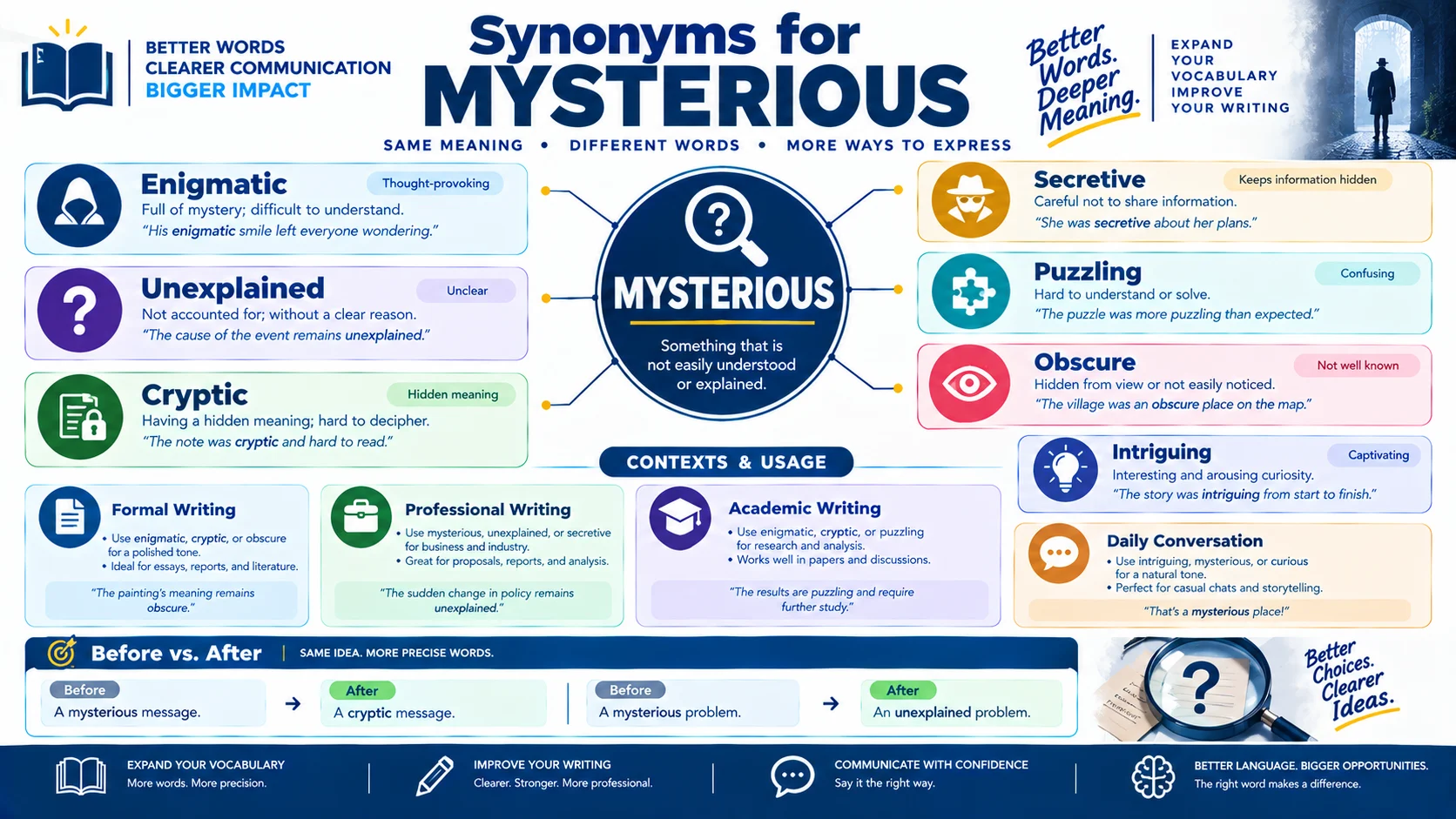
Another word for mysterious is enigmatic. Depending on context, you can also use cryptic, unexplained, puzzling, secretive, obscure, intriguing, or perplexing. Each synonym has a slightly different meaning, so the best choice depends on whether something is unknown, difficult to understand, hidden, or unusually intriguing.
What Does Mysterious Mean?
Definition
Mysterious describes something that is difficult to understand, explain, identify, or discover. It can refer to a person, event, place, object, behavior, or situation that creates curiosity because important information is unknown or unclear.
For example, you might describe an unexplained disappearance as mysterious, or call someone mysterious when they reveal very little about themselves.
Common Uses
The word mysterious commonly appears in descriptions involving:
- Unknown facts or circumstances
- Strange or unexplained events
- Secretive people
- Hidden information
- Unusual places or objects
- Intriguing stories
- Unsolved problems
The best synonym depends on what kind of mystery you want to communicate. Enigmatic emphasizes something difficult to interpret, while secretive usually describes someone who deliberately hides information.
Best Synonyms for Mysterious
| Synonym | Meaning | Best Used When | Example |
|---|---|---|---|
| Enigmatic | Difficult to understand or interpret | Describing people, behavior, or ideas | Her enigmatic expression revealed nothing. |
| Unexplained | Not yet given a clear explanation | Events, incidents, or phenomena | The cause of the outage remains unexplained. |
| Cryptic | Difficult to understand because the meaning is hidden | Messages, statements, clues | He left a cryptic note on my desk. |
| Secretive | Unwilling to reveal information | People or organizations | The company has been secretive about its plans. |
| Unclear | Not easy to understand or determine | Facts, situations, instructions | The reason for the change remains unclear. |
| Obscure | Difficult to understand, see, or know | Ideas, references, facts | The book contains several obscure references. |
| Puzzling | Causing confusion or curiosity | Situations, behavior, problems | Her sudden decision was puzzling. |
| Intriguing | Extremely interesting or curiosity-provoking | Ideas, stories, discoveries | The scientist made an intriguing observation. |
| Perplexing | Very confusing or difficult to explain | Problems or situations | The results were perplexing. |
| Unfathomable | Extremely difficult to understand | Complex or seemingly impossible situations | His decision seemed unfathomable. |
| Arcane | Known or understood by very few people | Specialized knowledge | The document discusses an arcane legal principle. |
| Veiled | Partly hidden or indirectly expressed | Meanings, intentions, references | She made a veiled reference to the disagreement. |
Enigmatic
Meaning: Difficult to understand, interpret, or figure out.
Best used for: People, personalities, expressions, behavior, and ideas.
Tone: Sophisticated and intriguing
Difficulty: Advanced
Usage frequency: Common
Business example: The executive gave an enigmatic response to questions about the merger.
Academic example: The author’s enigmatic argument has generated several interpretations.
Daily conversation example: My neighbor is pretty enigmatic. I never know what she’s thinking.
Unexplained
Meaning: Something for which no clear explanation has been established.
Best used for: Events, occurrences, changes, and phenomena.
Tone: Neutral and factual
Difficulty: Easy
Usage frequency: Very Common
Business example: The accounting team discovered an unexplained discrepancy.
Academic example: Researchers documented several unexplained variations in the results.
Daily conversation example: There was an unexplained noise coming from upstairs.
Cryptic
Meaning: Expressed in a way that is deliberately or unusually difficult to understand.
Best used for: Messages, comments, clues, notes, and statements.
Tone: Intriguing, sometimes playful
Difficulty: Medium
Usage frequency: Common
Business example: The manager sent a cryptic email about an upcoming announcement.
Academic example: The inscription contains several cryptic symbols.
Daily conversation example: She sent me a cryptic text that made no sense.
Secretive
Meaning: Tending to keep information private or hidden.
Best used for: People, groups, companies, or behavior.
Tone: Neutral to slightly negative
Difficulty: Easy
Usage frequency: Very Common
Business example: The startup has remained secretive about its product launch.
Academic example: The organization was criticized for its secretive decision-making process.
Daily conversation example: He’s really secretive about where he goes on weekends.
Intriguing
Meaning: Interesting in a way that creates curiosity or makes you want to know more.
Best used for: Ideas, stories, discoveries, people, and possibilities.
Tone: Positive
Difficulty: Medium
Usage frequency: Common
Business example: The proposal presents an intriguing opportunity for expansion.
Academic example: The study raises several intriguing questions for future research.
Daily conversation example: That’s an intriguing idea. Tell me more.
Synonyms by Context
Formal Writing
For formal writing, choose words that communicate the specific type of mystery rather than simply replacing mysterious.
Good options include:
Enigmatic: for something difficult to interpret.
Obscure: for something little known or difficult to understand.
Unexplained: for something without an established explanation.
Unfathomable: for something exceptionally difficult to comprehend.
Arcane: for specialized or obscure knowledge.
Example:
Instead of:
The report describes a mysterious phenomenon.
You could write:
The report describes an unexplained phenomenon.
This version is more precise when researchers do not yet know the cause.
Professional Writing
Professional writing generally benefits from precise and neutral alternatives.
Useful choices include unclear, unexplained, undisclosed, confidential, ambiguous, and enigmatic, depending on the situation.
For example:
The reason for the policy change remains unclear.
This is usually more appropriate in a business report than:
The reason for the policy change remains mysterious.
If information has intentionally not been released, undisclosed may be even more precise:
The company has not disclosed the reason for the decision.
Academic Writing
Academic writing often requires careful distinctions.
Use unexplained when evidence exists but the cause is unknown.
Use ambiguous when something has multiple possible interpretations.
Use obscure when information is difficult to understand or not widely known.
Use enigmatic when a person, text, finding, or phenomenon is particularly difficult to interpret.
For example:
The study identifies an unexplained correlation between the variables.
This is more precise than simply calling the correlation mysterious.
Daily Conversation
In everyday speech, simple words usually sound more natural.
Try:
- Strange
- Puzzling
- Unclear
- Secretive
- Weird
- Unexplained
- Intriguing
For example:
There’s something strange about that old house.
or:
Her reaction was really puzzling.
Professional Alternatives for Mysterious
The best professional replacement depends on the intended meaning.
Unclear works when the facts or reasons are not understood.
Undisclosed works when information has not been revealed.
Confidential works when information is intentionally restricted.
Ambiguous works when something has more than one possible interpretation.
Unexplained works when there is no established explanation.
Enigmatic works when something remains difficult to interpret.
For resumes and professional profiles, avoid using mysterious unless it describes a specific creative quality. Words such as intriguing, innovative, unconventional, or distinctive may communicate a positive quality more directly.
Simple Alternatives for Mysterious
If you want an easy replacement, consider:
- Strange
- Unknown
- Unclear
- Hidden
- Secret
- Unexplained
- Puzzling
- Unusual
For example:
The reason is mysterious.
can become:
The reason is unknown.
Or:
Her behavior was mysterious.
can become:
Her behavior was strange.
The simpler choice is often better when your audience needs immediate clarity.
Stronger Alternatives for Mysterious
When you want a more dramatic or sophisticated effect, consider:
Enigmatic suggests deep uncertainty or difficulty interpreting something.
Cryptic suggests concealed meaning.
Perplexing emphasizes confusion.
Unfathomable suggests something extremely difficult to comprehend.
Arcane suggests knowledge that is obscure and understood by only a limited group.
Inscrutable describes someone or something whose intentions or meaning are extremely difficult to understand.
For creative writing, these distinctions can make descriptions more vivid:
The detective encountered a cryptic clue.
is different from:
The detective encountered an unexplained clue.
The first suggests hidden meaning. The second emphasizes that nobody has explained it.
Difference Between Similar Synonyms
Mysterious vs. Enigmatic
Mysterious is broad and commonly used. Enigmatic is more specific and often suggests that something is difficult to interpret.
She was mysterious.
She was enigmatic.
The second sounds more sophisticated and emphasizes her unreadable nature.
Mysterious vs. Secretive
Mysterious means something is difficult to understand or know. Secretive usually implies that someone is actively withholding information.
His past is mysterious.
He is secretive about his past.
The first focuses on what is unknown. The second focuses on his behavior.
Mysterious vs. Cryptic
Cryptic usually involves communication that is difficult to understand because the meaning is concealed or indirect.
She gave me a mysterious look.
She gave me a cryptic message.
A look can be mysterious, while a deliberately puzzling message is often cryptic.
Mysterious vs. Unexplained
Unexplained is more factual. It indicates that an explanation has not been established.
A mysterious disappearance occurred.
An unexplained disappearance occurred.
The second emphasizes the absence of an explanation rather than the atmosphere of mystery.
Mysterious vs. Intriguing
Mysterious emphasizes what is unknown.
Intriguing emphasizes how interesting or curiosity-provoking something is.
The mysterious letter contained no name.
The letter contained an intriguing idea.
The two words can overlap, but they do not have exactly the same meaning.
Opposite Words
Common antonyms for mysterious include:
- Clear
- Obvious
- Known
- Explained
- Understandable
- Transparent
- Certain
- Familiar
- Revealed
- Straightforward
The correct opposite depends on context. For example, clear works when meaning is difficult to understand, while known works when information is no longer unknown.
FAQs
What is another word for mysterious?
Common alternatives for mysterious include enigmatic, unexplained, cryptic, secretive, puzzling, obscure, perplexing, intriguing, and unclear. The best choice depends on whether you mean difficult to understand, unexplained, secretive, or especially interesting.
What is a formal synonym for mysterious?
Enigmatic is one of the strongest formal synonyms for mysterious. Other formal choices include unexplained, obscure, perplexing, unfathomable, arcane, and inscrutable, depending on the context.
What is a professional alternative for mysterious?
In professional writing, unclear, unexplained, undisclosed, ambiguous, or confidential may be more precise than mysterious. The appropriate term depends on whether information is unknown, withheld, or open to interpretation.
What word can replace mysterious?
You can replace mysterious with enigmatic, strange, unknown, unexplained, cryptic, puzzling, secretive, obscure, or intriguing. Choose the word that matches the exact meaning you want.
What is a simple synonym for mysterious?
Strange, unknown, unclear, and puzzling are simple alternatives to mysterious. They are easy to understand and work well in everyday communication.
What is a stronger word for mysterious?
Enigmatic, inscrutable, unfathomable, and cryptic can create a stronger or more sophisticated sense of mystery. Each emphasizes a different aspect of the original word.
Is enigmatic the same as mysterious?
They are closely related but not identical. Mysterious is a broad term for something unknown or difficult to explain. Enigmatic specifically emphasizes something that is difficult to interpret or understand.
Is secretive a synonym for mysterious?
Sometimes, but the meanings are different. Secretive describes someone who deliberately keeps information private, while mysterious describes something that is difficult to know or understand.
What is the difference between mysterious and unknown?
Unknown simply means not known. Mysterious usually adds a sense of curiosity, puzzlement, or uncertainty. Something can be unknown without being mysterious.
What is the opposite of mysterious?
Depending on the context, opposites include clear, obvious, known, explained, transparent, understandable, and straightforward.
Conclusion
The best synonym for mysterious depends on what you want to emphasize. Use enigmatic for something difficult to interpret, unexplained for something without a known explanation, cryptic for hidden or puzzling communication, secretive for someone who withholds information, and intriguing when the main idea is curiosity or interest.
For everyday writing, strange, unclear, unknown, and puzzling are easy choices. For formal or sophisticated writing, enigmatic, obscure, perplexing, and inscrutable can provide greater precision.