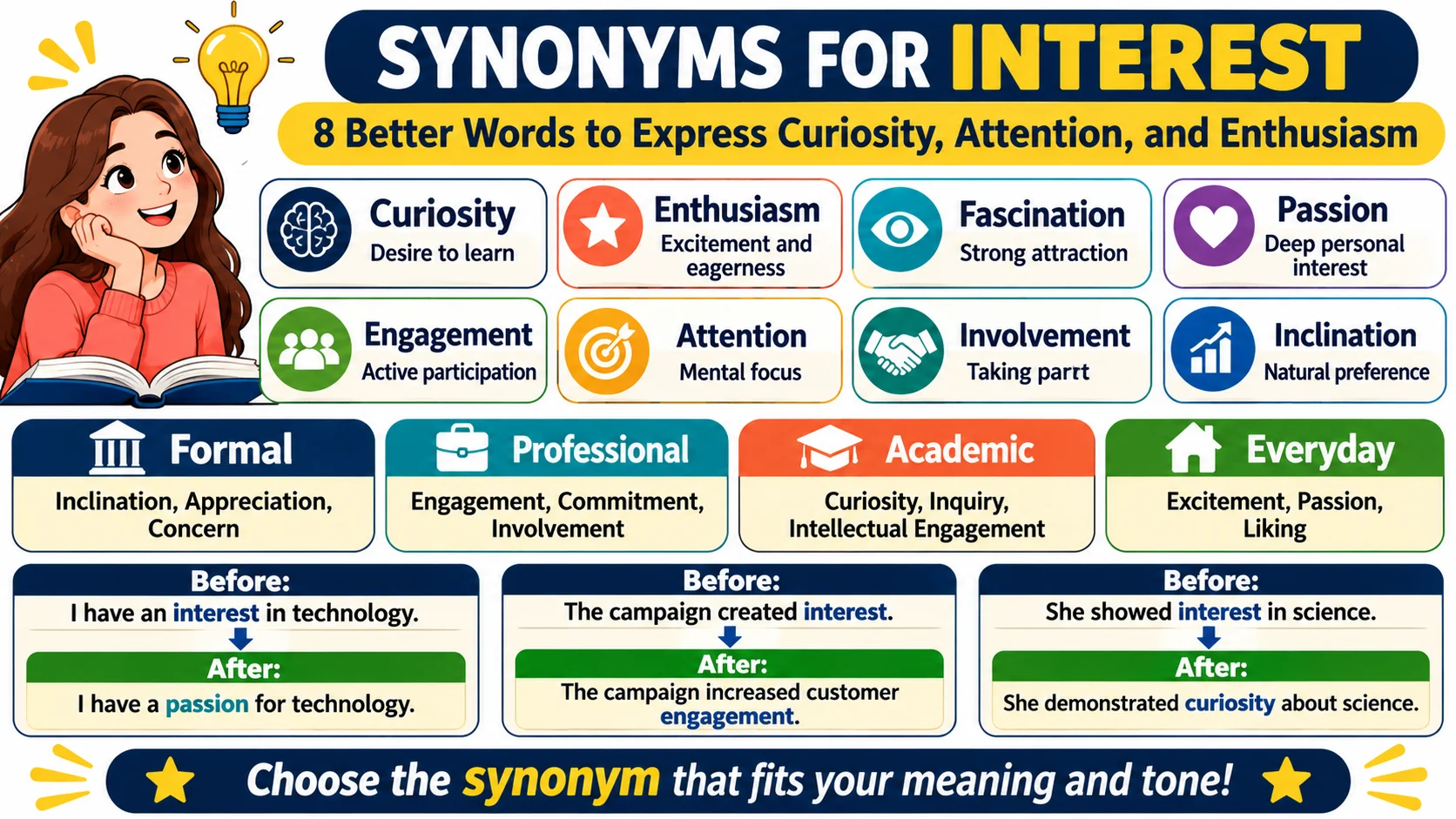
A synonym for interest depends on the context in which the word is used. Common alternatives include curiosity, attention, enthusiasm, fascination, concern, passion, and involvement. For professional writing, engagement or inclination may work better, while curiosity and excitement are natural choices in everyday conversations.
What Does Interest Mean?
Definition
The word interest is a noun that describes a feeling of wanting to know, learn, or understand something. It can also refer to attention, enthusiasm, personal concern, or involvement in an activity, subject, or situation.
For example, someone might have an interest in science because they enjoy learning how things work. A business may show interest in a potential partnership, while a student may develop an interest in history through classroom discussions.
Interest also has other meanings. In finance, it refers to the money paid for borrowing or saving money. In business and personal relationships, it can describe a benefit, advantage, or stake in something.
Common Uses
Interest appears in several everyday and professional situations:
- Curiosity: Wanting to discover or understand something.
- Attention: Giving mental focus to a particular subject.
- Enthusiasm: Showing excitement about an activity or idea.
- Concern: Caring about an issue or someone’s well-being.
- Involvement: Taking part in an activity or situation.
- Financial context: Money earned or paid on a loan or investment.
Understanding these meanings helps you choose a synonym that communicates the intended message accurately.
Best Synonyms for Interest
The following table highlights useful alternatives, their meanings, and situations where they work best.
| Synonym | Meaning | Best Used When | Example |
|---|---|---|---|
| Curiosity | Desire to learn or discover | Describing a desire for knowledge | Her curiosity led her to study biology. |
| Attention | Mental focus | Discussing concentration | The presentation captured everyone’s attention. |
| Enthusiasm | Strong excitement or interest | Expressing excitement | He showed enthusiasm for the new project. |
| Fascination | Intense attraction or curiosity | Describing something captivating | She has a fascination with astronomy. |
| Passion | Deep emotional interest | Discussing strong personal dedication | His passion for music began in childhood. |
| Concern | Care or involvement | Discussing important issues | Environmental protection is a major concern. |
| Engagement | Active participation or involvement | Professional and academic contexts | Student engagement improved during the course. |
| Involvement | Participation in something | Describing active contribution | Her involvement in the campaign was valuable. |
| Attraction | A feeling of being drawn toward something | Describing appeal | The attraction of the opportunity was obvious. |
| Inclination | A natural preference or tendency | Formal writing | She has an inclination toward creative work. |
| Appreciation | Recognition of value or quality | Describing admiration | He developed an appreciation for classical music. |
| Excitement | A feeling of enthusiasm | Casual conversations | The announcement created excitement among employees. |
| Curiosity | A desire to understand something | Learning and exploration | Curiosity encouraged him to ask questions. |
| Fascination | Strong attraction or admiration | Describing captivating subjects | Her fascination with technology never faded. |
| Commitment | Dedication to a responsibility or goal | Professional and personal contexts | Her commitment to research was impressive. |
Important Synonym Details
1. Curiosity
- Meaning: A desire to learn, explore, or discover something.
- Best used for: Learning, research, exploration, and asking questions.
- Tone: Neutral and positive.
- Difficulty: Easy.
- Frequency: Very Common.
- Best for: Essays, emails, academic writing, and everyday conversations.
Examples:
- Business: His curiosity about emerging markets encouraged him to explore new opportunities.
- Academic: Scientific curiosity often leads to important discoveries.
- Daily conversation: My curiosity made me open the package.
2. Enthusiasm
- Meaning: Strong excitement, eagerness, or positive energy toward something.
- Best used for: Expressing excitement about projects, activities, or goals.
- Tone: Positive and energetic.
- Difficulty: Medium.
- Frequency: Very Common.
- Best for: Resumes, interviews, business emails, and marketing copy.
Examples:
- Business: She demonstrated enthusiasm for the company’s expansion plans.
- Academic: The teacher appreciated the students’ enthusiasm for learning.
- Daily conversation: I have a lot of enthusiasm for traveling.
3. Fascination
- Meaning: A powerful feeling of attraction, curiosity, or admiration.
- Best used for: Subjects or activities that strongly capture someone’s attention.
- Tone: Expressive and engaging.
- Difficulty: Medium.
- Frequency: Common.
- Best for: Essays, creative writing, blogs, and personal communication.
Examples:
- Business: His fascination with technology inspired him to develop innovative solutions.
- Academic: The research explores the public’s fascination with artificial intelligence.
- Daily conversation: I have always had a fascination with old buildings.
4. Engagement
- Meaning: Active participation, attention, or involvement.
- Best used for: Workplace communication, education, marketing, and customer relationships.
- Tone: Professional and neutral.
- Difficulty: Medium.
- Frequency: Common.
- Best for: Resumes, business reports, emails, and academic writing.
Examples:
- Business: The campaign increased customer engagement.
- Academic: Classroom engagement plays an important role in student learning.
- Daily conversation: Her engagement in the discussion made it more interesting.
5. Passion
- Meaning: A strong and lasting feeling of enthusiasm or dedication.
- Best used for: Personal interests, careers, hobbies, and long-term goals.
- Tone: Emotional and positive.
- Difficulty: Easy.
- Frequency: Very Common.
- Best for: Resumes, personal statements, essays, and marketing copy.
Examples:
- Business: Her passion for leadership helped motivate the entire team.
- Academic: His passion for environmental science influenced his research.
- Daily conversation: Photography has always been my passion.
Synonyms for Interest by Context
Different writing situations require different alternatives. A word that works in a casual conversation may sound inappropriate in an academic paper or business report.
Formal Writing
Formal writing benefits from precise and professional vocabulary. Consider these alternatives:
- Inclination: A natural preference toward something.
- Curiosity: A desire to gain knowledge.
- Appreciation: Recognition of value or importance.
- Concern: A matter of care or attention.
- Fascination: Strong attraction toward a subject.
Example: Instead of writing, “She has an interest in environmental issues,” you could write, “She has a strong concern for environmental protection.”
Professional Writing
In workplaces, resumes, reports, and business emails, the following alternatives often sound more specific:
- Engagement
- Involvement
- Commitment
- Enthusiasm
- Investment
- Attention
Example: Instead of “I have an interest in project management,” write, “I have a strong enthusiasm for project management and team coordination.”
For a resume, you could also say, “Demonstrated commitment to effective project management.”
Academic Writing
Academic writing often requires words that describe intellectual engagement or a desire to investigate a subject.
Useful alternatives include:
- Curiosity
- Inquiry
- Fascination
- Attention
- Engagement
- Intellectual curiosity
Example: “The study examines students’ curiosity about artificial intelligence and its applications.”
Daily Conversation
In everyday speech, simple and familiar alternatives sound more natural.
- Curiosity
- Excitement
- Passion
- Attraction
- Enthusiasm
- Appreciation
Example: Instead of “I have an interest in cooking,” you could say, “I enjoy cooking” or “I’m passionate about cooking.”
Professional Alternatives for Interest
If you frequently use the word interest in professional communication, replacing it with a more precise term can make your writing clearer.
| Professional Alternative | Best Application | Example |
|---|---|---|
| Engagement | Customer relationships and participation | We increased customer engagement. |
| Commitment | Dedication to responsibilities | I have a strong commitment to quality. |
| Enthusiasm | Positive attitude toward work | I bring enthusiasm to collaborative projects. |
| Involvement | Participation in activities | My involvement improved team coordination. |
| Expertise | Established knowledge or skill | I have developed expertise in digital marketing. |
| Investment | Time, effort, or resources devoted to something | The company increased its investment in research. |
| Inclination | Professional preference | I have an inclination toward strategic planning. |
Remember that these alternatives are not interchangeable in every sentence. For example, expertise describes knowledge or skill, whereas interest describes curiosity or attraction. Choose the word that accurately represents your intended meaning.
Simple Alternatives for Interest
For basic English, everyday communication, and beginner-friendly writing, these words are easy to understand:
| Simple Word | Example |
|---|---|
| Curiosity | Her curiosity encouraged her to explore. |
| Enjoyment | I get enjoyment from reading. |
| Excitement | He showed excitement about the trip. |
| Attention | The story caught my attention. |
| Love | She has a love for painting. |
| Liking | I have a liking for classical music. |
| Desire | He has a desire to learn new skills. |
| Care | She showed care for the community. |
These alternatives make sentences easier to understand without making them sound overly formal.
Stronger Alternatives for Interest
Sometimes, interest does not fully communicate the strength of someone’s feelings. Stronger alternatives can express deeper enthusiasm, attraction, or dedication.
- Passion: A powerful and lasting interest in something.
- Obsession: An extremely strong preoccupation with something.
- Devotion: Deep dedication to a person, activity, or purpose.
- Fascination: An intense attraction that captures attention.
- Enthusiasm: Strong excitement and eagerness.
- Dedication: Consistent commitment to a particular goal.
- Admiration: A feeling of respect or approval.
Example comparisons:
- Basic: She has an interest in photography.
- Stronger: She has a passion for photography.
- More intense: She has a fascination with experimental photography.
Use words such as obsession carefully because they can suggest an unhealthy or excessive preoccupation.
Difference Between Similar Synonyms
Although many words can replace interest, their meanings are not exactly the same.
Interest vs. Curiosity
Interest describes a general feeling of attention or attraction toward something. Curiosity specifically refers to wanting to discover or understand something.
Example:
- Interest: He has an interest in history.
- Curiosity: He has a curiosity about ancient civilizations.
Interest vs. Enthusiasm
Interest can be mild or strong, while enthusiasm usually communicates excitement and eagerness.
Example:
- Interest: She showed interest in the new project.
- Enthusiasm: She showed enthusiasm for the new project.
Interest vs. Passion
Interest can describe a temporary preference or general attraction. Passion suggests a deeper emotional connection or long-term dedication.
Example:
- Interest: He has an interest in football.
- Passion: He has a passion for playing football.
Interest vs. Fascination
Interest describes a general attraction, whereas fascination suggests that something strongly captures someone’s attention.
Example:
- Interest: She has an interest in space exploration.
- Fascination: She has a fascination with distant galaxies.
Interest vs. Concern
Interest can mean wanting to know about something, while concern usually suggests care, responsibility, or worry.
Example:
- Interest: The manager showed interest in the proposal.
- Concern: The manager expressed concern about the project’s cost.
Opposite Words for Interest
The opposite of interest depends on the intended meaning. If interest means curiosity or attention, its opposites include:
| Antonym | Meaning | Example |
|---|---|---|
| Indifference | Lack of interest or concern | His indifference surprised the team. |
| Disinterest | Lack of personal interest | She showed disinterest in the discussion. |
| Apathy | Absence of enthusiasm or concern | Public apathy affected participation. |
| Boredom | Lack of excitement or engagement | The lecture caused boredom among students. |
| Unconcern | Lack of worry or attention | His unconcern about the issue was noticeable. |
| Detachment | Emotional separation or lack of involvement | She maintained detachment during the debate. |
Note that disinterest can sometimes mean impartiality or lack of bias, so it is not always interchangeable with indifference.
Frequently Asked Questions
1. What is another word for interest?
Common alternatives include curiosity, attention, enthusiasm, fascination, passion, concern, engagement, and involvement. The best replacement depends on whether you mean curiosity, excitement, attention, or participation.
2. What is a formal synonym for interest?
Inclination, appreciation, concern, fascination, and intellectual curiosity can work as formal alternatives. The appropriate choice depends on the sentence and intended meaning.
3. What is a professional alternative for interest?
Engagement, commitment, involvement, enthusiasm, and investment are useful professional alternatives. For example, customer engagement is more specific than customer interest when discussing active participation.
4. What is a stronger word for interest?
Passion, fascination, devotion, and enthusiasm can express stronger feelings. Obsession is another possibility, but it often has a negative meaning.
5. What is a simple word for interest?
Curiosity, liking, excitement, attention, and enjoyment are simple alternatives. They work well in everyday conversations and basic English writing.
6. What is another word for showing interest?
Showing curiosity, expressing enthusiasm, demonstrating engagement, displaying attention, and expressing concern are useful alternatives.
7. What is another word for personal interest?
Personal passion, individual preference, personal curiosity, inclination, and personal enthusiasm can communicate different aspects of personal interest.
8. What is another word for interest in business?
Business engagement, commercial involvement, investment, commitment, and enthusiasm may work depending on the context. In financial writing, interest may refer to a payment or return rather than curiosity.
9. What is the difference between interest and enthusiasm?
Interest means having attention or attraction toward something. Enthusiasm expresses a stronger sense of excitement, eagerness, or positive energy.
10. What is the opposite of interest?
Common opposites include indifference, apathy, disinterest, boredom, and unconcern. The best antonym depends on the intended meaning.
Conclusion
Finding the right synonym for interest makes your writing more natural, precise, and engaging. Words such as curiosity, enthusiasm, fascination, passion, engagement, and concern offer different ways to communicate attention, excitement, or involvement.
For academic writing, curiosity and intellectual engagement are useful choices. In professional communication, engagement, commitment, and involvement often sound more appropriate. For everyday conversations, simple alternatives such as liking, excitement, and passion work well.
Instead of replacing interest with the first synonym you find, consider the meaning, tone, and context of your sentence. Choosing the right word will make your message clearer and more effective.