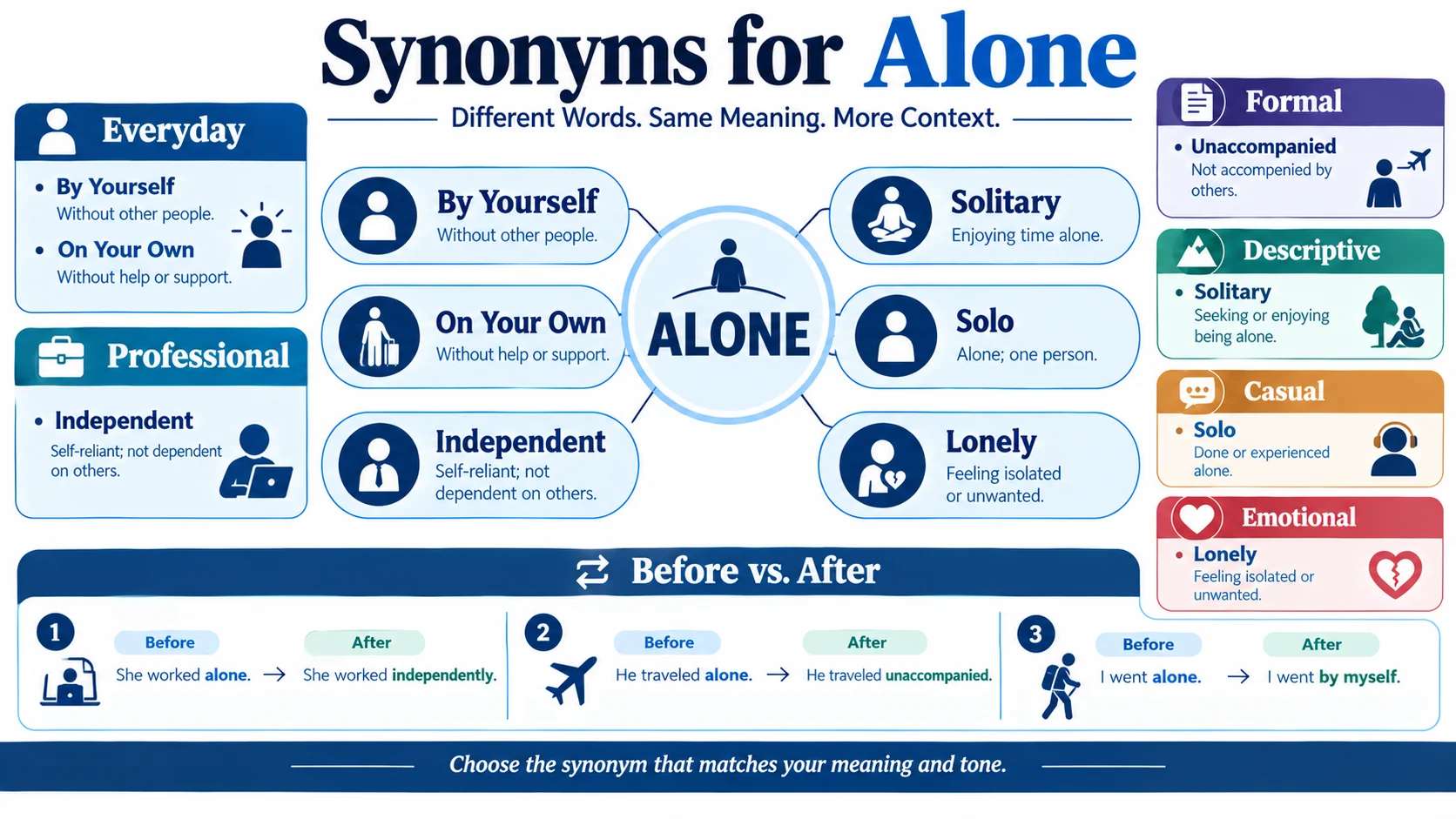
Common synonyms for alone include by oneself, on your own, solitary, solo, unaccompanied, isolated, independent, and lonely. The best choice depends on meaning. Use by oneself for simple situations, unaccompanied for formal writing, solitary for descriptive writing, and independent when emphasizing self-reliance.
What Does Alone Mean?
Definition
Alone means being without other people or without assistance. It can describe physical separation, independent action, emotional isolation, or the idea that something is the only one involved.
For example:
- She lives alone.
- He completed the project alone.
- I wanted to be alone for a while.
- The evidence alone was enough to support the claim.
The word has several related meanings, so the best synonym depends heavily on the sentence. Major dictionaries distinguish between alone meaning “without other people,” alone meaning “without help,” and alone meaning “only or solely.” (Cambridge Dictionary)
Common Uses
Alone can describe:
- Being physically without other people
- Doing something without assistance
- Being emotionally isolated
- Being the only person or thing involved
- Being separate or distinctive
This is why lonely, solitary, solo, independent, and solely are not always interchangeable.
Best Synonyms for Alone
| Synonym | Meaning | Best Used When | Example |
|---|---|---|---|
| By oneself | Without other people | Everyday writing | She traveled by herself. |
| On your own | Without assistance or company | Casual conversation | I finished the assignment on my own. |
| Solitary | Existing or occurring alone | Formal or descriptive writing | He lived a solitary life. |
| Solo | Alone or independently | Informal, creative, or professional contexts | She performed a solo presentation. |
| Unaccompanied | Without someone accompanying you | Formal situations | The child was not allowed to travel unaccompanied. |
| Isolated | Separated from others | Physical or social separation | The village remained isolated. |
| Independent | Able to act without help | Work, education, and personal ability | She is an independent researcher. |
| Lonely | Alone with a feeling of sadness | Emotional situations | He felt lonely after moving away. |
| Lonesome | Lonely or without companionship | Informal American English | She felt lonesome after her friends left. |
| Separate | Apart from others | Formal or neutral contexts | The teams worked in separate rooms. |
| Lone | Single or only one | Descriptive writing | A lone traveler walked along the road. |
| Unaided | Without help | Academic or professional writing | The patient completed the task unaided. |
These distinctions reflect established dictionary usage. Cambridge, Collins, and Thesaurus.com group words such as solitary, unaccompanied, isolated, solo, lonely, lonesome, and by oneself under different senses of alone. (Cambridge Dictionary)
Synonyms by Context
Formal Writing
For formal documents, avoid overly casual alternatives such as on your lonesome. Better choices include:
- Unaccompanied
- Solitary
- Separate
- Unaided
- Independently
- Isolated
Example:
Instead of:
The researcher worked alone.
You could write:
The researcher worked independently.
Or:
The participant completed the procedure unaided.
Unaided specifically emphasizes the absence of help, while unaccompanied emphasizes the absence of another person.
Professional Writing
In business and workplace writing, independently, individually, and on one’s own often sound more natural than alone.
Examples:
- She completed the report independently.
- Each employee was asked to work individually.
- He managed the project on his own.
If you want to emphasize competence rather than isolation, independently is usually more precise.
Academic Writing
Academic writing benefits from precise alternatives such as:
- Independently
- Individually
- Separately
- Unaided
- Solitary
For example:
Students completed the experiment independently.
This communicates that students performed the work without assistance. It does not necessarily suggest that they were socially isolated.
Daily Conversation
Natural conversational alternatives include:
- By myself
- By yourself
- On my own
- On your own
- Solo
- By yourself
Examples:
I went to the movie by myself.
She learned how to cook on her own.
I’m traveling solo this weekend.
In American English, by yourself and on your own are especially natural alternatives to alone. Cambridge also identifies all by yourself, on your own, and by oneself as common expressions related to alone. (Cambridge Dictionary)
Professional Alternatives for Alone
If you’re writing a resume, cover letter, report, or business email, choose a synonym based on the intended meaning.
Independent
Meaning: Able to work without supervision or assistance.
Tone: Professional
Difficulty: Easy
Usage Frequency: Very Common
Best for: Resume, email, business writing, academic writing
Business example:
She independently managed the company’s social media campaign.
Academic example:
Students independently analyzed the research data.
Daily example:
I prefer to make decisions independently.
Unaccompanied
Meaning: Without another person present.
Tone: Formal
Difficulty: Medium
Usage Frequency: Common
Best for: Formal documents, policies, travel, professional writing
Business example:
Visitors may not enter the facility unaccompanied.
Academic example:
Participants arrived unaccompanied for the interview.
Unaided
Meaning: Without help or assistance.
Tone: Formal
Difficulty: Medium
Usage Frequency: Common
Best for: Academic writing, professional writing, reports
Example:
The participant completed the assessment unaided.
Simple Alternatives for Alone
For everyday writing, these are easy replacements:
- By myself
- By yourself
- By oneself
- On my own
- On your own
- On their own
- Solo
Examples:
Original:
I went alone.
Simple:
I went by myself.
Original:
She completed the task alone.
Simple:
She completed the task on her own.
Original:
He lives alone.
Simple:
He lives by himself.
Stronger Alternatives for Alone
When you want a more specific or vivid word, consider:
Solitary
Suggests being alone, often for an extended period or by preference.
He spent years living a solitary life.
Isolated
Suggests separation from other people, places, or groups.
The community became isolated after the storm.
Lonely
Focuses on emotional sadness rather than simply being physically alone.
She felt lonely after moving to a new city.
Lone
Emphasizes one person or thing standing apart from others.
A lone figure stood near the entrance.
Forlorn
A more literary word suggesting abandonment, loneliness, or sadness.
The abandoned house looked forlorn.
These words should not be treated as perfect replacements. For example, being alone does not automatically mean being lonely. A person can enjoy being alone without feeling lonely. Dictionary sources similarly distinguish physical solitude from emotional loneliness. (Collins Dictionary)
Difference Between Similar Synonyms
Alone vs. Lonely
Alone describes a situation.
Lonely describes an emotional experience.
I was alone at home.
This only tells us that nobody else was there.
I was lonely at home.
This suggests that the person felt unhappy because of a lack of companionship.
Alone vs. Solitary
Alone is neutral and common. Solitary sounds more descriptive and formal.
She was alone in the room.
She lived a solitary life.
Alone vs. Isolated
Isolated suggests separation from other people or surroundings. It can also describe something physically remote.
He was alone in his office.
The research station was isolated from the rest of the region.
Alone vs. Independent
Alone means without others. Independent means able to function or act without assistance.
She worked alone.
She worked independently.
The second sentence emphasizes capability rather than simply the absence of other people.
Alone vs. Solo
Solo is often more casual and can suggest an intentional individual activity.
She traveled alone.
She went on a solo trip.
Alone vs. Solely
Solely is usually an adverb meaning “only” or “exclusively.”
The decision was based solely on cost.
Here, alone can also work:
The decision was based on cost alone.
Both express the idea that cost was the only factor.
Opposite Words
Common opposites of alone include:
- Together
- Accompanied
- Connected
- Supported
- Assisted
- Surrounded
- With others
- In company
- Jointly
The appropriate opposite depends on the meaning.
For example:
She traveled alone.
Opposite:
She traveled with friends.
But:
He completed the task alone.
Opposite:
He completed the task with assistance.
FAQs
What is another word for alone?
Common alternatives include by oneself, on your own, solitary, solo, unaccompanied, isolated, and independent. The best synonym depends on whether you mean physical separation, lack of assistance, emotional loneliness, or individual responsibility.
What is a formal synonym for alone?
Unaccompanied, solitary, unaided, independently, and separately can work in formal contexts. Choose based on the exact meaning rather than replacing alone automatically.
What is a professional alternative for alone?
Independently is often the strongest professional alternative when you mean that someone completed work without assistance. Individually can work when emphasizing separate participation.
What word can replace alone?
For simple everyday writing, use by myself, by yourself, by oneself, or on your own. For more formal writing, consider solitary, unaccompanied, unaided, or independently.
Is lonely the same as alone?
No. Alone refers primarily to being without other people, while lonely usually describes an unwanted or emotionally painful feeling of lacking companionship. (Cambridge Dictionary)
What is a synonym for alone in a resume?
Use independently, especially when describing your ability to complete projects, solve problems, conduct research, or manage responsibilities without constant supervision.
What is a synonym for alone in an essay?
Depending on the context, use independently, individually, separately, solitary, or unaccompanied. Academic writing should favor precision over simply choosing a more sophisticated word.
What is a stronger word for alone?
Isolated, solitary, forlorn, or lone can create stronger effects, but each carries a different nuance. Forlorn, for example, adds an emotional sense of sadness or abandonment.
What is a casual way to say alone?
By myself, on my own, by yourself, and solo are natural casual alternatives.
Can alone mean only?
Yes. In expressions such as cost alone or she alone decided, alone can mean only or solely. This is a separate meaning from simply being without other people. (Cambridge Dictionary)
Conclusion
The best synonym for alone depends on what you want to communicate. Use by oneself or on your own for everyday situations, independently for professional and academic contexts, unaccompanied when another person is absent, solitary for descriptive writing, and lonely when you mean emotional isolation.
The key distinction is simple: alone describes being without others, while related words add specific ideas such as independence, separation, sadness, or exclusivity. Choosing the precise synonym makes your writing clearer and more natural.