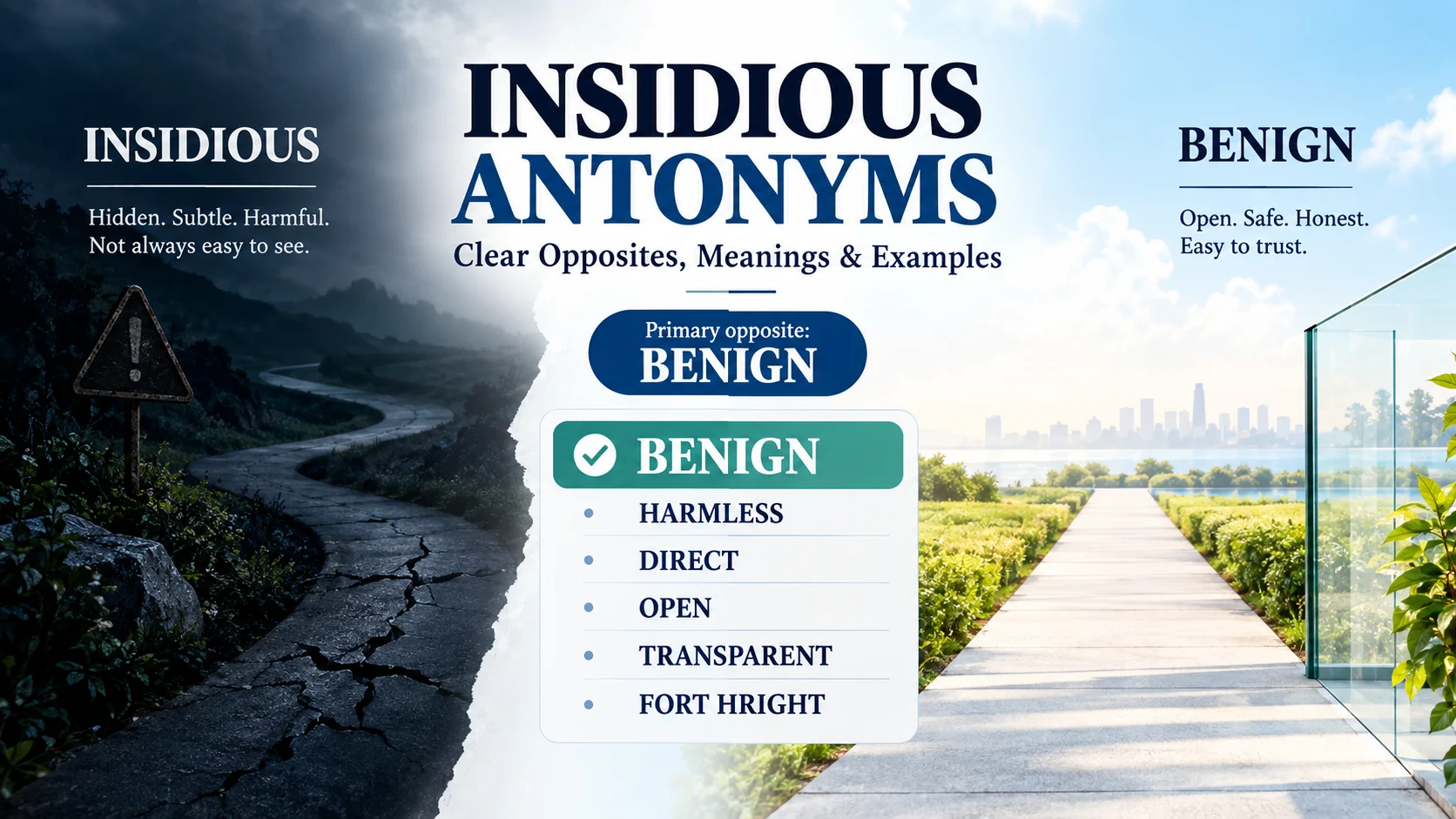
The strongest opposite of insidious is usually benign when describing something harmful or gradually damaging. Insidious means subtly harmful, deceptive, or difficult to notice. Depending on context, harmless, open, direct, or forthright may also express an opposite idea, especially when the focus is on secrecy or deception.
Part of Speech: Adjective
Primary Opposite: Benign
Insidious describes something that causes harm in a gradual, subtle, or difficult to detect way. It can also describe behavior or influences that work secretly to cause damage or deceive.
Benign is a strong opposite when the focus is on something that does not cause harm or danger.
For example:
The insidious effects of the toxic chemical developed slowly.
The opposite idea would be:
The treatment had a benign effect and caused no significant harm.
However, benign is not the only possible opposite. If insidious describes something deceptive or deliberately hidden, words such as open, direct, transparent, or forthright may provide a more precise contrast.
Direct and Strong Antonyms
| Antonym | Tone or Nuance | Example Sentence |
|---|---|---|
| Benign | Not harmful or dangerous | The doctor confirmed that the growth was benign. |
| Harmless | Producing little or no harm | The substance appeared harmless under normal conditions. |
| Open | Not hidden or secret | She made her intentions open from the beginning. |
| Direct | Clear and straightforward | His direct explanation removed any confusion. |
| Forthright | Honest and straightforward | The manager was forthright about the company’s problems. |
| Transparent | Easy to understand or see through | The organization used a transparent decision making process. |
| Obvious | Easy to notice or recognize | The warning signs were obvious to everyone. |
These words are not interchangeable in every sentence.
Benign and harmless work best when insidious refers to something harmful or damaging. Open, direct, forthright, and transparent work better when the word describes hidden, deceptive, or secretive behavior.
For example, calling a disease direct would not make sense. Likewise, calling a person’s communication benign may sound unnatural if the intended meaning is simply that the person was honest and straightforward.
Contextual and Subtle Opposites
The best opposite depends on which meaning of insidious matters in the sentence.
| Context | Insidious Meaning | Better Opposite |
|---|---|---|
| Disease or health | Gradually harmful and difficult to detect | Benign |
| Chemical exposure | Slowly causing damage | Harmless |
| Influence | Quietly causing harmful effects | Beneficial |
| Manipulation | Secretly influencing someone | Open |
| Communication | Indirect or deceptive | Direct |
| Behavior | Deceptive or underhanded | Forthright |
| Process or policy | Hidden or difficult to detect | Transparent |
Consider these examples.
Health context:
“An insidious disease may develop without obvious symptoms.”
Here, benign can provide a strong contrast when describing a condition that does not cause serious harm.
Communication context:
“His insidious remarks were designed to undermine her reputation.”
Here, direct is a better contrast because the problem involves indirect or concealed intent.
Business context:
“The company faced an insidious campaign of misinformation.”
A suitable opposite might be transparent communication because transparency contrasts with concealed or misleading activity.
This distinction matters because an antonym is not always a simple word pair. Meaning changes with context.
Words That Seem Opposite But Are Not
Some words may look like opposites of insidious but do not provide a true semantic contrast.
Common Grammatical Confusions
Innocent and innocuous can sometimes seem like opposites of insidious, but their meanings are not identical.
Innocent generally means not guilty of wrongdoing or not intended to cause harm. It can contrast with the deceptive or harmful implications of insidious in some contexts, but it does not directly describe something that is openly harmless.
Innocuous means unlikely to cause harm, offense, or damage. It can be a useful contextual opposite when insidious refers to something harmful, but it is not appropriate for every use.
For example:
The seemingly innocuous habit eventually caused problems.
This sentence highlights a subtle distinction. Something can appear innocuous without actually being the opposite of insidious.
Subtle Tone Differences
Obvious and visible may contrast with the hidden quality of something insidious, but they do not necessarily mean harmless.
For example:
The damage was obvious.
This tells us that the damage was easy to notice. It does not tell us that the damage was harmless.
Similarly, honest can contrast with deceptive behavior, but it does not directly oppose the gradual or harmful sense of insidious.
Choosing the right antonym therefore requires identifying the exact feature you want to contrast.
Frequently Asked Questions
What is the most common opposite of insidious?
Benign is one of the strongest opposites when insidious describes something gradually harmful or dangerous. For hidden or deceptive behavior, however, direct, open, transparent, or forthright may provide a more accurate contrast.
Is harmless the opposite of insidious?
Harmless can be an opposite of insidious when the word describes something that causes gradual or hidden harm. For example, a harmless substance does not produce the damaging effect associated with an insidious substance.
What is the opposite of insidious in personality or behavior?
For behavior, forthright, honest, open, or direct may be better opposites than benign. These words emphasize clear intentions and communication rather than the absence of physical or psychological harm.
Practical Word Choice
- Identify the meaning first. If insidious means gradually harmful, choose benign or harmless. If it means deceptive or concealed, consider direct, open, or forthright.
- Match the noun and context. A disease can be benign, while a person’s communication can be direct or forthright. The most accurate antonym should fit naturally with the noun it describes.
Final Thoughts
The word insidious has more than one shade of meaning, so its opposite depends on context. Benign and harmless work well for harmful effects, while direct, open, transparent, and forthright can contrast with secrecy or deception.
The key is to identify what makes something insidious in the first place. Once you know whether the contrast involves harm, secrecy, deception, or gradual development, choosing the right opposite becomes much easier.
Which opposite of insidious best fits the sentence you are writing?