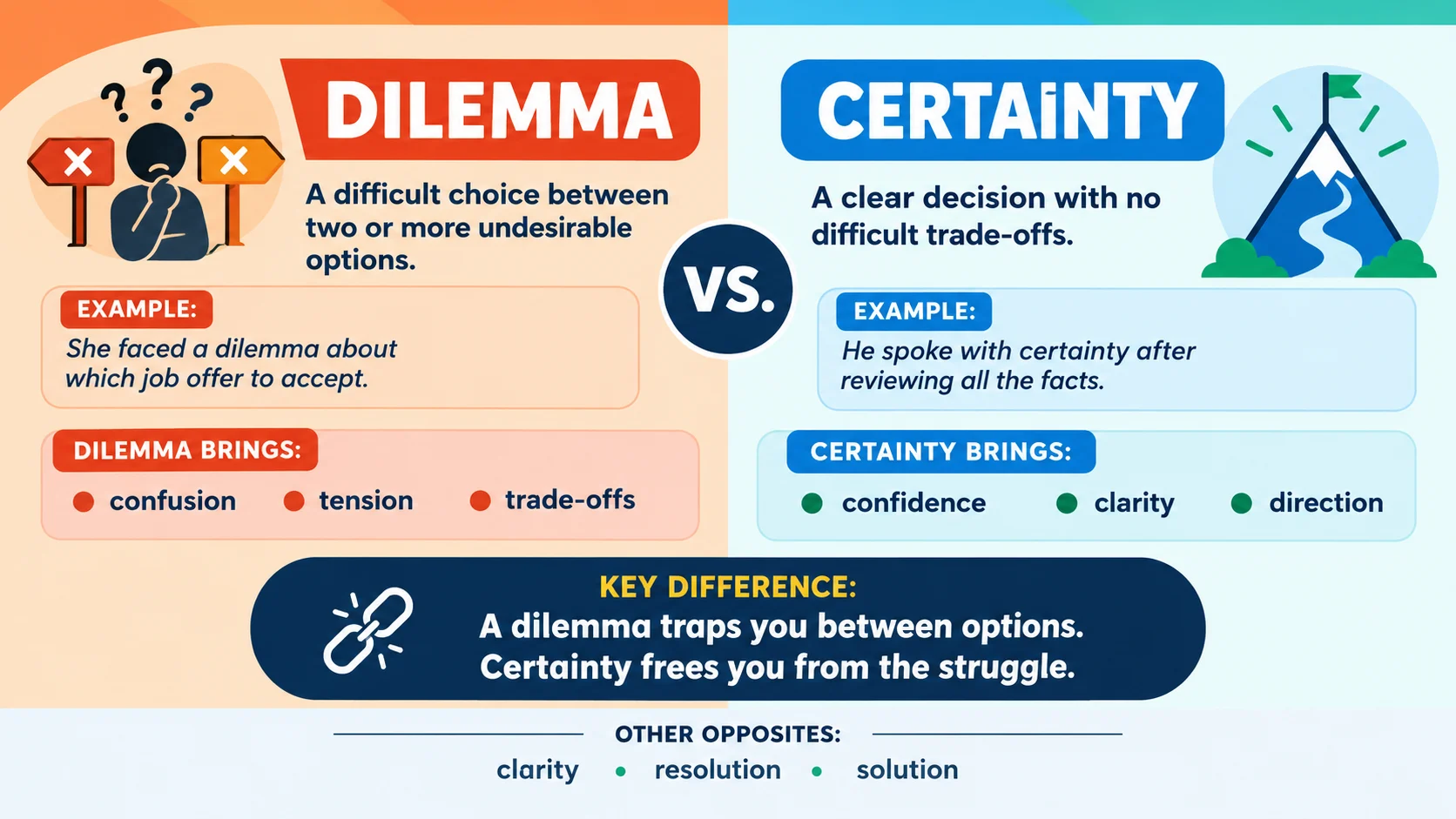
The opposite of a dilemma is certainty. A dilemma is a difficult situation requiring a choice between two or more undesirable options. Certainty means no such difficult choice exists. Other opposites include clarity, resolution, and solution, depending on the specific context of the sentence.
Part of Speech: Noun
Primary Opposite: Certainty
A dilemma puts you in a tough spot. You must pick between two or more options, and none of them feel good. The word captures that trapped feeling. Certainty stands as the strongest direct opposite because it describes the absence of that trap. When you have certainty, no difficult trade-off exists. You know what to do, or only one reasonable path remains.
Context can shift the best answer. Sometimes you need a word that emphasizes understanding, not confidence. Other times you need a word that signals an ending. The sections below break down each option so you can choose with precision.
Direct and Strong Antonyms
| Antonym | Tone or Nuance | Example Sentence |
|---|---|---|
| Certainty | Confident, decisive | After months of debate, she finally spoke with certainty about her career path. |
| Clarity | Calm, intellectual | The new information brought clarity to a decision that once felt impossible. |
| Resolution | Formal, conclusive | The committee reached a resolution after reviewing all the competing proposals. |
| Solution | Practical, problem-solving | A creative solution eliminated the dilemma entirely. |
| Ease | Casual, comfortable | Choosing a college turned out to be a matter of ease once she visited the campus. |
These words are not interchangeable. Each highlights a different aspect of what a dilemma lacks. Certainty focuses on the mental state. Clarity focuses on understanding. Resolution focuses on the outcome. Solution focuses on the fix. Ease focuses on the lack of difficulty.
Contextual and Subtle Opposites
The best opposite for dilemma shifts depending on the situation. Consider these common contexts.
| Context | Best Opposite | Why It Fits |
|---|---|---|
| A moral or ethical problem | Clarity | Moral dilemmas involve confusion about values. Clarity suggests a clear sense of right and wrong. |
| A practical decision | Easy choice | When options are not equally painful, the decision is simple. |
| A legal or formal dispute | Resolution | Legal dilemmas end with a formal decision. |
| An emotional struggle | Peace | Emotional dilemmas create inner turmoil. Peace suggests calm and acceptance. |
| A business strategy problem | Clear path | Business dilemmas involve competing priorities. A clear path suggests an obvious direction. |
Notice that resolution and solution are related but not identical. A resolution ends the dilemma. A solution removes it. A dilemma can be resolved without being solved, such as when you accept the lesser of two evils.
Some opposites are more colloquial. No-brainer is a direct opposite in casual American English. It means a decision so easy that it requires no thought. However, no-brainer is informal. Do not use it in academic or professional writing.
Words That Seem Opposite But Are Not
Common Grammatical or Semantic Confusions
Problem is not an antonym of dilemma. A problem is a broader term. Every dilemma is a problem, but not every problem is a dilemma. A problem might have one obvious solution. A dilemma requires a difficult choice between competing options.
Choice is not an antonym either. A dilemma involves a choice. The word choice describes the situation itself. It does not describe the absence of difficulty. In fact, a dilemma is a specific type of choice.
Subtle Tone Differences
Certainty and clarity are close, but they differ in tone. Certainty is about confidence. Clarity is about understanding. You can have clarity about a dilemma without feeling certain about the outcome. For example, you might clearly see two bad options and still feel uncertain about which is worse.
Resolution is more formal than solution. You resolve a dilemma. You solve a problem. The difference matters in professional writing. Use resolution when the dilemma ends through a decision. Use solution when the dilemma disappears because a new option emerges.
Frequently Asked Questions
What is the opposite of dilemma?
The opposite of dilemma is certainty. A dilemma involves a difficult choice between undesirable options. Certainty means no such difficult choice exists. Other opposites include clarity, resolution, and solution, depending on context. Choose the word that matches your specific meaning.
Is solution a true antonym of dilemma?
Solution is a contextual antonym, not a perfect direct opposite. A solution removes a problem. A dilemma is not always a problem in the traditional sense. You can resolve a dilemma without solving it. The word solution works best in practical or business contexts.
How do I use dilemma and its opposite in a sentence?
Use dilemma to describe a difficult choice. She faced a dilemma about whether to accept the job offer. Use certainty to describe a clear decision. He spoke with certainty after weighing all the options. Match the opposite to the tone and context of your sentence.
Practical Word Choice
Tip 1: Identify the intended meaning first. Is the dilemma about confusion, difficulty, or a specific choice? If confusion is the focus, use clarity. If difficulty is the focus, use ease or certainty. If the dilemma has ended, use resolution.
Tip 2: Match context, tone, and formality. Use certainty in professional writing. Use no-brainer in casual conversation. Use resolution in formal or legal contexts. The right antonym sounds natural in the sentence you are writing.
Final Thoughts
The opposite of a dilemma depends on what you are emphasizing. Certainty is the strongest direct antonym because it removes the difficult choice entirely. But clarity, resolution, and solution all work in specific contexts.
Context shapes word choice more than any rule. A dilemma in a business meeting is not the same as a moral dilemma in a novel. The best opposite reflects the specific tension you are trying to contrast.
When in doubt, ask yourself what the dilemma lacks. If it lacks confidence, use certainty. If it lacks understanding, use clarity. If it lacks an ending, use resolution. That simple question will guide you to the right word every time.
What dilemma have you faced recently, and what brought you certainty or clarity?