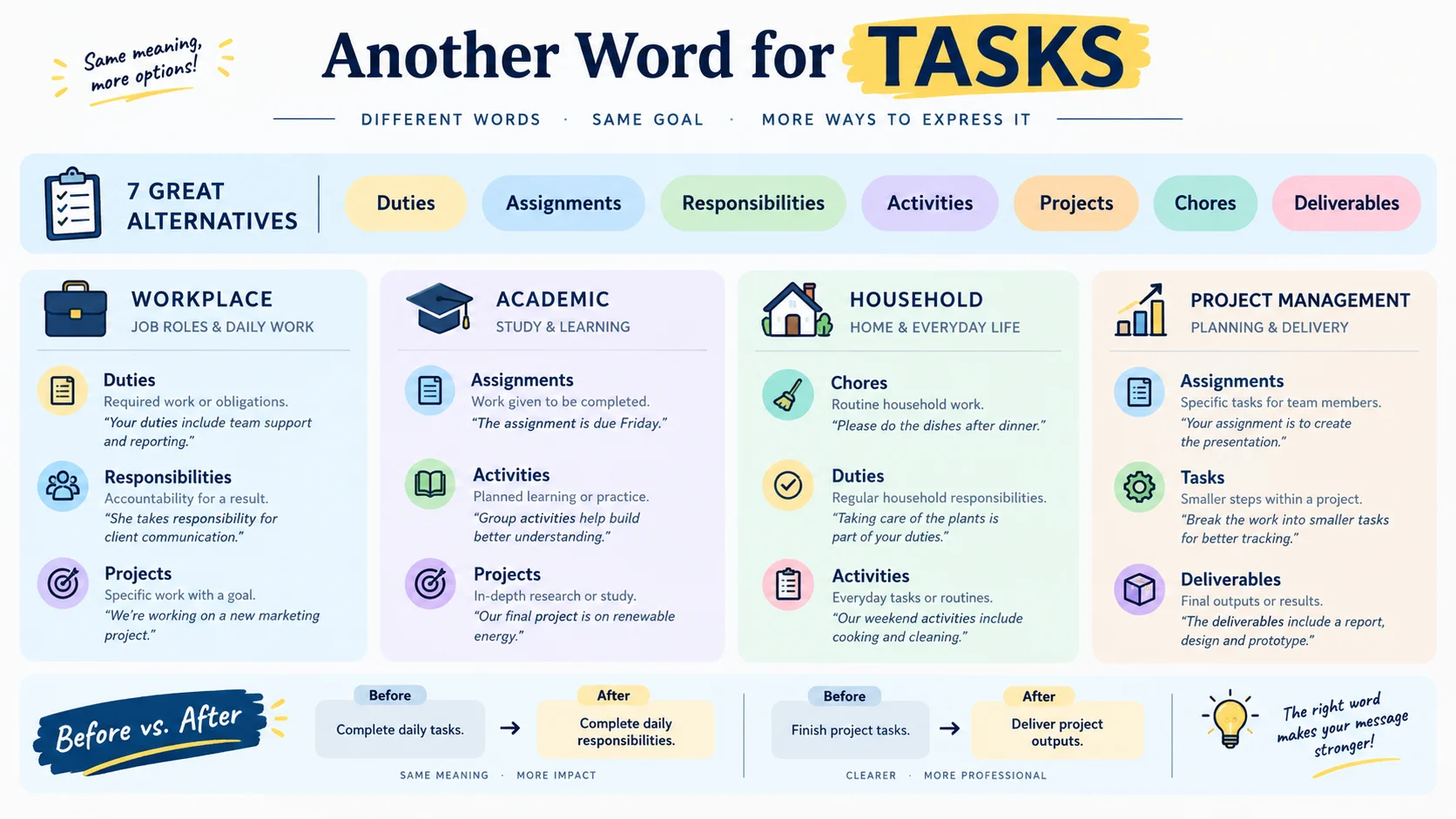
Another word for tasks depends on the context. Common synonyms include duties, assignments, responsibilities, activities, jobs, projects, functions, and chores. Use duties for expected work, assignments for tasks given to someone, responsibilities for ongoing obligations, and projects for larger pieces of work with specific goals. The best alternative depends on the type of task and the tone of your writing.
What Does Tasks Mean?
Definition
The word tasks is the plural form of task. It refers to pieces of work that need to be completed, activities that require effort, or specific duties assigned to a person or group.
For example:
- I completed all my daily tasks before lunch.
- The manager assigned new tasks to the team.
- Students must finish their research tasks before Friday.
- Her job includes several administrative tasks.
A task is usually a specific activity with a clear purpose. However, some tasks are small and routine, while others require extensive planning, specialized skills, or collaboration.
Common Uses
The word tasks appears in several everyday contexts:
- Workplace tasks: Activities completed as part of a job.
- Academic tasks: Assignments, exercises, and research activities.
- Household tasks: Cleaning, cooking, laundry, and other chores.
- Project tasks: Individual steps required to complete a larger project.
- Administrative tasks: Scheduling, recordkeeping, data entry, and organization.
- Technical tasks: Specific operations performed by a person, computer, or system.
Because these meanings overlap, choosing a more precise synonym can make your writing clearer and more professional.
Best Synonyms for Tasks
| Synonym | Meaning | Best Used When | Example |
|---|---|---|---|
| Duties | Work someone is expected to perform | Job descriptions and official roles | Her duties include managing records. |
| Assignments | Work given to someone to complete | School, college, and workplace projects | The team received three assignments. |
| Responsibilities | Obligations or areas of accountability | Leadership and ongoing work | His responsibilities include staff training. |
| Activities | Actions or things people do | General, educational, and group settings | The students completed several activities. |
| Jobs | Individual pieces of work | Informal conversation and practical work | I have a few jobs to finish today. |
| Projects | Organized efforts with a particular goal | Business, education, and teamwork | We are managing two major projects. |
| Chores | Routine or necessary everyday work | Household and repetitive activities | I finished my household chores. |
| Functions | Duties associated with a role or system | Organizational and technical contexts | These functions support daily operations. |
| Operations | Activities involved in running a process or organization | Business and technical work | The department oversees daily operations. |
| Procedures | Established steps for completing something | Compliance and technical processes | Employees must follow the required procedures. |
| Steps | Individual actions within a process | Instructions and project planning | We completed the first three steps. |
| Action items | Specific actions agreed upon or assigned | Meetings and project management | The meeting produced five action items. |
| Work items | Individual units of work to be tracked | Project management and software development | The developer closed all assigned work items. |
| Undertakings | Activities or commitments requiring effort | Formal and professional writing | The team completed several important undertakings. |
| Errands | Short trips or tasks done outside the home or workplace | Everyday responsibilities | I ran a few errands after work. |
Synonyms by Context
Formal Writing
In formal writing, duties, responsibilities, undertakings, assignments, and functions are useful alternatives to tasks.
Duties works well when describing the work associated with a position.
Example: The employee’s duties include preparing reports and maintaining records.
Responsibilities emphasizes accountability rather than simply completing individual activities.
Example: The department’s responsibilities include budget planning and performance monitoring.
Undertakings is a more formal choice for substantial activities or commitments.
Example: The organization completed several strategic undertakings during the reporting period.
Professional Writing
For business communication, consider action items, deliverables, work items, responsibilities, and operations.
Action items are specific actions that need to be completed, often following a meeting.
Business example: The team reviewed the action items and assigned deadlines to each department.
Deliverables refers to the results or outputs that must be produced, not necessarily every activity involved in producing them.
Business example: The project deliverables include a final report and a working prototype.
Work items is especially useful in project management when individual pieces of work are tracked.
Business example: The project manager reviewed the outstanding work items.
Academic Writing
Academic writing often uses assignments, exercises, activities, research activities, and projects.
Assignments refers to work given to students or researchers.
Academic example: Students must submit their assignments before the deadline.
Exercises is appropriate for practice activities designed to develop knowledge or skills.
Academic example: The instructor prepared exercises to improve students’ analytical abilities.
Research activities works when describing specific actions performed during a study.
Academic example: The research activities included collecting data and reviewing previous studies.
Daily Conversation
In everyday English, jobs, chores, things to do, errands, and activities often sound more natural than formal alternatives.
Examples:
- Instead of “I have several tasks,” say “I have several things to do.”
- Instead of “I completed my household tasks,” say “I finished my chores.”
- Instead of “I have three tasks outside the office,” say “I have three errands to run.”
- Instead of “We divided the tasks,” say “We split up the work.”
These expressions make casual communication feel more natural and conversational.
Professional Alternatives for Tasks
When writing a resume, email, job description, or business report, choose a synonym that reflects the type of work and your level of responsibility.
Responsibilities
Meaning: Duties or obligations that someone is expected to manage.
Best Used For: Job descriptions, leadership roles, and professional accountability.
Tone: Professional
Difficulty: Easy
Usage Frequency: Very Common
Best For: Resume, Email Writing, Business Writing
- Business example: Managed responsibilities related to customer service and team coordination.
- Academic example: The researcher’s responsibilities included reviewing data and documenting results.
- Daily conversation example: My responsibilities have increased since I became a supervisor.
Assignments
Meaning: Specific pieces of work given to someone for completion.
Best Used For: Academic work, workplace projects, and delegated activities.
Tone: Neutral to professional
Difficulty: Easy
Usage Frequency: Very Common
Best For: Resume, Email Writing, Essay Writing, Business Writing
- Business example: Completed assigned projects and supported cross-functional teams.
- Academic example: Students completed assignments designed to strengthen critical thinking.
- Daily conversation example: I finished my assignments early.
Deliverables
Meaning: Specific outputs or results that a project or person is expected to provide.
Best Used For: Project management, client work, consulting, and business agreements.
Tone: Professional
Difficulty: Medium
Usage Frequency: Common
Best For: Resume, Email Writing, Marketing Copy, Business Writing
- Business example: Delivered project deliverables within the agreed timeline.
- Academic example: The research deliverables included a written report and a presentation.
- Daily conversation example: We need to finish the deliverables before Friday.
Action Items
Meaning: Specific actions that have been identified and need to be completed.
Best Used For: Meetings, planning, project tracking, and team coordination.
Tone: Professional and practical
Difficulty: Easy
Usage Frequency: Common
Best For: Email Writing, Resume, Business Writing
- Business example: Tracked action items and followed up with team members.
- Academic example: The research group documented action items after each meeting.
- Daily conversation example: I’ll take care of my action items this afternoon.
Simple Alternatives for Tasks
If you want an easy replacement, consider these options:
- Work: General activities that need to be completed.
- Jobs: Individual pieces of work, often informal.
- Things to do: A natural conversational phrase.
- Chores: Routine household or everyday duties.
- Steps: Individual actions in a process.
- Activities: General actions or organized events.
- Assignments: Work given to someone.
- Duties: Expected work associated with a role.
For example, “I have several tasks to complete” could become “I have several jobs to finish” or “I have several things to do.”
Stronger Alternatives for Tasks
Sometimes a more specific word makes your writing stronger.
Responsibilities emphasizes accountability and ongoing obligations.
Deliverables focuses on the results that must be produced.
Action items highlights concrete actions that require follow-up.
Operations describes the activities involved in running a business, department, or system.
Initiatives refers to planned efforts designed to achieve a broader objective. It is not a direct synonym for every task.
Milestones identifies important stages or checkpoints in a project, rather than individual activities.
For example, “The team completed its tasks” could become “The team delivered the required project outputs.” This version is more precise when the intended meaning concerns results rather than the work itself.
Difference Between Similar Synonyms
Tasks vs. Duties: Tasks are specific pieces of work. Duties are expected responsibilities associated with a role or position.
Tasks vs. Responsibilities: A task is an activity to complete, while a responsibility is an obligation or area of accountability that may involve many tasks.
Tasks vs. Assignments: Tasks can be self-selected or assigned. Assignments specifically refer to work given to someone.
Tasks vs. Projects: A task is usually one unit of work. A project typically contains multiple tasks organized around a larger goal.
Tasks vs. Activities: Activities is a broader term that can include actions that do not have a specific completion requirement. Tasks generally imply work that needs to get done.
Tasks vs. Deliverables: Tasks describe the work performed, while deliverables describe the outputs produced.
Tasks vs. Chores: Chores are routine or necessary activities, often related to household upkeep. Tasks can include almost any type of work.
Opposite Words
The word tasks does not have one exact antonym. Its opposite depends on the intended contrast.
| Meaning of Tasks | Possible Opposite | Example |
|---|---|---|
| Work to complete | Leisure | She spent the evening enjoying leisure time. |
| Assigned duties | Free time | He had no assigned duties that afternoon. |
| Required activities | Inactivity | The system remained inactive during maintenance. |
| Work obligations | Rest | The employees took a break after finishing their work. |
| Actions to perform | Inaction | Inaction delayed the project. |
These are contextual contrasts rather than exact antonyms. The most natural choice depends on the sentence.
FAQs
What is another word for tasks?
Common alternatives include duties, assignments, responsibilities, activities, jobs, projects, chores, and action items. The best word depends on the type of work and the intended tone.
What is a formal synonym for tasks?
Formal alternatives include duties, responsibilities, assignments, functions, and undertakings. In professional reports, the most accurate choice depends on whether you mean assigned work, ongoing obligations, or broader activities.
What is a professional alternative for tasks?
Useful business alternatives include responsibilities, action items, deliverables, work items, and operations. Use deliverables when referring to expected results rather than the individual activities required to produce them.
What is another word for tasks on a resume?
Consider responsibilities, duties, projects, deliverables, and achievements. Use achievements only when describing actual results, not routine work alone.
What is another word for daily tasks?
Common alternatives include daily duties, routine activities, everyday responsibilities, and chores. For a workplace, “daily responsibilities” often sounds professional and natural.
What is another word for assigned tasks?
Use assignments, delegated duties, action items, or allocated work. “Assignments” is especially suitable for schoolwork and formally delegated activities.
What is another word for work tasks?
Useful options include work items, job duties, responsibilities, assignments, and activities. In project management, “work items” can be useful for tracking individual pieces of work.
Is task the same as responsibility?
No. A task is a specific activity that needs to be completed. A responsibility is a duty or area of accountability that may include several tasks.
What is another word for completing tasks?
Depending on the context, use finishing assignments, fulfilling responsibilities, executing activities, accomplishing objectives, or delivering results. Each phrase emphasizes a slightly different aspect of completion.
What is the difference between tasks and deliverables?
Tasks are the activities performed to complete work. Deliverables are the tangible or defined results produced by that work, such as a report, design, presentation, or software feature.
Conclusion
The best another word for tasks depends on the context. Choose duties for expected work, assignments for delegated activities, responsibilities for accountability, chores for routine work, and deliverables for expected results.
For professional writing and resumes, specific terms can communicate your role more effectively than repeatedly using tasks. In everyday conversation, simple alternatives such as jobs, work, and things to do are often more natural.
The goal is to select a word that accurately describes the work, its purpose, and the context in which it is being discussed.