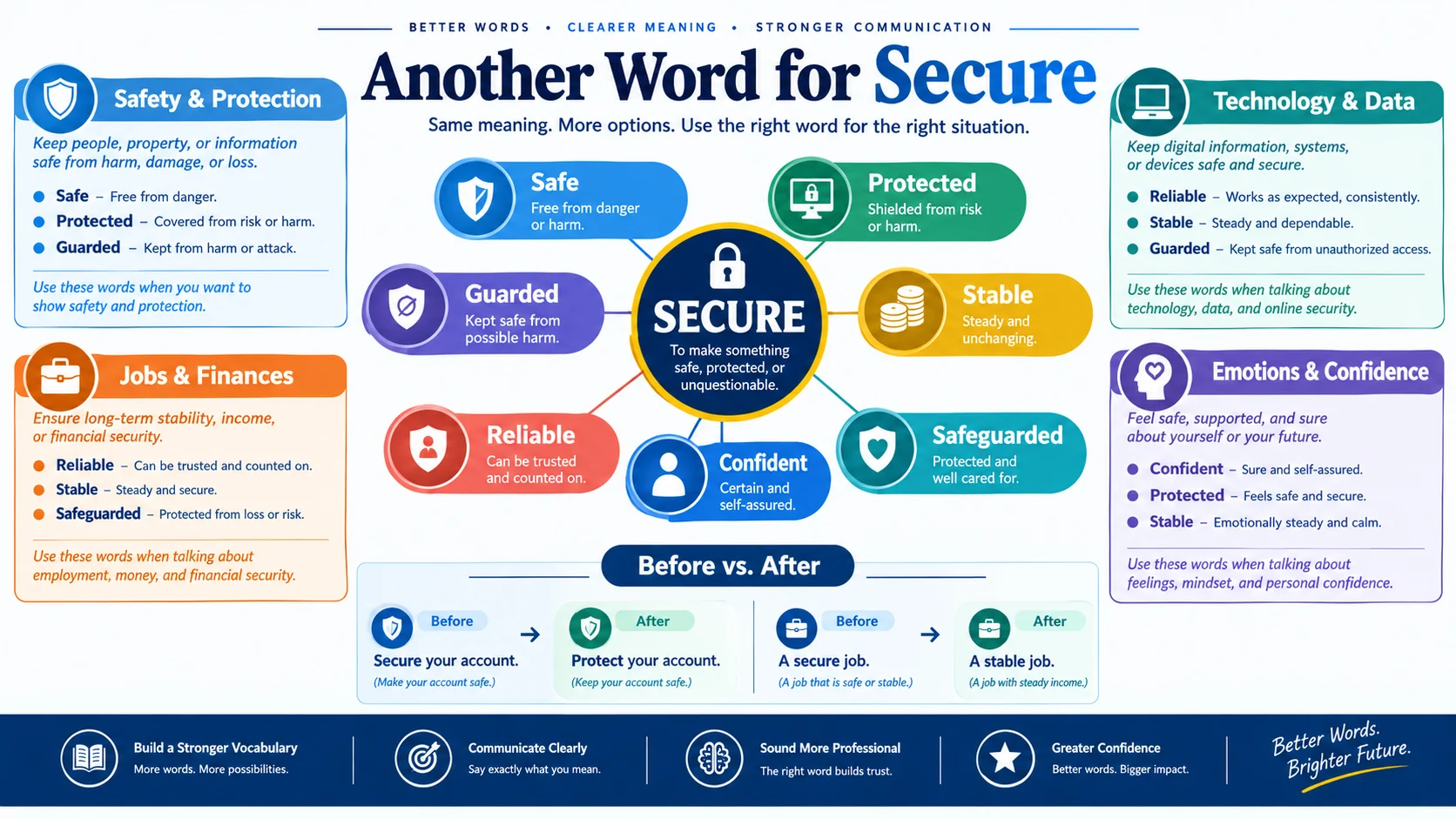
Another word for secure depends on the context. Common synonyms include safe, protected, stable, reliable, guaranteed, fastened, assured, and confident. Use safe when something is free from danger, protected when safeguards are in place, stable for something unlikely to change, and confident when describing a person’s feelings. The right word makes your meaning more precise.
What Does Secure Mean?
Definition
The word secure can function as both an adjective and a verb in American English. As an adjective, it describes something that is safe, protected, stable, or free from danger. As a verb, it means to protect something, fasten it firmly, or obtain something successfully.
For example:
- The website uses a secure payment system.
- She feels secure in her new position.
- Please secure the door before leaving.
- The company hopes to secure a new contract.
Because secure has several meanings, its synonyms are not always interchangeable. A secure password, a secure job, a secure building, and a secure business deal each require different word choices.
Common Uses
The word secure commonly appears in these contexts:
- Safety: A secure building or location is protected from danger.
- Technology: A secure account or connection is protected against unauthorized access.
- Employment: A secure job offers stability and dependable income.
- Emotions: A secure person feels confident and reassured.
- Physical objects: To secure something means to fasten it firmly.
- Business and achievements: To secure a contract means to obtain or successfully arrange it.
Understanding the intended meaning helps you choose a synonym that sounds natural.
Best Synonyms for Secure
| Synonym | Meaning | Best Used When | Example |
|---|---|---|---|
| Safe | Free from danger or harm | Personal safety and general protection | The children are safe at home. |
| Protected | Defended against harm or loss | Data, people, property, and information | Your files are protected by encryption. |
| Guarded | Watched over or defended | Locations, assets, and personal behavior | The entrance is guarded around the clock. |
| Stable | Unlikely to change suddenly | Jobs, finances, relationships, and systems | She has a stable source of income. |
| Reliable | Dependable and consistent | Equipment, services, and systems | We need a reliable security system. |
| Certain | Definite or assured | Outcomes, decisions, and expectations | Success is not certain. |
| Assured | Confident or guaranteed | Feelings, outcomes, and formal communication | She sounded assured during the presentation. |
| Confident | Believing in one’s abilities or judgment | People, emotions, and decisions | He feels confident about the interview. |
| Firm | Fixed or unlikely to move | Physical objects, agreements, and commitments | The equipment needs a firm attachment. |
| Fastened | Attached or closed securely | Doors, belts, packages, and equipment | Make sure the lid is fastened. |
| Locked | Closed with a lock or locking mechanism | Doors, accounts, devices, and containers | The office is locked after hours. |
| Defended | Protected against an attack or threat | People, property, and arguments | The facility is defended by trained personnel. |
| Sheltered | Protected from harsh conditions or danger | People, animals, and places | The plants are sheltered from strong winds. |
| Established | Recognized, settled, or firmly in place | Businesses, careers, and arrangements | She has an established career. |
| Obtain | To get or acquire something | Contracts, funding, permission, or employment | The team hopes to obtain funding. |
Synonyms by Context
Formal Writing
In formal writing, protected, assured, stable, reliable, and established can replace secure when their meanings fit.
For example:
- Original: The organization maintains a secure database.
- Alternative: The organization maintains a protected database.
Here, protected emphasizes safeguards against unauthorized access.
For a long-term agreement, stable may be more appropriate:
- Original: The company has a secure partnership.
- Alternative: The company has a stable partnership.
However, secure may be the better choice when you specifically mean protection against threats or risks.
Professional Writing
In business communication, useful alternatives include reliable, stable, protected, established, and obtain.
Reliable describes a system or service that performs dependably.
Business example: We selected a reliable provider for our data storage needs.
Stable works well when discussing employment, finances, or business conditions.
Business example: The company offers stable employment opportunities.
Obtain is suitable when secure means successfully getting something.
Business example: The sales team worked to obtain a long-term client contract.
For resumes, use action verbs that communicate your actual achievements, such as obtained funding, established partnerships, or protected confidential information.
Academic Writing
Academic writing often benefits from protected, stable, reliable, assured, and established, depending on the subject.
For research involving technology, protected can describe information safeguarded against unauthorized access.
Academic example: The researchers stored the participants’ information in a protected database.
For scientific systems or experimental conditions, stable may be more precise.
Academic example: The experiment required stable environmental conditions.
When describing a research method, reliable refers to consistency and dependability rather than safety alone.
Academic example: The team used a reliable instrument to collect measurements.
Daily Conversation
In everyday conversation, safe, protected, locked, confident, and fastened are usually easy and natural choices.
Examples:
- Instead of “The children are secure,” say “The children are safe.”
- Instead of “Make the door secure,” say “Lock the door.”
- Instead of “She feels secure about her decision,” say “She feels confident about her decision.”
- Instead of “Secure your seat belt,” say “Fasten your seat belt.”
These alternatives sound natural because they describe the exact action or feeling.
Professional Alternatives for Secure
The best professional alternative depends on whether you are describing protection, stability, confidence, or an achievement.
Protected
Meaning: Kept safe from harm, damage, or unauthorized access.
Best Used For: Data security, confidential information, assets, and personal safety.
Tone: Professional and neutral
Difficulty: Easy
Usage Frequency: Very Common
Best For: Resume, Email Writing, Business Writing
- Business example: Protected confidential client records through access controls.
- Academic example: The study’s data were protected through appropriate security measures.
- Daily conversation example: I keep my personal information protected online.
Reliable
Meaning: Dependable and likely to perform consistently.
Best Used For: Services, equipment, systems, and business partners.
Tone: Professional
Difficulty: Easy
Usage Frequency: Very Common
Best For: Resume, Marketing Copy, Business Writing
- Business example: Selected reliable vendors to support daily operations.
- Academic example: The researchers used a reliable measurement tool.
- Daily conversation example: This is a reliable car for long trips.
Stable
Meaning: Firm, steady, or unlikely to change unexpectedly.
Best Used For: Employment, finances, systems, and long-term arrangements.
Tone: Neutral to professional
Difficulty: Easy
Usage Frequency: Very Common
Best For: Resume, Essay Writing, Business Writing
- Business example: Maintained stable operations during a period of growth.
- Academic example: The model produced stable results across repeated trials.
- Daily conversation example: I’m looking for a stable job.
Obtain
Meaning: Successfully get or acquire something.
Best Used For: Contracts, funding, permissions, and resources.
Tone: Formal
Difficulty: Medium
Usage Frequency: Common
Best For: Resume, Email Writing, Academic Writing, Business Writing
- Business example: Obtained approval for the proposed project.
- Academic example: The research team obtained permission to access the records.
- Daily conversation example: I finally obtained a copy of the document.
Simple Alternatives for Secure
If you want a straightforward replacement, consider these options:
- Safe: A safe place or person.
- Protected: Information protected from unauthorized access.
- Locked: A locked door or device.
- Fixed: An object held firmly in place.
- Steady: A steady income or situation.
- Confident: A person who trusts their abilities.
- Get: Get a contract or permission.
- Fasten: Fasten a belt or strap.
The simplest word is often the clearest. For example, “Keep your account safe” may be more approachable than “Maintain a secure account,” depending on the audience.
Stronger Alternatives for Secure
Sometimes a more specific word creates a stronger sentence.
Safeguard emphasizes actively protecting something against harm or loss.
Example: The company introduced controls to safeguard customer information.
Fortify means strengthening something against attack, damage, or failure.
Example: The organization fortified its network against cyber threats.
Guarantee means providing an assurance that something will happen or be true, although the strength of that assurance depends on the context.
Example: The agreement guarantees payment under specified conditions.
Obtain emphasizes successfully getting something that may require effort or negotiation.
Example: The company obtained a major government contract.
Establish emphasizes creating or building something that becomes recognized or firmly in place.
Example: She established a secure professional network.
These words are not universal replacements for secure. Choose them when their more specific meanings match your intention.
Difference Between Similar Synonyms
Secure vs. Safe: Safe generally means free from danger or harm. Secure often emphasizes protection against identifiable risks or threats. A location can be safe without having extensive security measures.
Secure vs. Protected: Protected highlights the presence of safeguards. Secure can also describe stability, confidence, or successful acquisition.
Secure vs. Stable: Stable means unlikely to change or fail unexpectedly. A stable job is dependable, while a secure job often emphasizes freedom from the threat of losing employment.
Secure vs. Reliable: Reliable means dependable and consistent. A reliable system works as expected, while a secure system is protected against threats. A system can be reliable without being secure.
Secure vs. Confident: Confident describes belief in one’s abilities or decisions. Secure can describe emotional confidence, but it also applies to physical safety and protection.
Secure vs. Obtain: Secure can mean successfully obtaining something, especially through effort or negotiation. Obtain simply means getting or acquiring it.
Secure vs. Fasten: Fasten means attach or close something firmly. Secure may describe the broader goal of making an object stable or safe.
Opposite Words
The antonym of secure depends on its meaning in a sentence.
| Meaning | Opposite | Example |
|---|---|---|
| Safe from danger | Unsafe | The building was declared unsafe. |
| Protected | Vulnerable | The system remained vulnerable to attacks. |
| Stable | Unstable | The financial situation became unstable. |
| Confident | Insecure | He felt insecure about his performance. |
| Firmly attached | Loose | The strap was loose. |
| Locked or fastened | Unlocked | The door was left unlocked. |
| Successfully obtained | Lose or forfeit | The company lost the contract. |
These words express different kinds of opposition, so choose the antonym that matches the intended meaning.
FAQs
What is another word for secure?
Common synonyms include safe, protected, stable, reliable, guarded, assured, confident, and fastened. When secure means obtaining something, alternatives include obtain, acquire, and gain.
What is a formal synonym for secure?
Formal alternatives include protected, safeguarded, established, stable, and assured. The best option depends on whether the context involves safety, confidence, or stability.
What is a professional alternative for secure?
Use protected for confidential information, reliable for dependable systems, stable for employment or finances, and obtain for contracts or funding.
What is another word for secure a job?
Depending on the sentence, you can say obtain a job, land a job, gain employment, or find a position. “Land a job” is conversational, while “obtain employment” is more formal.
What is another word for secure information?
Useful alternatives include protect, safeguard, encrypt, and restrict access to. The most accurate word depends on the specific security measure.
What is another word for secure a deal?
Common alternatives include finalize, obtain, negotiate, close, and conclude a deal. “Close a deal” is common in business conversation.
Is safe the same as secure?
Not exactly. Safe emphasizes freedom from danger or harm, while secure can emphasize protection, stability, or freedom from unauthorized access. The words overlap but are not always interchangeable.
What is another word for emotionally secure?
Possible alternatives include confident, self-assured, comfortable, and reassured. “Self-assured” is especially useful when describing confidence in one’s judgment or abilities.
What is another word for a secure password?
Depending on the context, use strong password or hard-to-guess password. A strong password is designed to resist guessing or cracking, while a secure account also depends on other protective measures.
What is the opposite of secure?
Common antonyms include unsafe, vulnerable, insecure, unstable, and unprotected. The correct opposite depends on whether secure describes safety, stability, emotional confidence, or physical attachment.
Conclusion
The best another word for secure depends on what you want to communicate. Choose safe for general protection, protected for information and assets, stable for jobs and finances, reliable for dependable systems, and confident for a person’s feelings. When secure means successfully obtaining something, consider obtain, acquire, or gain.
Precise word choice makes your writing clearer and more natural, whether you’re preparing a resume, writing an academic paper, communicating professionally, or having an everyday conversation.