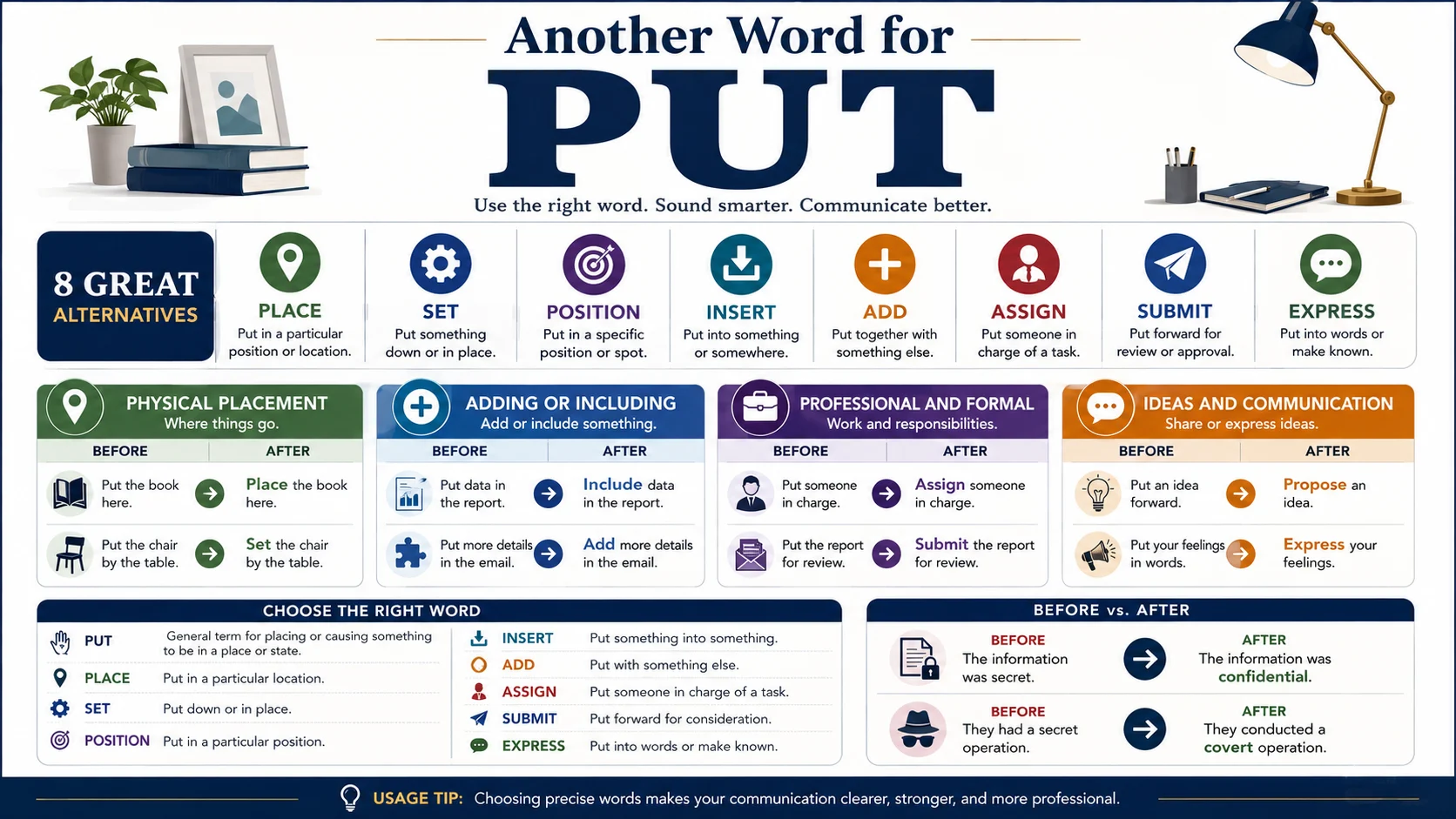
Another word for put depends on the context. Common alternatives include place, set, position, insert, add, submit, present, state, assign, establish, and cause. For example, “put the book on the table” can become “place the book on the table,” while “put your ideas into words” can become “express your ideas.”
What Does Put Mean?
Definition
Put is a versatile English verb that generally means to move, place, position, add, or cause something to be in a particular condition, location, or situation. It can also mean to express an idea, submit something, assign responsibility, or take an action.
The word is extremely common in American English because it works naturally in both casual and formal sentences.
For example:
- Put the keys on the desk.
- Put the information in the report.
- She put her ideas into words.
- The manager put him in charge of the project.
- They put the proposal forward for discussion.
Because put has so many meanings, choosing a synonym requires attention to the sentence.
Common Uses
Put can describe several different actions:
| Meaning of “Put” | Example |
|---|---|
| Place something somewhere | Put the phone on the table. |
| Insert something | Put the card into the machine. |
| Add something | Put sugar in the coffee. |
| Express something | Put your thoughts into words. |
| Submit something | Put forward a proposal. |
| Assign someone | Put her in charge. |
| Cause something to happen | Put pressure on the team. |
| Establish something | Put a system in place. |
| Store something | Put the documents away. |
| Apply something | Put cream on the wound. |
This range explains why place is not always the best replacement for put.
Best Synonyms for Put
The best synonym depends on what you mean.
| Synonym | Meaning | Best Used When | Example |
|---|---|---|---|
| Place | Put something in a particular location | Physical objects and formal writing | Place the files on the desk. |
| Set | Put something somewhere or into a position | Objects, settings, or arrangements | Set the glass on the counter. |
| Position | Place deliberately or strategically | Professional, technical, or formal contexts | Position the equipment near the wall. |
| Insert | Put something inside another thing | Forms, devices, documents, and text | Insert the card into the reader. |
| Add | Put something together with something else | Ingredients, information, features, or items | Add the details to the report. |
| Assign | Give a task, role, or responsibility | Workplace and academic contexts | Assign the project to a team member. |
| Submit | Give something for review or consideration | Applications, assignments, proposals | Submit the form by Friday. |
| Present | Put forward information or an idea | Meetings, business, and academic writing | Present your findings to the committee. |
| State | Put an idea or fact into words | Formal and academic writing | State your main argument clearly. |
| Express | Put thoughts or feelings into words | Communication and writing | Express your concerns professionally. |
| Establish | Put something into operation or existence | Systems, rules, policies, and procedures | Establish a clear process. |
| Apply | Put something into use or onto a surface | Rules, methods, products, and substances | Apply the solution carefully. |
| Install | Put equipment or software in place | Technology and construction | Install the new software. |
| Store | Put something somewhere for future use | Files, equipment, and belongings | Store the documents securely. |
| Arrange | Put things into an organized order | Objects, schedules, and plans | Arrange the chairs in rows. |
Place
Place is one of the closest alternatives to put when you mean physically moving something to a location.
Meaning: To put something in a particular position or location.
Best used for: Physical objects, instructions, formal writing.
Tone: Neutral to formal
Difficulty: Easy
Usage Frequency: Very Common
Business example: Place the signed contract in the client folder.
Academic example: Place the samples on a clean laboratory surface.
Daily conversation: Please place your bag by the door.
Set
Set can replace put when something is deliberately positioned or arranged.
Meaning: To put something in a particular position.
Best used for: Objects, devices, tables, settings, and arrangements.
Tone: Neutral
Difficulty: Easy
Usage Frequency: Very Common
Business example: Set the equipment on the designated platform.
Academic example: Set the temperature to 25°C before beginning the experiment.
Daily conversation: Set your phone on the table.
Position
Position suggests deliberate placement, often with attention to location or strategy.
Meaning: To place something or someone in a particular position.
Best used for: Professional, technical, business, and formal contexts.
Tone: Professional
Difficulty: Medium
Usage Frequency: Common
Business example: Position the product prominently on the display.
Academic example: Position the camera directly above the sample.
Daily conversation: Position the chair closer to the window.
Insert
Use insert when something goes inside another object, document, system, or space.
Business example: Insert the customer ID into the required field.
Academic example: Insert the citation after the relevant statement.
Daily conversation: Insert the card into the machine.
Add
Use add when put means including something with something else.
Business example: Add the revised figures to the financial report.
Academic example: Add supporting evidence to the discussion.
Daily conversation: Add some milk to my coffee.
Assign
Use assign when put means giving someone a task, responsibility, position, or role.
Business example: The manager assigned the task to the marketing team.
Academic example: The professor assigned each student a research topic.
Daily conversation: They assigned me a different seat.
Submit
Use submit when put means formally giving something for review, approval, grading, or consideration.
Business example: Please submit the proposal before the deadline.
Academic example: Students must submit their essays electronically.
Daily conversation: I put in my application yesterday. → I submitted my application yesterday.
Synonyms by Context
Formal Writing
Formal alternatives to put include:
- Place
- Position
- Establish
- Insert
- Present
- State
- Apply
- Implement
- Introduce
- Submit
Instead of writing:
The organization put a new policy in place.
You could write:
The organization established a new policy.
The second version sounds more precise because establish specifically describes creating or formally introducing something.
Professional Writing
In business writing, choose a synonym that explains the exact action.
Instead of:
We put the information in the report.
Consider:
We included the information in the report.
Instead of:
The company put a new system in place.
Consider:
The company implemented a new system.
Instead of:
The manager put Sarah in charge.
Consider:
The manager assigned Sarah to lead the team.
Professional writing benefits from specificity. The more accurately your replacement describes the action, the clearer your sentence becomes.
Academic Writing
Academic alternatives include:
- State
- Present
- Establish
- Demonstrate
- Include
- Introduce
- Propose
- Identify
- Define
- Explain
For example:
The researcher put forward a possible explanation.
can become:
The researcher proposed a possible explanation.
Similarly:
The study puts emphasis on early intervention.
can become:
The study emphasizes early intervention.
Daily Conversation
Everyday alternatives include:
- Place
- Set
- Add
- Leave
- Move
- Drop
- Keep
- Give
- Put away
- Put down
Examples:
Put the keys here.
Place the keys here.
Put your phone down.
Set your phone down.
Put the dishes away.
Store the dishes.
However, the original put often sounds more natural in casual conversation. A synonym is not automatically better simply because it sounds more formal.
Professional Alternatives for Put
When writing a resume, email, report, or business document, more precise alternatives can improve clarity.
| Instead of “put” | Consider |
|---|---|
| Put a plan into action | Implemented a plan |
| Put a system in place | Established a system |
| Put information in a report | Included information |
| Put someone in charge | Assigned someone to lead |
| Put an idea forward | Proposed an idea |
| Put data into a database | Entered data |
| Put a product on the market | Launched a product |
| Put a rule into effect | Enforced or implemented a rule |
| Put emphasis on | Emphasized |
| Put together a report | Compiled a report |
For resume writing, implemented, developed, established, coordinated, organized, launched, created, and compiled can be more informative than repeatedly using put.
Simple Alternatives for Put
If you want easy words that most readers understand, try:
- Place
- Set
- Add
- Move
- Leave
- Keep
- Give
- Store
- Include
- Put down
- Put away
For example:
Put the book on the shelf.
→ Place the book on the shelf.
Put the files in the folder.
→ Place the files in the folder.
Put some sugar in the tea.
→ Add some sugar to the tea.
Simple alternatives work especially well when writing for a broad audience.
Stronger Alternatives for Put
When put feels too vague, choose a stronger verb based on the intended meaning.
- Implement a strategy
- Establish a system
- Introduce a policy
- Insert a value
- Assign a responsibility
- Submit an application
- Propose an idea
- Express an opinion
- Emphasize an important point
- Position an object
- Install equipment
- Organize materials
- Arrange objects
- Deploy technology
The strongest replacement is the one that communicates the exact action rather than simply sounding more sophisticated.
Difference Between Similar Synonyms
Put vs. Place
Put is broader and more common. Place specifically emphasizes putting something somewhere.
- Put the book here.
- Place the book here.
Both work, but place can sound more deliberate or formal.
Put vs. Set
Set often suggests positioning something carefully or establishing a particular setting.
- Put the cup on the table.
- Set the cup on the table.
Both are natural, but the exact distinction can depend on regional and contextual usage.
Put vs. Position
Position implies deliberate placement, often according to a particular purpose.
- Put the camera near the door.
- Position the camera near the entrance.
The second sentence sounds more technical and intentional.
Put vs. Insert
Insert means putting something inside something else.
- Put the card in the reader.
- Insert the card into the reader.
Insert is more precise when the object enters an opening, system, document, or container.
Put vs. Add
Add means including something with something else.
- Put some salt in the soup.
- Add some salt to the soup.
Use add when the important idea is inclusion rather than physical placement.
Put vs. Establish
Establish means creating, setting up, or formally putting something into existence.
- The company put a new procedure in place.
- The company established a new procedure.
The second sentence clearly communicates that the company created or formally introduced the procedure.
Opposite Words
The opposite of put depends on the meaning.
| Meaning of Put | Possible Opposite |
|---|---|
| Put something somewhere | Remove |
| Put something inside | Take out |
| Put something on | Take off |
| Put something down | Pick up |
| Put something away | Take out |
| Put something together | Separate |
| Put something in place | Remove |
| Put something into operation | Disable |
| Put something forward | Withdraw |
There is no single opposite that works for every use of put.
FAQs
What is another word for put?
Common alternatives include place, set, position, insert, add, assign, submit, present, state, establish, apply, and store. The correct choice depends on what put means in the sentence.
What is a formal synonym for put?
Formal alternatives include place, position, establish, implement, introduce, submit, present, state, and insert. Choose the word that accurately describes the specific action.
What is a professional alternative for put?
Professional alternatives include implement, establish, assign, submit, position, introduce, include, present, and propose. For business writing, specificity is usually more useful than simply replacing every occurrence of put.
What word can replace put in an essay?
Depending on the sentence, use state, present, establish, propose, introduce, include, demonstrate, emphasize, or explain. Academic writing should use the verb that precisely describes the author’s action.
What is another word for “put in”?
Possible alternatives include insert, add, include, install, introduce, submit, enter, or place. For example, “put in the data” may become “enter the data.”
What is another word for “put together”?
Depending on the context, alternatives include assemble, compile, organize, arrange, construct, create, or combine.
What is another word for “put forward”?
Common alternatives include propose, present, suggest, recommend, introduce, or submit.
What is another word for “put in place”?
Alternatives include establish, implement, introduce, install, create, or set up.
What is another word for “put into words”?
The best alternatives include express, articulate, describe, explain, state, or communicate.
What is another word for “put pressure on”?
Depending on the meaning, alternatives include pressure, influence, urge, push, compel, or encourage. The appropriate choice depends on the degree and type of pressure involved.
Conclusion
Put is one of the most flexible verbs in English, so its best synonym changes with the context. Use place for physical location, position for deliberate placement, insert for putting something inside, add for inclusion, assign for responsibilities, submit for formal delivery, express for ideas or feelings, and establish or implement for systems and procedures.
The goal is not to replace put every time. In everyday American English, put is often the clearest and most natural choice. Use a synonym when it gives your sentence greater precision, variety, or an appropriate level of formality.