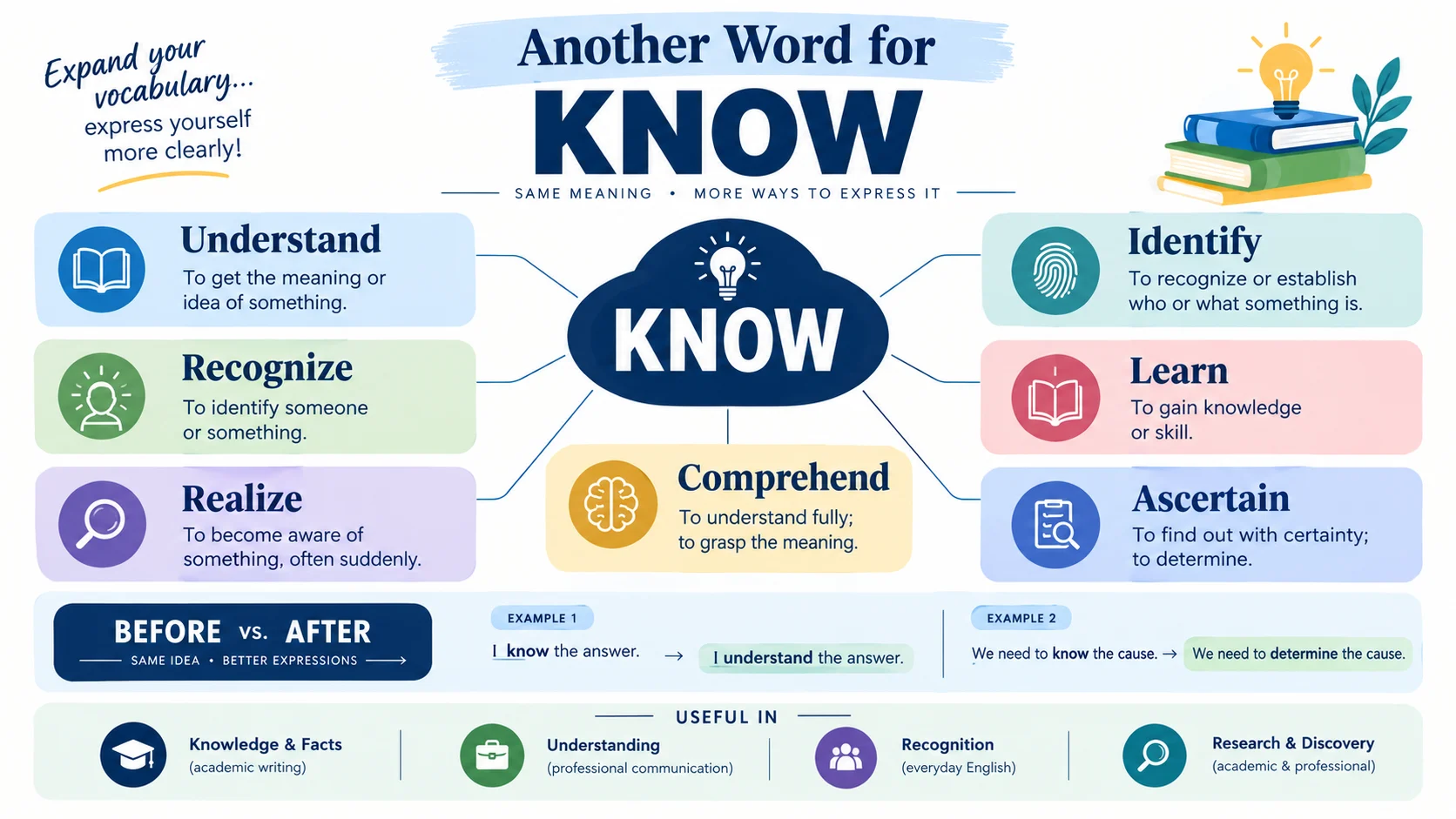
Another word for know depends on the context. Common synonyms include understand, recognize, realize, comprehend, understand, identify, learn, and be aware of. Use understand when you grasp an idea, recognize when you identify someone or something, realize when you become aware of a fact, and comprehend in formal or academic writing. The best alternative depends on what you mean.
What Does Know Mean?
Definition
The word know is a verb in American English that means to have information about something, understand a fact or idea, recognize a person or object, or be familiar with a subject through experience.
For example:
- I know the answer to the question.
- She knows how the system works.
- Do you know that person?
- He knows a lot about computer science.
The word can describe factual knowledge, personal familiarity, practical experience, or understanding. Because these meanings differ, no single synonym works naturally in every sentence.
Common Uses
The word know commonly appears in these contexts:
- Knowledge of facts: Knowing information, answers, or details.
- Understanding: Knowing how an idea, process, or system works.
- Recognition: Knowing a person, face, sound, or object.
- Awareness: Knowing that something exists or has happened.
- Experience: Knowing a subject or situation firsthand.
- Certainty: Knowing that something is true or likely to happen.
Identifying the intended meaning helps you select a synonym that makes your writing clearer and more precise.
Best Synonyms for Know
| Synonym | Meaning | Best Used When | Example |
|---|---|---|---|
| Understand | Grasp the meaning of something | Ideas, instructions, and concepts | I understand the problem. |
| Comprehend | Understand something fully | Formal and academic writing | Students must comprehend the material. |
| Recognize | Identify someone or something familiar | People, patterns, and signs | I recognize her voice. |
| Realize | Become aware of a fact or situation | Discovering or noticing something | She realized her mistake. |
| Understand | Have a clear grasp of information | General conversation and writing | He understands the rules. |
| Identify | Establish who or what something is | Research, analysis, and problem-solving | The team identified the cause. |
| Learn | Gain knowledge or a skill | Education and new information | I learned the procedure yesterday. |
| Discover | Find out something previously unknown | Research and investigation | Researchers discovered a new pattern. |
| Be aware of | Have knowledge of something | Situations, risks, and developments | We are aware of the issue. |
| Be familiar with | Have experience or knowledge of something | Skills, subjects, and systems | She is familiar with the software. |
| Grasp | Understand something clearly | Ideas, concepts, and explanations | He grasped the main idea. |
| Perceive | Become aware of or interpret something | Formal, analytical, or psychological contexts | They perceived a change in behavior. |
| Acknowledge | Accept or recognize a fact | Professional and formal communication | She acknowledged the mistake. |
| Appreciate | Recognize the value or importance of something | Benefits, concerns, and perspectives | I appreciate the challenges involved. |
| Determine | Establish something through investigation | Research, decisions, and analysis | The test determined the cause. |
| Ascertain | Find out or establish something with certainty | Formal and professional writing | The investigator ascertained the facts. |
Note: These words overlap with know in particular contexts, but they are not interchangeable in every sentence. For example, learn describes gaining knowledge, while know often describes already having it.
Synonyms by Context
Formal Writing
In formal writing, comprehend, ascertain, recognize, acknowledge, and be aware of may replace know, depending on the intended meaning.
Comprehend is useful when discussing the understanding of complex information.
Example: Researchers must comprehend the limitations of their methodology.
Ascertain means to find out or establish something, usually through investigation.
Example: The committee sought to ascertain the cause of the delay.
Acknowledge works when someone accepts or recognizes a fact, concern, or contribution.
Example: The report acknowledges the limitations of the existing research.
These words are more specific than know and can improve precision in formal documents.
Professional Writing
In business communication, useful alternatives include understand, recognize, identify, determine, and be familiar with.
Understand communicates comprehension of instructions, expectations, or business needs.
Business example: We understand the client’s requirements and proposed timeline.
Identify emphasizes finding or recognizing a particular issue.
Business example: The team identified three opportunities to improve efficiency.
Determine is useful when a decision or conclusion follows an evaluation.
Business example: Management will determine the next steps after reviewing the results.
For resumes, choose action verbs that describe your actual achievements, such as identified customer needs, determined project requirements, or developed expertise in data analysis.
Academic Writing
Academic writing often benefits from comprehend, establish, recognize, ascertain, and demonstrate knowledge of.
Comprehend is suitable for understanding theories, concepts, or research findings.
Academic example: Students must comprehend the principles behind the model.
Establish works when evidence supports a conclusion or fact.
Academic example: The researchers established a relationship between the two variables.
Ascertain is appropriate when information is determined through a process of inquiry.
Academic example: The experiment aimed to ascertain whether the treatment affected the results.
Choose the word according to the research action. A study may establish a finding or ascertain a fact, but it does not necessarily know something in the personal sense.
Daily Conversation
In everyday English, understand, realize, recognize, learn, and be familiar with often sound more natural than formal alternatives.
Examples:
- Instead of “I know what you mean,” say “I understand what you mean.”
- Instead of “I know her face,” say “I recognize her.”
- Instead of “I knew I was wrong,” say “I realized I was wrong.”
- Instead of “I know this program,” say “I’m familiar with this program.”
The best alternative depends on whether you are talking about understanding, recognition, awareness, or experience.
Professional Alternatives for Know
When writing a resume, business email, research report, or professional profile, select a word that communicates the exact kind of knowledge you have.
Understand
Meaning: Grasp the meaning, significance, or operation of something.
Best Used For: Instructions, requirements, concepts, and business needs.
Tone: Neutral to professional
Difficulty: Easy
Usage Frequency: Very Common
Best For: Resume, Email Writing, Essay Writing, Business Writing
- Business example: I understand the project requirements and delivery schedule.
- Academic example: The students understand the fundamental concepts of machine learning.
- Daily conversation example: I understand why you’re concerned.
Recognize
Meaning: Identify someone or something, or acknowledge its existence or importance.
Best Used For: Patterns, problems, achievements, and familiar people or objects.
Tone: Neutral to professional
Difficulty: Easy
Usage Frequency: Very Common
Best For: Resume, Essay Writing, Marketing Copy, Business Writing
- Business example: The company recognized an opportunity to improve customer service.
- Academic example: The researchers recognized a limitation in the study design.
- Daily conversation example: I recognize that song.
Determine
Meaning: Establish something after examining evidence or considering information.
Best Used For: Analysis, decisions, causes, and project requirements.
Tone: Professional
Difficulty: Medium
Usage Frequency: Very Common
Best For: Resume, Email Writing, Academic Writing, Business Writing
- Business example: Determined the key factors affecting customer retention.
- Academic example: The experiment determined the effect of temperature on the reaction.
- Daily conversation example: We need to determine what happened.
Ascertain
Meaning: Find out or establish something through investigation.
Best Used For: Formal reports, research, investigations, and official communication.
Tone: Formal
Difficulty: Advanced
Usage Frequency: Less Common
Best For: Essay Writing, Academic Writing, Business Writing
- Business example: The audit team ascertained the source of the discrepancy.
- Academic example: The researchers sought to ascertain the accuracy of the measurements.
- Daily conversation example: I called to ascertain whether the office was open.
Simple Alternatives for Know
If you want a simple, natural replacement, consider these options:
- Understand: Know what someone means.
- Learn: Gain new information.
- Recognize: Identify a familiar face or sound.
- Realize: Become aware of something.
- Remember: Retain or recall information.
- Find out: Discover information.
- Be aware of: Have knowledge of a situation.
- Be familiar with: Have experience with a subject or system.
For example, “I know the answer” could become “I have the answer.” However, “I understand the answer” has a slightly different meaning because it emphasizes comprehension rather than simply possessing information.
Stronger Alternatives for Know
Sometimes a more specific verb makes your writing stronger.
Comprehend emphasizes a deep understanding of information or concepts.
Ascertain emphasizes finding out a fact through investigation.
Recognize highlights identification or acknowledgment.
Establish suggests determining a fact or conclusion using evidence.
Demonstrate expertise in emphasizes proven knowledge or skill, especially in a professional setting.
Master indicates a high level of skill or understanding developed through learning and practice.
For example, instead of writing “I know Python,” a resume might say “I have experience developing applications in Python” or “I demonstrate proficiency in Python.” Use these stronger descriptions only when they accurately reflect your abilities.
Difference Between Similar Synonyms
Know vs. Understand: Know can mean possessing information, while understand emphasizes grasping its meaning. You may know a formula without understanding how it works.
Know vs. Recognize: Recognize means identifying something familiar or acknowledging its importance. Knowing a person can imply familiarity beyond simply recognizing their face.
Know vs. Realize: Realize usually describes becoming aware of something. Know often describes information or awareness you already possess.
Know vs. Learn: Learn means gaining knowledge, while know generally describes having knowledge. You learn a fact and then know it.
Know vs. Comprehend: Comprehend emphasizes understanding information, often in a deeper or more formal sense. Know has a broader range of meanings.
Know vs. Acknowledge: Acknowledge means accepting, admitting, or recognizing something. It does not necessarily mean fully understanding it.
Know vs. Ascertain: Ascertain means finding out or establishing something through inquiry. It emphasizes the process of determining information rather than simply possessing it.
Opposite Words
The opposite of know depends on the meaning of the sentence.
| Meaning of Know | Opposite | Example |
|---|---|---|
| Have information | Be unaware | She was unaware of the change. |
| Understand | Misunderstand | He misunderstood the instructions. |
| Recognize | Fail to recognize | I failed to recognize the building. |
| Remember | Forget | I forgot the appointment. |
| Be certain | Doubt | They doubted the explanation. |
| Be familiar with | Be unfamiliar with | I’m unfamiliar with the software. |
These are contextual opposites rather than exact antonyms for every use of know.
FAQs
What is another word for know?
Common alternatives include understand, recognize, realize, comprehend, identify, learn, grasp, and be aware of. The best word depends on whether you mean having information, understanding an idea, or identifying something familiar.
What is a formal synonym for know?
Formal alternatives include comprehend, ascertain, establish, recognize, and acknowledge. Use ascertain when finding out a fact and comprehend when discussing understanding.
What is a professional alternative for know?
Useful professional alternatives include understand, identify, determine, recognize, and be familiar with. For example, “I know the requirements” can become “I understand the requirements.”
What word can replace know in academic writing?
Depending on the sentence, use comprehend, establish, ascertain, recognize, or demonstrate knowledge of. Each word communicates a different relationship to the information.
What is another word for know something well?
Possible alternatives include understand thoroughly, comprehend, master, and be well-versed in. Use master when referring to a high level of skill or proficiency.
What is another word for know about something?
You can say be aware of, be familiar with, understand, or have knowledge of. The best option depends on whether you have general awareness or detailed understanding.
Is understand a synonym for know?
Yes, in some contexts. However, understand emphasizes grasping meaning, while know can simply mean having information or familiarity.
What is another word for know on a resume?
Consider understand, identify, determine, recognize, or demonstrate proficiency in. Choose an expression that accurately describes your knowledge, skills, or accomplishments.
What is the difference between know and realize?
Know usually describes information or awareness you possess. Realize often describes the moment you become aware of a fact or understand its significance.
What is the opposite of know?
Depending on the context, opposites include be unaware, misunderstand, forget, doubt, and be unfamiliar with.
Conclusion
The best another word for know depends on the meaning you want to communicate. Choose understand for comprehension, recognize for identification, realize for newly acquired awareness, comprehend for deeper understanding, and ascertain for finding out a fact.
In professional and academic writing, specific verbs help explain exactly what you know and how you know it. In everyday conversation, simple alternatives such as understand, learn, and find out often sound more natural.
The goal is to choose a word that accurately expresses your intended meaning rather than replacing know automatically.