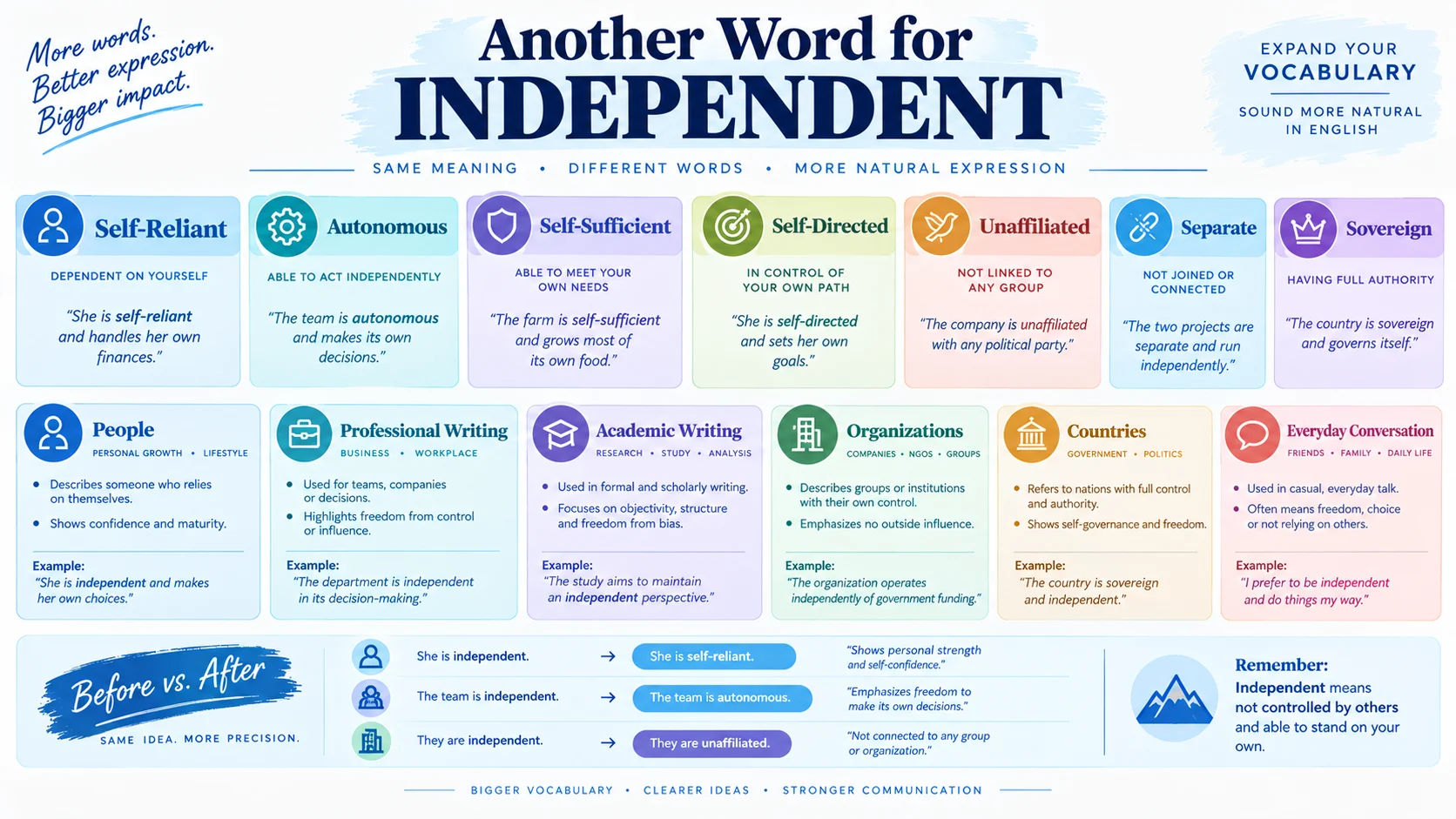
If you need another word for independent, good alternatives include self-reliant, autonomous, self-sufficient, free, self-governing, separate, unaffiliated, and sovereign. The best choice depends on the context. For a person, self-reliant often works well. For an organization or process, autonomous may be more precise. For countries or governments, sovereign is often the strongest choice.
What Does Independent Mean?
Definition
Independent describes someone or something that is free from outside control, influence, support, or dependence.
For a person, independent can mean capable of making decisions and handling responsibilities without relying heavily on others.
For an organization, it can mean operating separately from another company, government, or controlling authority.
The word can also describe a country that governs itself, a person who works for themselves, or an opinion that is formed without being influenced by others.
Common Uses
The meaning of independent changes slightly depending on how it is used.
- Independent person: Someone who manages their own life and decisions.
- Independent worker: Someone who works without direct supervision or may work for themselves.
- Independent company: A business that is not controlled by a larger corporation.
- Independent decision: A choice made without outside pressure.
- Independent country: A nation that governs itself.
- Independent thinking: The ability to form opinions based on one’s own judgment.
Because of these different meanings, there is no single synonym that fits every sentence.
Best Synonyms for Independent
| Synonym | Meaning | Best Used When | Example |
|---|---|---|---|
| Self-reliant | Able to depend on yourself | Describing a person | She became more self-reliant after moving out. |
| Autonomous | Able to operate or make decisions independently | Professional or technical contexts | The department operates as an autonomous unit. |
| Self-sufficient | Able to meet your own needs | People, organizations, or systems | The community became more self-sufficient. |
| Free | Not controlled or restricted | Personal freedom or choices | He wanted to remain free to make his own decisions. |
| Self-governing | Governed by its own authority | Governments or organizations | The territory became largely self-governing. |
| Unaffiliated | Not officially connected to another group | Organizations, professionals, or politics | She is an unaffiliated researcher. |
| Separate | Existing apart from something else | Businesses, groups, or objects | The two companies remain separate. |
| Sovereign | Having supreme governing authority | Countries and states | The nation became a sovereign state. |
| Unrestricted | Not limited or controlled | Actions, access, or choices | Members have unrestricted access to the facility. |
| Self-determined | Guided by one’s own choices | Personal or academic contexts | Her career path was self-determined. |
Synonyms by Context
Formal Writing
For formal writing, choose a synonym that clearly communicates the specific type of independence.
Autonomous is useful when something has authority to make its own decisions.
The research center operates as an autonomous institution.
Self-sufficient works when the focus is on the ability to function without outside assistance.
The program aims to create self-sufficient local communities.
Sovereign is appropriate when discussing nations, governments, or political authority.
The agreement recognized the territory as a sovereign state.
Unaffiliated works when you want to emphasize a lack of formal connection.
The study was conducted by an unaffiliated research group.
Professional Writing
In workplace communication, autonomous, self-reliant, self-sufficient, and self-directed are particularly useful.
Instead of writing:
She is an independent employee.
You could write:
She is a self-directed employee who manages projects with minimal supervision.
This version tells the reader what kind of independence you mean.
Business Example:
The company maintains an autonomous operations team that makes day-to-day decisions without corporate approval.
Resume Example:
“Self-reliant professional with strong problem-solving skills and the ability to manage projects independently.”
Academic Writing
Academic writing often benefits from precise alternatives such as autonomous, self-determined, unaffiliated, and self-directed.
Academic Example:
Students developed self-directed learning strategies throughout the semester.
Academic Example:
The researchers conducted an independent analysis using publicly available data.
In research contexts, however, do not automatically replace independent with a synonym. Sometimes independent is the most accurate technical term, especially in phrases such as independent variable, independent study, or independent research.
Daily Conversation
For everyday speech, simple words usually sound more natural.
Use self-reliant, free, on my own, or self-sufficient depending on the meaning.
Daily Conversation Example:
“I’ve become much more self-reliant since I started living on my own.”
You could also say:
“I like being free to make my own decisions.”
These alternatives sound more conversational than autonomous or sovereign.
Professional Alternatives for Independent
When describing a person professionally, consider these choices:
Self-Reliant
Meaning: Able to solve problems and manage responsibilities without depending heavily on others.
Tone: Positive and practical
Difficulty: Easy
Usage Frequency: Very Common
Best for: Resumes, emails, business writing, everyday communication.
Business Example:
“She is a self-reliant employee who handles complex assignments with minimal guidance.”
Self-Directed
Meaning: Able to organize and motivate yourself without constant supervision.
Tone: Professional
Difficulty: Medium
Usage Frequency: Common
Best for: Resumes, performance reviews, academic writing, business communication.
Resume Example:
“Self-directed professional capable of managing competing priorities independently.”
Autonomous
Meaning: Able to operate or make decisions without external control.
Tone: Formal and professional
Difficulty: Advanced
Usage Frequency: Common
Best for: Business writing, academic writing, technical documents, marketing copy.
Business Example:
“The manager leads an autonomous team responsible for regional operations.”
Simple Alternatives for Independent
If you want an easy-to-understand replacement, try:
- Self-reliant
- On your own
- Free
- Separate
- Able to manage yourself
- Not dependent
- Self-sufficient
For general readers, self-reliant is one of the closest natural alternatives to independent when describing a person.
For example:
Independent person → Self-reliant person
However, “on your own” is often more natural in casual conversation:
“She learned how to live on her own.”
Stronger Alternatives for Independent
Some words communicate a more specific or stronger form of independence.
Autonomous
Suggests freedom from external control, particularly in organizations, systems, or decision-making.
Sovereign
A powerful term associated with political independence and governing authority.
Self-sufficient
Emphasizes the ability to function without external resources or assistance.
Unrestricted
Focuses on freedom from limitations, rules, or controls.
Self-governing
Emphasizes the ability to manage or govern oneself without outside authority.
Choose these words carefully because they are not interchangeable in every situation.
Difference Between Similar Synonyms
Independent vs. Self-Reliant
Independent is broader. It can describe freedom from control, dependence, or influence.
Self-reliant specifically emphasizes the ability to rely on yourself.
She is independent and makes her own choices.
She is self-reliant and solves problems without asking for help.
Independent vs. Autonomous
Independent can describe people, organizations, countries, decisions, and ideas.
Autonomous usually emphasizes freedom to govern, operate, or make decisions independently.
The employee works independently.
The department is autonomous.
Independent vs. Self-Sufficient
Self-sufficient focuses on providing what is needed without outside help.
The teenager is independent.
The farm is self-sufficient.
Independent vs. Separate
Separate means apart from something else. It does not necessarily mean capable of making its own decisions.
The companies are separate.
The company is independent.
An organization can be separate from another organization without necessarily being fully independent.
Independent vs. Free
Free emphasizes the absence of restrictions or control.
Independent emphasizes the ability or status of operating without dependence or external authority.
She is free to choose.
She is financially independent.
Opposite Words
Common antonyms for independent include:
- Dependent
- Reliant
- Controlled
- Subordinate
- Restricted
- Interdependent
- Constrained
- Subservient
- Connected
- Affiliated
The correct opposite depends on the intended meaning.
For example, the opposite of an independent person may be dependent, while the opposite of an independent organization may be a subsidiary or controlled organization.
FAQs
What is another word for independent?
Common alternatives include self-reliant, autonomous, self-sufficient, self-directed, free, unaffiliated, separate, and self-governing. The best synonym depends on whether you are describing a person, organization, country, decision, or process.
What is a formal synonym for independent?
Autonomous is one of the best formal synonyms for independent when referring to the ability to make decisions or operate without external control. Sovereign is more appropriate for countries and political entities.
What is a professional alternative for independent?
Self-directed, self-reliant, and autonomous are strong professional alternatives. For a resume, “self-directed” often communicates independence while also suggesting initiative and responsibility.
What word can replace independent on a resume?
Depending on the intended meaning, use self-directed, self-reliant, autonomous, or self-sufficient. “Self-directed” is especially useful when describing someone who works effectively without constant supervision.
What is another word for an independent person?
Self-reliant, self-sufficient, self-directed, and autonomous can describe an independent person. Self-reliant is one of the most natural choices in everyday American English.
What is another word for independent thinking?
Useful alternatives include original thinking, critical thinking, individual thinking, and self-directed thinking. The best option depends on whether you want to emphasize originality, analysis, or freedom from outside influence.
What is another word for financially independent?
Depending on the context, you can say financially self-sufficient, financially secure, or self-supporting. These terms emphasize the ability to meet financial needs without relying on others.
What is another word for an independent business?
Possible alternatives include self-owned business, privately owned business, standalone business, or unaffiliated business. The exact choice depends on ownership and corporate structure.
Is autonomous the same as independent?
Not exactly. Autonomous emphasizes the ability to make decisions or operate without external control, while independent has a broader meaning that includes freedom from dependence, influence, or control.
Is self-reliant a positive word?
Yes. Self-reliant is generally positive because it suggests confidence, responsibility, resourcefulness, and the ability to handle challenges without excessive assistance.
Conclusion
The best synonym for independent depends on what kind of independence you want to express. Use self-reliant for a person who depends on themselves, self-directed for someone who works without constant supervision, autonomous for independent decision-making, self-sufficient for the ability to function without outside support, and sovereign for political independence.
If you are choosing a word for a resume, essay, business document, or everyday conversation, focus on the precise meaning first. A specific synonym will usually make your writing clearer and stronger than simply replacing “independent” with the first word that appears in a thesaurus.