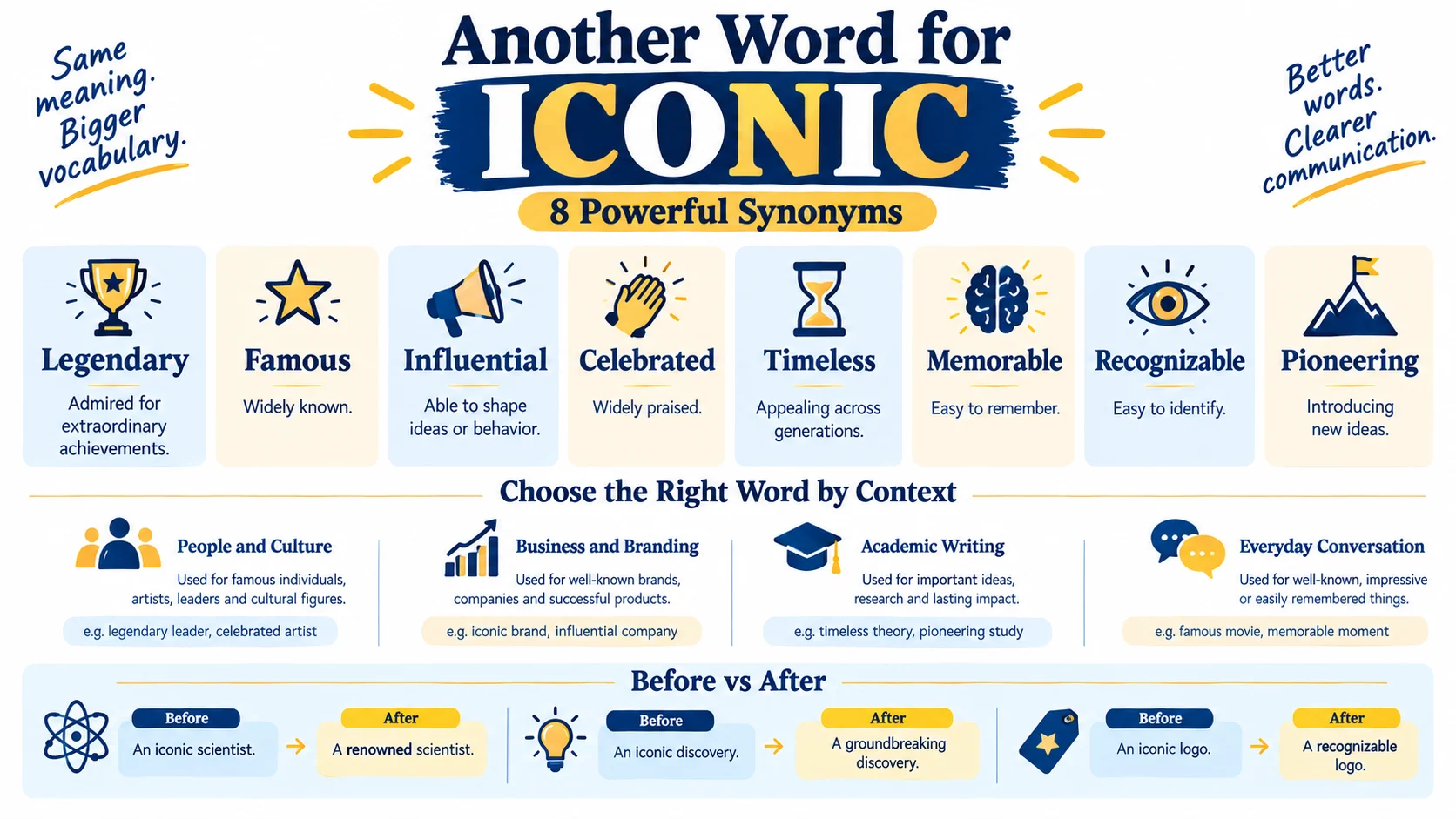
Another word for iconic is legendary, famous, celebrated, unforgettable, or influential. The best alternative depends on what you want to describe. Use legendary for someone admired over time, famous for widespread recognition, influential for something that shapes culture, and unforgettable for something that leaves a lasting impression.
What Does Iconic Mean?
Definition
The word iconic is an adjective that describes someone or something widely recognized, highly distinctive, or strongly associated with a particular person, place, era, movement, or cultural idea.
An iconic person may be admired for their achievements, while an iconic object may become a symbol of a generation. The word can also describe memorable fashion, historic locations, famous movie scenes, and recognizable designs.
For example:
- Marilyn Monroe is an iconic figure in American popular culture.
- The Statue of Liberty is an iconic American landmark.
- Her red dress became an iconic part of the movie.
- The brand is known for its iconic logo.
Iconic often means more than simply famous. It suggests that something has become a recognizable symbol or made a lasting cultural impression.
Common Uses
People commonly use iconic in these contexts:
- People: Iconic actors, musicians, athletes, and leaders.
- Places: Iconic buildings, landmarks, and city skylines.
- Fashion: Iconic outfits, hairstyles, and accessories.
- Entertainment: Iconic movies, songs, characters, and scenes.
- Brands: Iconic logos, products, and advertising campaigns.
- Moments: Iconic performances, speeches, and historical events.
Choosing a synonym that matches the context makes your writing more precise.
Best Synonyms for Iconic
The following alternatives offer different shades of meaning. Some emphasize recognition, while others highlight cultural influence, lasting importance, or memorability.
| Synonym | Meaning | Best Used When | Example |
|---|---|---|---|
| Legendary | Famous and admired over time | Celebrated people or achievements | She is a legendary singer. |
| Famous | Known by many people | General recognition | They visited a famous landmark. |
| Celebrated | Widely praised or honored | Accomplishments and talent | He is a celebrated filmmaker. |
| Influential | Able to affect people or culture | Leaders, artists, and ideas | She was an influential designer. |
| Unforgettable | Impossible to forget | Experiences and moments | It was an unforgettable performance. |
| Recognizable | Easy to identify | Logos, faces, and designs | The company has a recognizable logo. |
| Historic | Important in history | Events, sites, and milestones | It was a historic achievement. |
| Timeless | Remaining appealing over time | Fashion, music, and design | The dress has a timeless style. |
| Symbolic | Representing a larger idea | Objects, places, and gestures | The monument is symbolic of freedom. |
| Classic | Widely admired and enduring | Art, products, and entertainment | It is a classic film. |
| Renowned | Widely known and respected | Professionals and institutions | She is a renowned scientist. |
| Seminal | Having a major influence on later developments | Academic work, art, and ideas | It was a seminal study. |
Synonyms by Context
Formal Writing
In formal writing, choose words that communicate the exact kind of recognition or importance you mean.
- Renowned: Best for a person or institution widely respected for expertise or achievements.
- Celebrated: Appropriate when emphasizing public praise or recognition.
- Historic: Useful when an event or place has significant historical importance.
- Influential: Best when something has shaped ideas, practices, or later developments.
- Seminal: Suitable for foundational works that have influenced a field.
Example: Instead of writing, “The researcher produced an iconic study,” you could write, “The researcher produced an influential study that transformed the field.”
The second sentence explains why the study matters rather than relying on a broad adjective.
Professional Writing
In business, marketing, and workplace communication, the best alternative depends on the message.
- Recognizable: For a logo, brand identity, or product design.
- Leading: For a company or professional at the forefront of an industry.
- Influential: For a person or organization that shapes decisions.
- Established: For a business with a strong presence or reputation.
- Distinguished: For professionals with notable achievements.
Business example: “The company developed a recognizable brand identity that customers associate with quality.”
Resume example: “Led a successful rebranding initiative that strengthened brand recognition.”
In professional writing, measurable descriptions are often stronger than calling something iconic without explaining its impact.
Academic Writing
Academic writing benefits from precise alternatives rather than exaggerated praise.
Consider these options:
- Seminal: A foundational study or publication.
- Influential: Research that affects later scholarship.
- Pioneering: Work that introduces a new method or opens a new area of investigation.
- Landmark: A development that marks a major advance.
- Historically significant: An event, discovery, or source with lasting historical importance.
Academic example: “The article was a seminal contribution to research on language acquisition.”
Use seminal only when the work genuinely established ideas or methods that influenced later research. A study can be famous without being foundational.
Daily Conversation
Everyday conversations often call for simpler, more natural words.
- Famous: “That is a famous scene.”
- Legendary: “His performance was legendary.”
- Classic: “That song is a classic.”
- Unforgettable: “The concert was unforgettable.”
- Amazing: “That outfit looks amazing.”
- Memorable: “It was a memorable trip.”
For casual social media captions, iconic is often used playfully to describe a funny reaction, stylish outfit, or impressive moment. In those cases, legendary, classic, or unforgettable may preserve the intended feeling.
Professional Alternatives for Iconic
The most effective professional alternative depends on what you are describing and what you want readers to understand.
1. Influential
Meaning: Having a meaningful effect on people, decisions, or developments.
Best used for: Leaders, companies, research, and industry trends.
Tone: Professional and analytical.
Difficulty: Medium.
Usage frequency: Common.
Best for: Business writing, email writing, essays, and marketing copy.
- Business: “She is an influential voice in product design.”
- Academic: “The theory remains influential in contemporary research.”
- Daily conversation: “He has been influential in shaping my career.”
2. Renowned
Meaning: Widely known and respected.
Best used for: Experts, institutions, artists, and professional achievements.
Tone: Formal and complimentary.
Difficulty: Medium.
Usage frequency: Common.
Best for: Resumes, professional biographies, business writing, and essays.
- Business: “The company partnered with a renowned design agency.”
- Academic: “The conference featured a renowned linguist.”
- Daily conversation: “She studied under a renowned chef.”
3. Distinguished
Meaning: Recognized as exceptional because of achievement, quality, or reputation.
Best used for: Experienced professionals, careers, institutions, and awards.
Tone: Formal and respectful.
Difficulty: Medium.
Usage frequency: Common.
Best for: Resumes, cover letters, professional profiles, and business writing.
- Business: “He has a distinguished career in engineering.”
- Academic: “The university invited a distinguished professor.”
- Daily conversation: “She is a distinguished artist in her community.”
4. Pioneering
Meaning: Introducing new ideas, methods, or approaches.
Best used for: Innovation, discoveries, and groundbreaking work.
Tone: Positive and achievement-focused.
Difficulty: Medium.
Usage frequency: Common.
Best for: Resumes, essays, business writing, and marketing copy.
- Business: “The team developed a pioneering customer service platform.”
- Academic: “The research introduced a pioneering analytical method.”
- Daily conversation: “She took a pioneering approach to the project.”
Simple Alternatives for Iconic
If you want a straightforward replacement, these words work in many everyday situations.
| Word | Best Meaning | Example |
|---|---|---|
| Famous | Known by many people | A famous actor |
| Great | Very good or impressive | A great performance |
| Popular | Liked by many people | A popular character |
| Memorable | Easy to remember | A memorable speech |
| Classic | Widely admired over time | A classic song |
| Special | Different or meaningful | A special moment |
| Amazing | Extremely impressive | An amazing outfit |
| Well-known | Recognized by many | A well-known landmark |
These words are not exact substitutes in every sentence. For example, a popular product is not necessarily iconic, and a famous person may not have influenced an entire generation.
Stronger Alternatives for Iconic
When you want to emphasize exceptional importance, lasting influence, or cultural significance, consider these alternatives.
- Legendary: Suggests extraordinary achievements and an enduring reputation.
- Landmark: Highlights a major turning point or significant achievement.
- Seminal: Emphasizes foundational influence, especially in research and creative work.
- Groundbreaking: Describes something innovative that changes established practices.
- Epoch-making: Refers to something important enough to mark a new historical period.
- Immortalized: Describes someone or something preserved in public memory, art, or history.
- Trailblazing: Emphasizes leading the way in a new field or movement.
Examples:
- Iconic performance → legendary performance.
- Iconic discovery → groundbreaking discovery.
- Iconic research paper → seminal research paper.
- Iconic historical event → landmark historical event.
- Iconic cultural figure → legendary cultural figure.
Choose the stronger term only when its meaning fits the facts. Groundbreaking, for instance, implies innovation, not merely popularity.
Difference Between Similar Synonyms
Although these words overlap with iconic, they emphasize different qualities.
| Word | Main Difference From Iconic | Example |
|---|---|---|
| Famous | Focuses on public recognition | A famous actor |
| Legendary | Suggests exceptional reputation over time | A legendary athlete |
| Influential | Emphasizes an effect on others | An influential author |
| Memorable | Focuses on the ability to be remembered | A memorable speech |
| Timeless | Suggests enduring appeal | A timeless design |
| Classic | Implies lasting value or established quality | A classic novel |
| Symbolic | Represents an idea or concept | A symbolic gesture |
| Historic | Has importance in history | A historic agreement |
| Renowned | Combines recognition with respect | A renowned architect |
| Pioneering | Emphasizes innovation or being among the first | A pioneering invention |
Iconic vs. Legendary
Iconic usually emphasizes recognition or symbolic importance. Legendary emphasizes an exceptional reputation, often built over time.
An iconic logo is immediately recognizable. A legendary athlete is remembered for extraordinary achievements.
Iconic vs. Famous
Famous means widely known, while iconic often suggests that the person or object represents something larger than itself.
A local celebrity might be famous in a particular community without becoming an iconic cultural figure.
Iconic vs. Influential
Influential describes the power to shape opinions, behavior, or developments. Something can be influential without being widely recognizable.
For example, a research paper may influence an entire scientific field while remaining unfamiliar to the general public.
Iconic vs. Timeless
Timeless refers to enduring appeal or relevance. Iconic refers to strong recognition or symbolic significance.
A design can be timeless without being iconic, and an iconic fashion trend may eventually become outdated.
Opposite Words for Iconic
There is no single perfect antonym for iconic. The best opposite depends on which meaning you want to reverse.
| Opposite | Meaning | Example |
|---|---|---|
| Unknown | Not known to people | An unknown performer |
| Obscure | Not widely known or understood | An obscure historical reference |
| Ordinary | Lacking distinctive qualities | An ordinary design |
| Unremarkable | Not especially noticeable or impressive | An unremarkable performance |
| Forgettable | Unlikely to be remembered | A forgettable advertisement |
| Insignificant | Lacking importance | An insignificant event |
| Unrecognized | Not acknowledged or appreciated | An unrecognized contribution |
| Generic | Lacking distinctive identity | A generic product design |
For example, replace “an iconic landmark” with “an obscure location” when emphasizing limited recognition, or “an ordinary building” when emphasizing a lack of distinction.
FAQs
1. What is another word for iconic?
Common alternatives include legendary, famous, celebrated, influential, unforgettable, recognizable, and timeless. The best choice depends on whether you mean cultural importance, popularity, or lasting appeal.
2. What is a formal synonym for iconic?
Renowned, distinguished, influential, and historically significant are useful formal alternatives. Use the word that accurately describes the subject’s reputation or importance.
3. What is a professional alternative for iconic?
Use recognizable for a brand or design, influential for a leader or organization, and distinguished for a professional with notable achievements.
4. What is a stronger word than iconic?
Legendary, groundbreaking, seminal, and landmark can be stronger in specific contexts. Each emphasizes a different quality, so none is universally stronger.
5. What is another word for iconic in an essay?
Depending on the subject, use influential, historically significant, seminal, renowned, or symbolic. Academic writing should favor precise language over exaggerated praise.
6. What is another word for iconic in marketing?
Useful alternatives include recognizable, memorable, distinctive, timeless, and legendary. For branding, recognizable describes visual identity, while memorable emphasizes recall.
7. What is a synonym for an iconic person?
You could use legendary figure, celebrated individual, renowned personality, influential leader, or cultural icon. The right phrase depends on the person’s achievements and public significance.
8. What is another word for an iconic moment?
Try unforgettable, historic, landmark, memorable, or defining. Use historic when the moment has historical significance and defining when it shapes a person’s career, an era, or a movement.
9. Is iconic the same as famous?
No. Famous means widely known, while iconic usually suggests strong recognition, symbolic value, or lasting cultural significance. An iconic subject is often famous, but not everything famous becomes iconic.
10. What is the opposite of iconic?
Possible opposites include unknown, obscure, ordinary, forgettable, and unremarkable. The best antonym depends on whether iconic refers to recognition, importance, or distinctiveness.
Conclusion
The best synonym for iconic depends on the message you want to convey. Choose famous for widespread recognition, legendary for an exceptional reputation, influential for cultural impact, timeless for enduring appeal, and recognizable for distinctive designs or brands.
For academic writing, seminal and historically significant can provide greater precision. For professional communication, renowned, distinguished, and influential are often more appropriate. In everyday conversation, classic, memorable, and unforgettable sound natural.
Rather than replacing iconic with the first synonym you find, consider the context, tone, and exact meaning. A precise word makes your writing clearer and more effective.