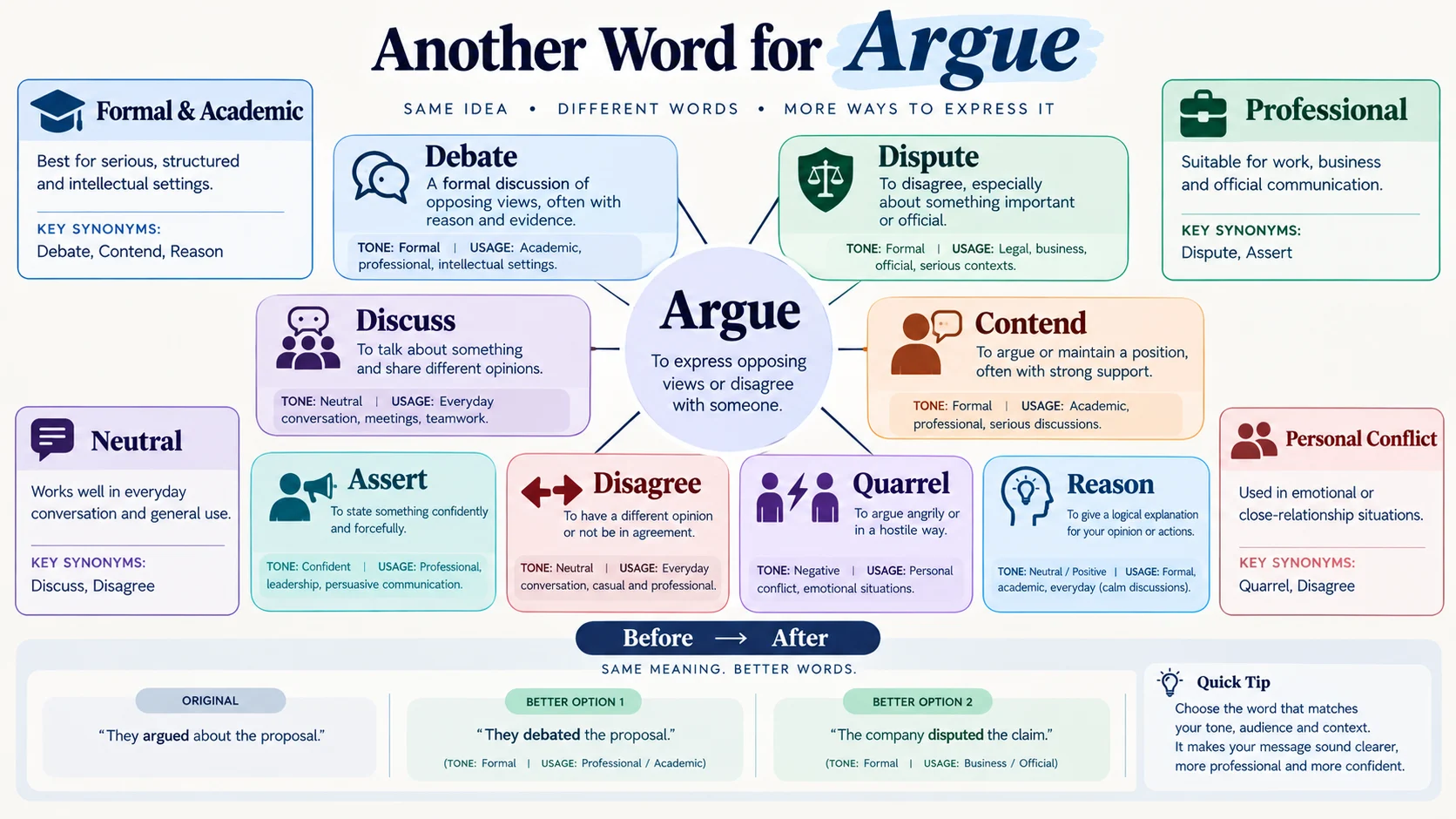
Another word for argue is debate, dispute, discuss, contend, claim, maintain, assert, disagree, quarrel, or reason. The best replacement depends on context. Use debate for a structured exchange of ideas, dispute for disagreement, contend for formal writing, and quarrel for a personal conflict.
What Does Argue Mean?
Definition
Argue means to give reasons or evidence to support an idea, opinion, or position. It can also mean to disagree with someone, especially during a heated or personal conversation.
The word has two major uses:
- To present reasons or evidence: “The researchers argue that the results support the theory.”
- To disagree or fight verbally: “The two coworkers argued about the schedule.”
Because argue can describe both a thoughtful exchange of ideas and a heated disagreement, the best synonym depends heavily on the situation.
Common Uses
You might use argue when discussing:
- An opinion or position
- A point in an essay
- Evidence in academic research
- A disagreement between people
- A legal position
- A business decision
- A personal conflict
For example, “The lawyer argued that the evidence was insufficient” is very different in tone from “The couple argued all night.”
Best Synonyms for Argue
| Synonym | Meaning | Best Used When | Example |
|---|---|---|---|
| Debate | Discuss opposing ideas | Structured disagreement | The students debated the issue. |
| Dispute | Challenge or disagree with something | Formal disagreement | The company disputed the claim. |
| Discuss | Talk about an issue | Neutral conversation | We discussed the proposed changes. |
| Contend | State or maintain a position | Formal or academic writing | The author contends that the policy is ineffective. |
| Assert | State something confidently | Strong claims | She asserted that the report was accurate. |
| Claim | Say something is true | Arguments or positions | The researcher claims that the method is reliable. |
| Maintain | Continue to state a position | Defending an opinion | He maintained that he was not responsible. |
| Reason | Use logic to reach or explain a conclusion | Logical discussion | She reasoned that the plan would save money. |
| Disagree | Have a different opinion | Everyday or professional situations | I disagree with that conclusion. |
| Quarrel | Argue angrily | Personal conflicts | The siblings quarreled over the inheritance. |
| Bicker | Argue about small matters | Minor personal disagreements | They bickered over who should wash the dishes. |
| Wrangle | Struggle over an issue | Prolonged disagreement | The committee wrangled over the budget. |
Synonyms by Context
Formal Writing
For formal writing, choose words that describe disagreement without sounding overly emotional.
Best choices: contend, assert, maintain, dispute, reason, demonstrate.
Example:
Original: “The author argues that public transportation needs improvement.”
Better formal alternatives:
- “The author contends that public transportation needs improvement.”
- “The author maintains that public transportation needs improvement.”
- “The author asserts that public transportation needs improvement.”
Contend is especially useful when presenting a formal position. Maintain suggests that someone continues to defend an existing position.
Professional Writing
In business communication, dispute, disagree, discuss, and address are often more appropriate than argue.
Instead of:
“The managers argued about the proposed budget.”
You could write:
“The managers discussed the proposed budget.”
If the disagreement was substantial:
“The managers disagreed about the proposed budget.”
If one side challenged the validity of a claim:
“The finance department disputed the projected costs.”
These alternatives sound more precise and professional.
Academic Writing
Academic writing often uses argue, but several alternatives can make your writing more precise.
Useful choices include:
- Contend for a formal position
- Claim for a stated conclusion
- Assert for a confident position
- Maintain for a defended viewpoint
- Demonstrate when evidence supports a conclusion
- Reason when logic is central
For example:
“The study argues that early intervention improves outcomes.”
Can become:
“The study contends that early intervention improves outcomes.”
However, demonstrate should only be used when the evidence actually establishes or strongly supports the conclusion.
Daily Conversation
In everyday speech, natural alternatives include disagree, debate, fight, quarrel, bicker, and discuss.
For example:
- “We disagreed about where to go.”
- “They quarreled over money.”
- “The kids bickered about the game.”
- “We debated whether to stay.”
- “Let’s discuss the problem.”
The emotional intensity changes depending on the word. Discuss sounds calm, while quarrel suggests a more emotional conflict.
Professional Alternatives for Argue
When writing an email, report, resume, proposal, or business document, these alternatives are often more effective:
Contend
Meaning: Present or defend a position.
Tone: Formal
Difficulty: Advanced
Usage Frequency: Common
Best For: Essay Writing, Academic Writing, Business Writing
Business Example: “The company contends that the revised strategy will improve efficiency.”
Academic Example: “The researcher contends that socioeconomic factors influence educational outcomes.”
Daily Conversation: “She contends that we made the right decision.”
Dispute
Meaning: Challenge the truth, validity, or accuracy of something.
Tone: Formal and professional
Difficulty: Medium
Usage Frequency: Common
Best For: Email Writing, Business Writing, Legal Writing
Business Example: “The customer disputed the charge.”
Academic Example: “Several scholars dispute this interpretation.”
Daily Conversation: “I dispute that version of what happened.”
Assert
Meaning: State something confidently and firmly.
Tone: Confident and formal
Difficulty: Medium
Usage Frequency: Common
Best For: Resume Writing, Essay Writing, Business Writing
Business Example: “The manager asserted that the decision was necessary.”
Academic Example: “The article asserts that the policy created unintended consequences.”
Daily Conversation: “He asserted that he had followed the instructions.”
Simple Alternatives for Argue
If you need an easy, natural replacement, consider:
- Disagree
- Discuss
- Debate
- Claim
- Say
- Explain
- Question
- Challenge
- Fight
- Quarrel
The simplest choice depends on what argue means in your sentence.
If you mean “have a different opinion,” use disagree.
If you mean “talk about opposing ideas,” use discuss or debate.
If you mean “have an angry disagreement,” use fight or quarrel.
Stronger Alternatives for Argue
Some synonyms make the disagreement sound more intense.
Dispute suggests a serious disagreement or challenge.
Challenge suggests questioning whether something is correct or acceptable.
Contend presents a firm position without necessarily implying anger.
Quarrel suggests emotional personal conflict.
Wrangle suggests a prolonged or difficult disagreement.
Bicker describes repeated arguments over relatively minor issues.
For example:
- Mild: “They discussed the issue.”
- Moderate: “They disagreed about the issue.”
- Strong: “They disputed the decision.”
- Emotional: “They quarreled about the decision.”
- Prolonged: “They wrangled over the decision.”
Difference Between Similar Synonyms
Argue vs. Debate
Argue can mean presenting reasons for a position or having a disagreement. Debate usually suggests a more organized exchange of opposing views.
“Students debated the proposal” sounds structured.
“Students argued about the proposal” can sound more confrontational.
Argue vs. Dispute
Dispute emphasizes challenging or rejecting something. It is particularly useful in professional, legal, and formal contexts.
“The company disputed the invoice” is more precise than “The company argued about the invoice.”
Argue vs. Discuss
Discuss is neutral. It does not necessarily involve disagreement.
Argue usually implies that opposing positions or reasons are involved.
Compare:
- “We discussed the new policy.”
- “We argued about the new policy.”
The first sounds cooperative. The second suggests conflict.
Argue vs. Quarrel
Quarrel almost always describes an emotional or personal disagreement.
“The researchers argued about the findings” could describe an intellectual disagreement.
“The siblings quarreled about the money” clearly suggests personal conflict.
Argue vs. Contend
Contend is more formal than argue and is especially useful when someone presents or defends a position.
For academic and professional writing, contend can be an excellent replacement when you want a more formal tone.
Opposite Words
The best antonym for argue depends on its meaning.
When argue means disagree, possible opposites include:
- Agree
- Concur
- Accept
- Approve
- Support
- Cooperate
When argue means engage in conflict, possible opposites include:
- Reconcile
- Compromise
- Agree
- Cooperate
- Collaborate
For example:
Argue: “They argued about the decision.”
Opposite: “They agreed on the decision.”
FAQs
What is another word for argue?
Common alternatives include debate, dispute, discuss, contend, assert, claim, maintain, disagree, quarrel, and reason. The best synonym depends on whether you mean presenting an argument, expressing disagreement, or having a personal conflict.
What is a formal synonym for argue?
Contend is one of the best formal synonyms for argue. Other options include assert, maintain, dispute, and reason, depending on the sentence and intended meaning.
What is a professional alternative for argue?
Use discuss, disagree, dispute, address, or challenge in professional writing. These words can communicate disagreement more precisely and with a more neutral tone.
What word can replace argue in an essay?
Contend, assert, maintain, claim, and demonstrate can replace argue in academic writing when their meanings accurately fit the sentence.
What is another word for argue in a positive way?
Debate, discuss, reason, and exchange ideas can describe disagreement in a constructive or neutral way.
What is another word for argue with someone?
Depending on the situation, use disagree with, debate, confront, quarrel with, or bicker with. Disagree with is usually the most neutral option.
What is a stronger word for argue?
Dispute, challenge, quarrel, wrangle, and confront can sound stronger than argue. The right choice depends on whether the disagreement is intellectual, professional, or personal.
Is debate the same as argue?
Not exactly. Debate generally suggests an organized or reasoned exchange of opposing views, while argue can refer to either presenting reasons or having a disagreement.
Is contend a synonym for argue?
Yes. Contend can mean to state or defend a particular position. It is more formal than argue and is especially common in academic, legal, and professional writing.
What is the best simple synonym for argue?
Disagree is often the best simple synonym when argue means having a different opinion. Discuss is better when the conversation is neutral and cooperative.
Conclusion
The best another word for argue depends on what you are trying to communicate. Use debate for an organized exchange of ideas, discuss for a neutral conversation, disagree for different opinions, dispute for challenging a claim, and contend for formal or academic writing. For personal conflict, words such as quarrel and bicker make the emotional meaning clearer.
Choosing a precise synonym does more than avoid repetition. It tells the reader whether the situation is professional, academic, neutral, logical, or confrontational.