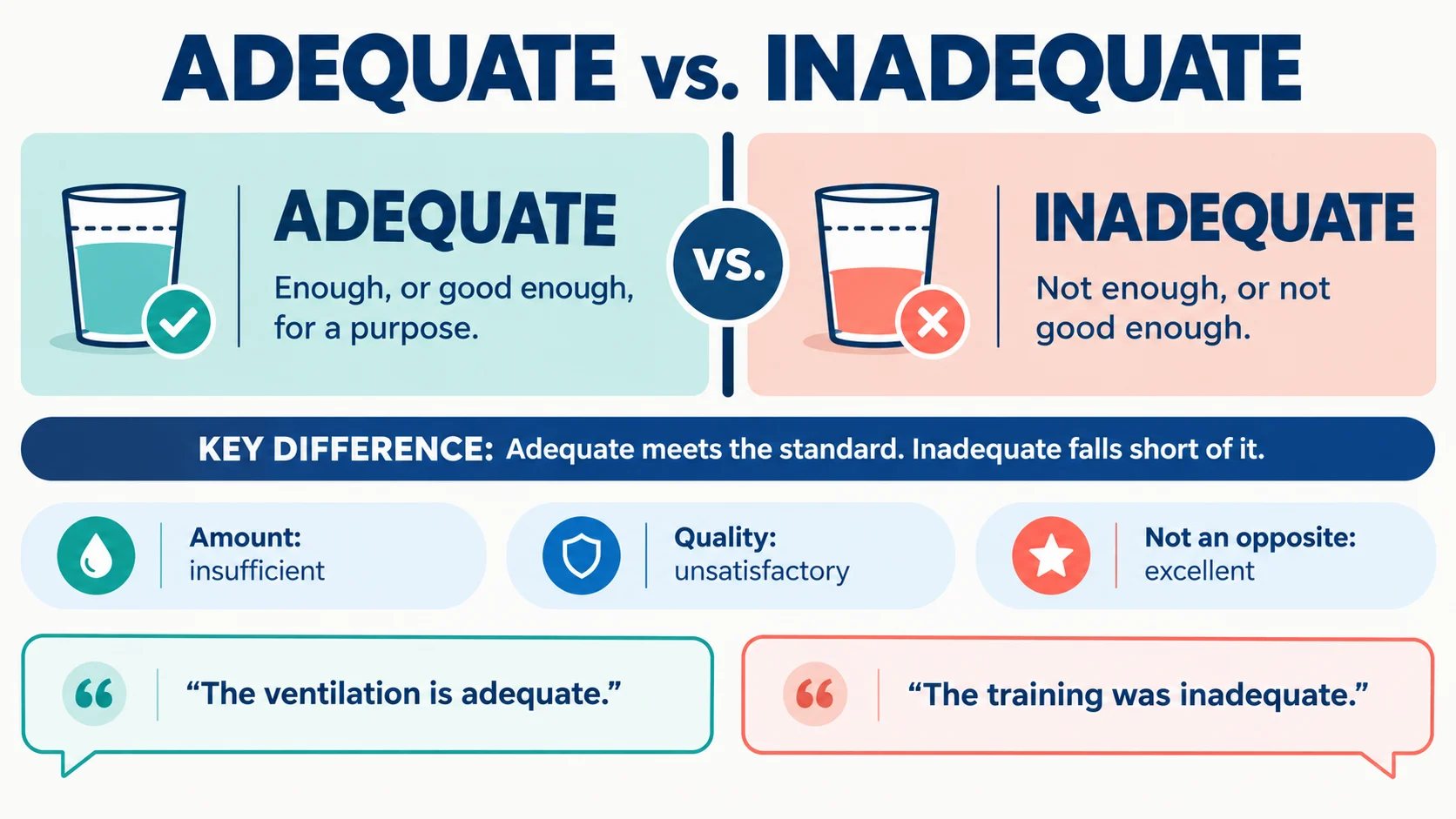
The opposite of adequate is inadequate. Adequate describes something that is enough or good enough for a purpose. When it refers to quantity, insufficient is the closest match. When it refers to quality, unsatisfactory fits best. Inadequate works in both cases and is the most direct, widely used antonym.
Part of speech: adjective
Primary opposite: inadequate
Adequate means meeting a requirement without going beyond it. It can describe an amount (“adequate funding”), a level of quality (“an adequate explanation”), or fitness for a task (“adequate for the job”).
When adequate means sufficient or acceptable, inadequate is the strongest direct opposite. It simply negates the standard, so the thing falls short of what is needed. Because it covers amount, quality, and ability, inadequate is the safest choice when you are unsure which sense you mean.
No single word fits every sense perfectly. Inadequate is the best all-purpose antonym, while the others below suit narrower situations.
Direct and Strong Antonyms
| Antonym | Tone or Nuance | Example Sentence |
|---|---|---|
| inadequate | Neutral and all-purpose, common in both everyday and formal writing | The hospital’s backup power proved inadequate during the storm. |
| insufficient | Formal, focused on amount | We had insufficient evidence to approve the claim. |
| unsatisfactory | Formal-leaning, focused on quality or performance | Her manager rated the quarterly report as unsatisfactory. |
| deficient | Formal or technical, often followed by “in” | The soil was deficient in nitrogen. |
Each of these negates the idea of “enough” or “good enough.” Notice that insufficient pairs naturally with things you can measure, while unsatisfactory pairs with things you can judge.
Contextual and Subtle Opposites
Adequate shifts meaning depending on what it describes, so the best opposite shifts too. The words below are contextual opposites, meaning they work as opposites only in the sense shown.
| Context | Best Opposite | Why It Fits |
|---|---|---|
| Amount or supply | insufficient | “Adequate supplies” becomes “insufficient supplies” because the issue is quantity. |
| Quality of work | unsatisfactory (contextual: substandard) | “Adequate work” meets the bar; unsatisfactory work misses it. |
| Ability or fitness | unqualified (contextual: unfit) | “She is adequate for the role” contrasts with “She is unqualified for the role.” |
| Legal or procedural wording | inadequate | “Adequate notice” and “inadequate notice” are the standard pairing in formal documents. |
Scant and meager also work as contextual opposites when you are talking about small amounts, as in “scant rainfall.” They add a vivid, slightly literary tone that inadequate lacks.
Words That Seem Opposite But Are Not
Excellent. People often reach for excellent because “merely adequate” sounds like faint praise. But excellent is not the opposite of adequate. It describes quality above the standard, while inadequate describes quality below it. Adequate sits in the middle of that scale, so excellent is a related contrast, not an antonym. “The food was excellent, not just adequate” shows the contrast without making them opposites.
Excessive. Adequate means enough. Excessive means more than enough. They differ, but excessive is not the opposite, because the real opposite of “enough” is “not enough.” A budget can be excessive or inadequate, and those are two different problems. Calling excessive an antonym of adequate would flip the wrong dimension.
Subtle Tone Differences
Choosing among the real antonyms is mostly a matter of precision and tone.
Inadequate is firm but neutral. “The training was inadequate” states a problem without assigning blame.
Insufficient sounds more clinical and measurable. A grant reviewer might write, “The applicant provided insufficient detail about the budget.”
Unsatisfactory carries evaluation. It suggests someone judged the result against expectations, which is why it appears on report cards and performance reviews.
Substandard is harsher. It implies the work falls below an established standard, often in construction, manufacturing, or care. “The inspector flagged the wiring as substandard” signals a more serious concern than “inadequate” would.
Tone also affects how adequate itself reads. In everyday conversation, “It was adequate” often sounds lukewarm. In a technical report, “The ventilation is adequate” is a plain compliance statement. The opposite you choose should match that register.
Frequently Asked Questions
What is the direct antonym of adequate?
Inadequate is the direct antonym. It is formed by adding the negating prefix in- and means not enough or not good enough. It works for amount, quality, and ability, which makes it the most dependable general opposite.
What is the opposite of adequate when talking about quantity?
Insufficient is the best opposite when adequate means “enough in amount.” It is common in formal writing, such as “insufficient funds” or “insufficient time.” Scant and meager work too when you want a more descriptive tone.
Can I use unsatisfactory instead of inadequate in a sentence?
Yes, when you are judging quality or performance. “Unsatisfactory results” works well. For shortages or missing amounts, choose insufficient or inadequate instead, since unsatisfactory suggests an evaluation rather than a measurement.
Practical Word Choice
1. Identify the intended meaning. Ask whether adequate refers to amount, quality, or ability. Amount points to insufficient, quality to unsatisfactory, and ability to unqualified. If the meaning is broad, inadequate covers it.
2. Match the context, tone, strength, and formality. Use inadequate for neutral statements, insufficient for formal or measurable claims, and substandard when you want a stronger warning. Save scant or meager for descriptive writing.
Final Thoughts
Adequate marks the point where something is just enough. Its true opposites describe falling short of that point, and inadequate is the cleanest way to say so. Words like excellent and excessive contrast with adequate, but they point in different directions rather than opposing it.
Context decides which opposite sounds right. A shortage calls for insufficient, a weak performance for unsatisfactory, and a poor fit for unqualified. The same word can feel precise in one sentence and awkward in another.
When you are stuck, name what is missing, whether amount, quality, or ability, and pick the word that matches. What is a sentence where you had to choose between inadequate and insufficient?