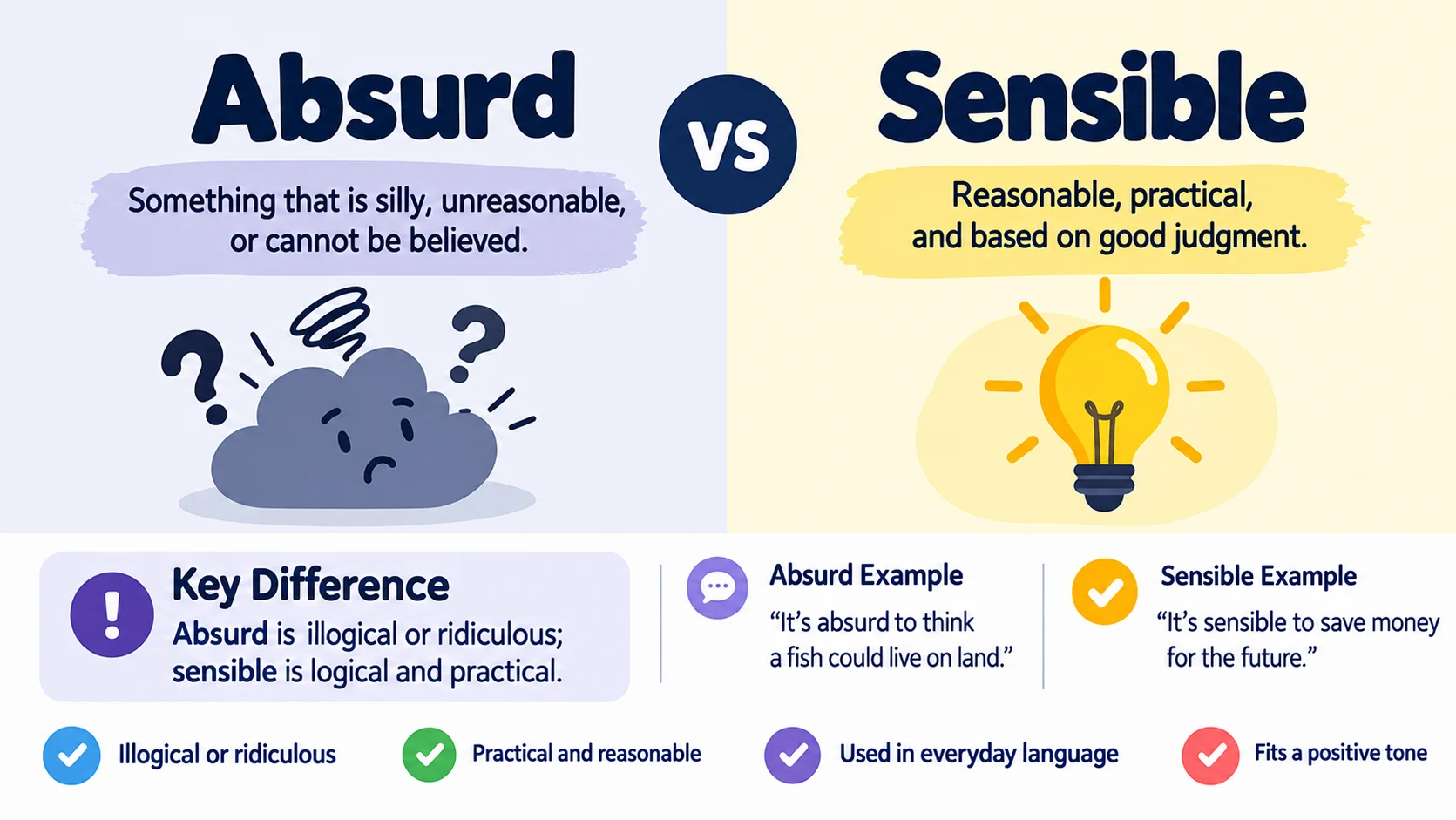
The strongest opposite of absurd is reasonable when absurd means illogical, irrational, or contrary to good judgment. Other useful antonyms include sensible, logical, rational, and plausible. The best choice depends on whether you are describing an idea, an argument, a decision, a claim, or a situation that seems ridiculous.
- Part of Speech: Adjective
- Primary Opposite: Reasonable
- Definition of Absurd: Extremely illogical, unreasonable, ridiculous, or contrary to common sense.
- Why Reasonable Fits: When absurd describes an idea or decision that makes little sense, reasonable expresses the opposite by suggesting sound judgment, logic, and fairness.
For example, calling a proposal absurd suggests that it is unreasonable or difficult to take seriously. Calling the same proposal reasonable indicates that it makes sense and can be justified.
There is no single antonym that fits every use of absurd. Words such as sensible, logical, and plausible provide more precise alternatives in particular contexts.
Direct and Strong Antonyms
The following words are natural opposites of absurd when it describes something irrational, ridiculous, or unreasonable.
| Antonym | Tone or Nuance | Example Sentence |
|---|---|---|
| Reasonable | Fair, sensible, and justified | Her request for a deadline extension was reasonable. |
| Sensible | Practical and based on good judgment | Buying a reliable used car was a sensible decision. |
| Logical | Consistent with clear reasoning | His explanation followed a logical sequence. |
| Rational | Based on reason rather than emotion or irrational thinking | They made a rational choice after reviewing the evidence. |
| Plausible | Believable or seemingly possible | The detective offered a plausible explanation for the missing evidence. |
| Credible | Worthy of belief or trust | The witness provided a credible account of what happened. |
| Sound | Well-founded and supported by good judgment | The manager presented a sound business strategy. |
Reasonable is often the best general-purpose antonym. Sensible emphasizes practical judgment, while logical and rational focus more directly on reasoning.
Plausible and credible are more context-dependent. They work especially well when absurd means unbelievable or impossible to take seriously.
Contextual and Subtle Opposites
The best opposite of absurd depends on what the word describes. An absurd argument, an absurd price, and an absurd situation do not necessarily require the same antonym.
| Context | Best Opposite | Why It Fits |
|---|---|---|
| Absurd idea | Reasonable | Suggests the idea makes sense. |
| Absurd argument | Logical | Emphasizes sound reasoning. |
| Absurd decision | Sensible | Highlights practical judgment. |
| Absurd explanation | Plausible | Suggests the explanation could be true. |
| Absurd accusation | Credible | Emphasizes believability and trustworthiness. |
| Absurd price | Fair or reasonable | Indicates an acceptable cost. |
| Absurd behavior | Appropriate | Contrasts ridiculous conduct with behavior suited to the situation. |
Consider these examples:
- “The landlord’s demand for six months of rent upfront seemed absurd.” A reasonable payment arrangement would be a more natural contrast.
- “Her argument was absurd because it contradicted the available evidence.” A logical argument would fit the opposite meaning.
- “The explanation sounded absurd at first.” A plausible explanation would seem believable.
- “His behavior during the formal meeting was absurd.” Appropriate behavior would better suit the professional setting.
These alternatives are contextual opposites rather than interchangeable replacements. Choose the word that addresses the specific problem with the original statement or situation.
Words That Seem Opposite But Are Not
Common Grammatical or Semantic Confusions
1. Serious
Serious may contrast with absurd when absurd means silly or ridiculous. However, the words do not have opposite meanings in every context.
A serious proposal can still be absurd if it contains unreasonable assumptions. Likewise, an absurd situation can have serious consequences.
Example:
– “The committee discussed the serious consequences of the absurd proposal.”
Here, both adjectives describe different qualities of the same situation.
2. Ordinary
Ordinary means usual, familiar, or not unusual. It does not necessarily mean reasonable or logical.
An ordinary event can involve an absurd decision, and an unusual idea can be perfectly rational.
Example:
– “It was an ordinary Tuesday, but the manager made an absurd demand.”
The words contrast in context, but ordinary is not a direct antonym of absurd.
Subtle Tone Differences
Choosing between reasonable, sensible, and logical can change the emphasis of a sentence.
Reasonable works well for decisions, requests, expectations, and prices. It often suggests fairness as well as sound judgment.
Example: “The customer made a reasonable request for a refund.”
Sensible emphasizes practicality and common sense.
Example: “Bringing a jacket was a sensible choice because the temperature was dropping.”
Logical focuses on whether reasoning follows consistently from the facts or assumptions.
Example: “Her conclusion was logical because it followed the evidence.”
Rational emphasizes reasoning rather than irrational thinking. It is particularly useful in discussions about decisions, beliefs, and judgment.
Example: “They took a rational approach to solving the problem.”
The distinctions matter in professional writing. Describing a decision as sensible praises its practicality, while calling it logical emphasizes the reasoning behind it. Calling it reasonable may also suggest that it is fair or acceptable.
Frequently Asked Questions
What is the direct antonym of absurd?
Reasonable is one of the strongest general antonyms of absurd. It describes something that makes sense or reflects sound judgment. Depending on the sentence, sensible, logical, or rational may provide a more precise opposite.
What is the opposite of absurd in a sentence?
The opposite depends on the intended meaning. Use reasonable for a fair request, logical for a well-reasoned argument, and plausible for a believable explanation. For example, “Her suggestion was reasonable” contrasts naturally with “Her suggestion was absurd.”
Is sensible a better antonym of absurd than reasonable?
Not always. Sensible is especially suitable for practical choices and everyday decisions. Reasonable has a broader range and can describe requests, prices, expectations, and arguments. Choose the word that most accurately expresses the intended contrast.
Practical Word Choice
1. Identify the intended meaning. Determine whether absurd describes poor reasoning, impractical behavior, an unbelievable claim, or an unreasonable demand.
2. Match the context and tone. Use reasonable for general situations, sensible for practical decisions, logical for arguments, and plausible for explanations.
Final Thoughts
The strongest general antonym of absurd is reasonable, but other words may express the intended opposite more precisely. Sensible emphasizes practicality, logical highlights consistent reasoning, and plausible focuses on believability.
Context matters because something can be unusual without being absurd, serious without being logical, or ordinary without being reasonable. Choosing the right antonym helps communicate exactly what makes an idea or action sound sensible rather than ridiculous.
When writing, ask yourself whether you want to emphasize fairness, practical judgment, logical reasoning, or credibility. Which sentence would you use to show the difference between something absurd and something reasonable?